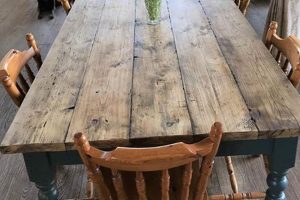
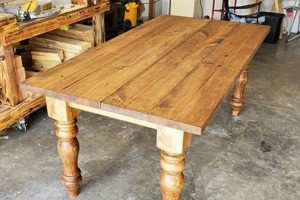
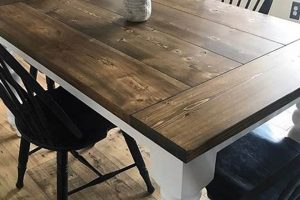
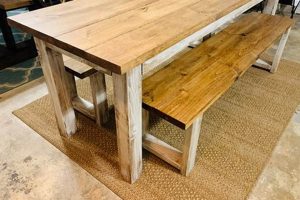
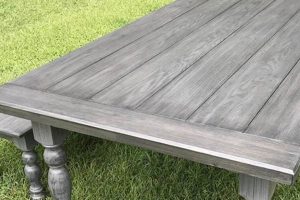
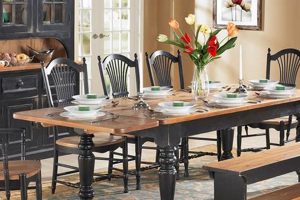
The construction of a robust and aesthetically pleasing dining surface, often characterized by its substantial dimensions and rustic charm, involves a series of woodworking techniques and material selections. This process typically includes the creation of a solid wood tabletop, sturdy leg assemblies, and connecting support structures. The result is a functional piece of furniture designed to accommodate gatherings and provide a focal point for a dining space. For example, one might start with rough-sawn lumber, precisely cut to the desired dimensions, then joined using traditional methods like mortise-and-tenon or more modern techniques employing fasteners and adhesives.
Such a furniture piece offers several advantages. Its durability ensures longevity, often becoming a treasured heirloom. The substantial surface area readily accommodates large meals and gatherings, fostering communal dining experiences. Historically, these tables served as central hubs in rural households, where food preparation and family gatherings took place. The design often reflects a connection to craftsmanship and simplicity, offering an alternative to mass-produced furniture.
The subsequent sections will delve into the specific stages involved in creating this furniture piece, from selecting appropriate lumber and tools to assembling the components and applying finishing techniques to ensure both visual appeal and long-term protection. Careful consideration of each step is essential for achieving a successful and satisfying outcome.
Essential Guidelines for Farm Table Construction
The following guidelines are intended to improve the quality and longevity of a farm table construction project. Adherence to these recommendations will facilitate a robust and aesthetically pleasing final product.
Tip 1: Lumber Selection. The selection of appropriate lumber is paramount. Opt for hardwoods such as maple, oak, or cherry for superior durability and resistance to wear. Ensure the lumber is properly dried and acclimatized to the workshop environment prior to commencing construction to minimize warping and cracking.
Tip 2: Joint Integrity. Employ robust joinery techniques. Mortise-and-tenon joints, reinforced with high-quality wood glue, provide exceptional structural integrity. Consider the use of dowels or floating tenons for added strength, particularly in high-stress areas such as leg attachments.
Tip 3: Surface Preparation. Thorough surface preparation is crucial for a professional finish. Sand the tabletop progressively, starting with a coarse grit and gradually moving to finer grits. Address any imperfections or blemishes prior to applying a finish.
Tip 4: Finishing Application. Select a durable finish that complements the aesthetic of the table. Oil-based finishes, such as polyurethane or varnish, offer superior protection against moisture and wear. Apply multiple thin coats, allowing adequate drying time between each coat, to achieve a smooth and even finish.
Tip 5: Leg Attachment Stability. Ensure the legs are securely attached to the tabletop. Utilize robust brackets or aprons, along with appropriate fasteners, to prevent wobbling or instability. Consider the use of metal inserts or threaded inserts to provide a more secure and long-lasting connection.
Tip 6: Edge Treatment. The table edge design contributes significantly to the overall aesthetic. Options include a square edge, a beveled edge, or a rounded edge. Regardless of the chosen design, ensure the edge is smooth and free of splinters.
Tip 7: Cross-Grain Considerations. Account for wood movement across the grain, particularly in wide tabletops. Avoid rigidly attaching the tabletop to the base in a manner that restricts expansion and contraction, as this can lead to cracking. Employ techniques that allow for slight movement, such as slotted screw holes or breadboard ends attached with sliding dovetails.
Following these guidelines will contribute significantly to the creation of a durable, aesthetically pleasing, and long-lasting farm table. Attention to detail and meticulous execution at each stage of the construction process are essential for achieving a superior outcome.
The next section will address potential pitfalls and troubleshooting techniques encountered during the construction process.
1. Planning and design

Effective planning and design constitute the foundational stage of any successful farm table construction project. This phase establishes the parameters for all subsequent actions and directly influences the final product’s functionality, aesthetics, and structural integrity.
- Dimensional Specifications
Determining the appropriate dimensions of the table is a critical aspect of the planning phase. This involves considering the intended use of the table, the available space in the dining area, and the number of individuals it will typically accommodate. For example, a table intended for a small family might require a length of six feet, while a table designed for larger gatherings could necessitate a length of eight feet or more. Failure to accurately assess dimensional requirements can result in a table that is either too small to meet the needs of the users or too large for the designated space.
- Style and Aesthetic Considerations
The design phase incorporates stylistic elements that reflect personal preferences and complement the surrounding dcor. This may involve selecting a specific leg style (e.g., turned legs, trestle legs, or tapered legs), choosing an edge profile for the tabletop (e.g., square edge, rounded edge, or live edge), and deciding on the overall finish (e.g., stained, painted, or natural). The chosen style should align with the intended ambiance of the dining space and the overall aesthetic of the home. For instance, a rustic-themed dining room might benefit from a table with distressed wood and a natural finish, while a more contemporary space might call for a sleek design with clean lines and a darker stain.
- Material Selection and Sourcing
The planning stage also encompasses the selection of appropriate materials. This includes choosing the type of wood for the tabletop, legs, and support structures. Hardwoods such as oak, maple, and cherry are typically preferred for their durability and resistance to wear. In addition, consideration must be given to the availability and cost of the chosen materials. Sourcing sustainable lumber from reputable suppliers is increasingly important. The material selection process should balance aesthetic considerations with practical factors such as cost, availability, and environmental impact.
- Structural Integrity and Joinery
A well-conceived design addresses structural integrity and specifies appropriate joinery techniques. This involves determining how the legs will be attached to the tabletop, how the tabletop will be constructed (e.g., solid wood or engineered wood), and how the table will be braced to prevent wobbling. Employing robust joinery methods such as mortise-and-tenon joints or dovetail joints is essential for creating a durable and stable table. The design should account for the wood’s natural tendency to expand and contract with changes in humidity, and should incorporate features that allow for this movement without compromising structural integrity.
In conclusion, thorough planning and design are indispensable for successful table building. Neglecting these initial phases often leads to complications and compromises in the later stages of the project. A well-considered design ensures that the final product meets the intended functional and aesthetic requirements, while also promoting structural integrity and longevity. The time and effort invested in planning and design are repaid through a more efficient and satisfying building process, and a superior finished product.
2. Wood selection

Wood selection is a determinant factor in the successful construction of a farm table, profoundly impacting both its structural integrity and aesthetic characteristics. The choice of wood dictates the table’s durability, resistance to wear and tear, and overall longevity. For instance, employing hardwoods, such as maple or oak, results in a more robust table capable of withstanding daily use and resisting dents or scratches. Conversely, utilizing softer woods, like pine, may lead to a table that is more susceptible to damage and requires more frequent maintenance. The selection of inappropriate wood can result in a table that warps, cracks, or deteriorates rapidly, diminishing its intended function and appearance.
Furthermore, wood species significantly influence the table’s aesthetic appeal. Different woods exhibit distinct grain patterns, colors, and textures, contributing to the overall visual impression. Cherry, for example, offers a rich, reddish-brown hue and a smooth grain pattern, lending itself to a more formal or elegant design. Pine, with its lighter color and prominent knots, evokes a rustic or country aesthetic. The careful selection of wood, therefore, directly contributes to achieving the desired aesthetic style, ensuring the table complements the surrounding dcor. Additionally, considerations such as wood cost, availability, and workability also factor into the selection process, influencing the overall feasibility of the construction project. The environmental impact of wood sourcing is also a factor; sustainable lumber harvesting supports responsible forestry practices.
In conclusion, the connection between wood selection and table construction is inextricably linked. The choice of wood is not merely a matter of aesthetics, but a critical decision impacting the table’s durability, longevity, and overall value. Understanding the properties and characteristics of different wood species is essential for ensuring a successful and enduring outcome, while responsible sourcing aligns project goals with sustainable practices.
3. Precise measurements
The adherence to precise measurements is not merely a recommendation but a fundamental necessity within the context of farm table construction. Minute deviations in dimensions during the cutting, shaping, or assembly stages can propagate errors that compromise the structural integrity and aesthetic quality of the final product. A tabletop that is not precisely square, for instance, results in an unstable and visually unappealing piece. Similarly, legs that are not cut to an identical length lead to a table that wobbles, rendering it impractical for its intended purpose.
The consequence of imprecise measurements extends beyond mere inconvenience. The joining of components, a critical element of farm table construction, is predicated on accurate dimensions. Mortise and tenon joints, commonly employed for their strength and durability, necessitate precise cuts to ensure a snug and secure fit. Gaps or misalignments resulting from inaccurate measurements weaken the joint, reducing the table’s load-bearing capacity and overall lifespan. In practical terms, this means that a farm table built with imprecise measurements is more likely to fail under normal use, requiring costly repairs or premature replacement.
In summary, precise measurements are not simply a matter of convenience; they are integral to the structural soundness, functionality, and aesthetic appeal of a farm table. Accurate measurements are the foundation upon which a well-built, durable, and visually pleasing table is constructed. A commitment to precision throughout the construction process minimizes errors, ensures proper component alignment, and ultimately results in a piece of furniture that can withstand the rigors of daily use and provide years of reliable service.
4. Strong Joinery

The structural integrity of a farm table is directly contingent upon the employment of strong joinery techniques. Deficiencies in joint construction compromise the table’s stability and longevity, regardless of the quality of lumber used. Weak joinery introduces points of failure, particularly under the weight of heavy objects or during regular use. Examples include mortise-and-tenon, dovetail, and bridle joints, each providing varying degrees of strength and aesthetic appeal. The selection of an appropriate joint depends on the location within the table structure and the anticipated stress it will endure. Inadequate execution of these techniques leads to wobbly legs, sagging tabletops, and ultimately, premature table failure. Therefore, mastery of joinery is not merely a decorative aspect of table building but a fundamental determinant of its structural performance.
Application of strong joinery extends beyond the selection of the joint type itself. Precise cutting, fitting, and gluing techniques are equally critical. A mortise and tenon joint, theoretically strong, fails if the mortise is too loose or the tenon is poorly fitted. Similarly, the choice of adhesive plays a crucial role. Modern wood glues provide significantly higher bond strengths than traditional alternatives. Proper clamping during glue-up is also essential to ensure intimate contact between joint surfaces, maximizing adhesive effectiveness. Furthermore, reinforcement methods, such as dowels or screws, can augment the strength of certain joints, particularly in areas subject to high stress. Examples of such areas include the connection between the table legs and the apron.
In conclusion, robust joinery is indispensable for the successful construction of a durable and functional farm table. Its implementation requires both a theoretical understanding of different joint types and the practical skill to execute them precisely. Deficiencies in joinery techniques represent a critical point of failure, undermining the overall quality and longevity of the table. Mastery of joinery is therefore a core competency for any woodworker undertaking such a project, ensuring that the finished product can withstand years of use and maintain its structural integrity.
5. Sanding and finishing

The processes of sanding and finishing are integral to the successful construction of a farm table, influencing both its aesthetic appeal and its long-term durability. These stages transform a functional piece of furniture into a refined and protected object, suitable for daily use and visual enjoyment.
- Surface Preparation for Finish Adhesion
Sanding creates a uniformly smooth surface, essential for the proper adhesion of any applied finish. The presence of scratches, gouges, or unevenness impedes the finish’s ability to bond with the wood, resulting in an inconsistent appearance and compromised protection. For instance, if a table is stained without proper sanding, the stain may absorb unevenly, leading to blotches and variations in color. Without this key process, the beauty and luster of the wood cannot be fully appreciated.
- Enhancement of Wood Grain and Aesthetic Qualities
Careful sanding highlights the natural grain and inherent aesthetic qualities of the wood. Progressive sanding with increasingly finer grits removes imperfections and reveals the wood’s unique character. The visual impact is substantial: a properly sanded surface exhibits depth and clarity, enhancing the wood’s visual texture and contributing to the table’s overall elegance. It is essential to avoid over-sanding, which can flatten the grain and diminish its natural beauty.
- Protection Against Moisture and Environmental Damage
Finishing provides a protective barrier against moisture, stains, and environmental damage. A properly applied finish seals the wood pores, preventing liquids from penetrating the surface and causing swelling, warping, or discoloration. Examples of appropriate finishes include polyurethane, varnish, and oil-based coatings, each offering varying levels of protection and aesthetic characteristics. Unfinished wood is highly susceptible to damage and deterioration, underscoring the importance of this step.
- Durability and Longevity of the Table
The combination of sanding and finishing significantly enhances the durability and longevity of the farm table. A well-prepared and protected surface resists scratches, stains, and general wear and tear, extending the table’s lifespan and reducing the need for frequent repairs or refinishing. A finish, such as a catalyzed varnish, provides a robust layer of protection that stands up to the challenges of daily use, maintaining the table’s appearance and structural integrity for many years.
In summation, sanding and finishing are indispensable components in farm table construction. These processes not only enhance the aesthetic beauty of the wood but also provide essential protection against environmental factors, ensuring the table’s durability and long-term usability. A farm table, meticulously sanded and expertly finished, represents a culmination of craftsmanship and attention to detail, resulting in a functional work of art.
6. Leg stability
The structural integrity of a farm table hinges significantly on the stability of its legs. Leg stability is not merely an aesthetic consideration, but a functional imperative directly impacting the table’s usability, safety, and longevity. Compromised leg stability renders the table unsuitable for its intended purpose, presenting potential hazards to users.
- Joint Integrity and Construction
The manner in which the legs are joined to the table’s apron or directly to the tabletop is paramount. Mortise-and-tenon joints, dovetail joints, and robust bracket systems are commonly employed to ensure a rigid connection. For instance, a poorly executed mortise-and-tenon joint, characterized by excessive play or inadequate adhesive application, weakens the entire structure, predisposing the table to wobbling or collapse under load. The use of high-quality wood glue and proper clamping during assembly are essential for maximizing joint strength.
- Leg Material and Dimensions
The selection of appropriate materials and dimensions for the legs is critical for preventing deformation and ensuring adequate support. Hardwoods such as oak, maple, or walnut are preferred for their inherent strength and resistance to bending. The leg’s cross-sectional dimensions must be sufficient to withstand the anticipated weight load without buckling or deflecting. A table with excessively slender legs relative to the size of the tabletop will exhibit instability, particularly when weight is concentrated towards the center.
- Bracing and Support Structures
The incorporation of bracing and support structures, such as aprons, stretchers, or diagonal braces, enhances leg stability by distributing weight and preventing lateral movement. An apron, for instance, connects the legs to the tabletop, providing a rigid framework that resists racking forces. Stretchers, typically positioned between the legs near the floor, further increase stability by connecting the legs and preventing them from splaying outward. Diagonal braces, strategically placed between the legs and apron, offer additional resistance to racking and twisting.
- Floor Surface Considerations
The surface upon which the table is placed influences its stability. Uneven flooring introduces imbalances, causing the legs to bear unequal loads. This can exacerbate existing weaknesses in the leg joints or material, leading to instability. Utilizing adjustable feet or shims can compensate for minor floor imperfections, ensuring that all legs bear weight evenly. A table placed on a soft or yielding surface, such as thick carpeting, may also exhibit instability due to compression of the flooring material.
The various facets outlined above underscore the connection between leg stability and successful table construction. Neglecting any of these considerations compromises the final product’s functionality and longevity. Proper planning, material selection, joinery techniques, and bracing strategies all contribute to creating a table that stands firm and provides a reliable surface for years to come. Addressing floor surface irregularities is also essential for maximizing stability in real-world settings.
7. Protective Coating

The application of a protective coating represents a crucial final step in the construction of a farm table, significantly extending its lifespan and preserving its aesthetic qualities. This layer serves as a barrier against environmental factors and physical wear, safeguarding the underlying wood from damage.
- Moisture Resistance
A primary function of a protective coating is to prevent moisture penetration. Wood, being a hygroscopic material, expands and contracts with changes in humidity, which can lead to warping, cracking, and eventual structural failure. Protective coatings, such as polyurethane or varnish, create a water-resistant barrier, minimizing moisture absorption and stabilizing the wood. For instance, a farm table used in a kitchen environment is constantly exposed to spills and humidity. Without a proper coating, the wood would quickly deteriorate.
- Scratch and Abrasion Resistance
Protective coatings enhance the table’s resistance to scratches and abrasions from daily use. Surfaces are subject to contact with dishes, utensils, and other objects, leading to surface damage over time. Coatings like catalyzed varnish provide a hard, durable layer that withstands these impacts, preserving the table’s smooth finish. A common example is a dining table subjected to the scraping of plates and cutlery; a durable coating will prevent visible scratching and maintain the table’s appearance.
- Stain Resistance
Protective coatings prevent staining from food, beverages, and other liquids. Porous wood readily absorbs spills, resulting in permanent discoloration. Coatings create a barrier that prevents liquids from penetrating the wood’s surface, allowing them to be easily wiped away. A table subjected to red wine spills, for example, will be significantly protected by a quality coating, preventing irreversible stains.
- UV Protection
Certain protective coatings contain UV inhibitors, shielding the wood from the damaging effects of ultraviolet radiation. Exposure to sunlight causes fading and discoloration of wood over time. Coatings with UV protection help maintain the table’s original color and prevent degradation of the finish. A farm table positioned near a window is vulnerable to sunlight exposure; a UV-resistant coating minimizes fading and preserves the table’s appearance.
The careful selection and application of a protective coating are integral to the overall success of building a farm table. While the construction of the table itself focuses on structural integrity, the protective coating ensures its long-term viability and preserves its aesthetic appeal, resulting in a functional and enduring piece of furniture.
Frequently Asked Questions
The following addresses common inquiries regarding the building of farm tables. The information below aims to clarify pertinent aspects of design, construction, and maintenance.
Question 1: What type of wood is most suitable for constructing a farm table intended for heavy use?
Hardwoods, such as maple, oak, or cherry, are generally recommended. These species exhibit superior density and resistance to wear compared to softwoods, ensuring greater durability for a table subject to frequent use.
Question 2: How can one ensure the legs of a farm table remain stable over time?
Employing robust joinery techniques, such as mortise-and-tenon or dovetail joints, is essential. Reinforcement with aprons or stretchers further enhances stability by distributing weight and preventing racking. Proper selection of leg dimensions appropriate to the table’s size and weight is also crucial.
Question 3: What is the optimal method for preventing a farm table tabletop from warping?
Properly seasoning lumber to reduce its moisture content before construction minimizes warping. Allowing for wood movement across the grain by using appropriate joinery techniques is crucial. Avoid rigidly attaching the tabletop to the base in a manner that restricts expansion and contraction.
Question 4: Which type of finish is recommended for a farm table that will be exposed to frequent spills and cleaning?
A durable, water-resistant finish, such as polyurethane or catalyzed varnish, is preferable. These finishes provide a protective barrier against moisture penetration and staining, while also withstanding repeated cleaning without degradation.
Question 5: What tools are essential for building a farm table?
Essential tools include a table saw, jointer, planer, miter saw, drill, sander, clamps, and various hand tools such as chisels and measuring devices. Precision and accuracy are paramount, therefore high-quality tools are advisable.
Question 6: How can one achieve a distressed or rustic appearance on a newly constructed farm table?
Techniques such as distressing the wood with chains or hammers, applying multiple layers of paint and then sanding them back, or using a dark stain followed by a lighter stain can create a distressed aesthetic. Experimentation on scrap wood is recommended to achieve the desired effect.
In summary, successful farm table construction demands careful consideration of material selection, joinery, finishing, and maintenance. Adherence to established best practices ensures a durable and aesthetically pleasing result.
The subsequent section will offer concluding remarks, summarizing the key elements involved in building a farm table.
Conclusion
The preceding exploration of how to build a farm table underscores the multifaceted nature of this endeavor. Successful execution involves careful consideration of wood selection, the implementation of robust joinery techniques, adherence to precise measurements, and the application of appropriate finishing methods. Stability of the leg structures, achieved through strategic bracing and secure attachment, is also critical. Attention to these details directly influences the durability, aesthetic appeal, and overall functionality of the finished product.
The construction of a farm table represents more than a mere woodworking project; it embodies a commitment to craftsmanship and enduring design. By applying the principles and techniques outlined, individuals can create a functional and aesthetically pleasing piece of furniture that will serve as a gathering point for years to come. Continued dedication to quality and precision ensures the longevity and enduring value of this tangible investment.