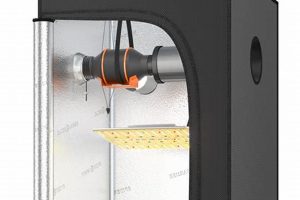
The SF1000 is a model of LED grow light manufactured by Spider Farmer. This lighting solution is specifically engineered for indoor plant cultivation, providing a full spectrum of light intended to mimic natural sunlight. Its design aims to support all stages of plant growth, from seedling to flowering, within a controlled environment.
The significance of this type of lighting lies in its efficiency and effectiveness in promoting plant development. Compared to traditional High-Pressure Sodium (HPS) or Metal Halide (MH) lamps, LED grow lights generally consume less power while producing comparable or superior results. Their use contributes to reduced energy costs and a smaller carbon footprint for indoor gardening operations. These advancements stem from ongoing research and development in horticultural lighting technology.
The following discussion will delve into the specifics of its features, performance metrics, and application scenarios. Further examination will cover installation guidelines, maintenance procedures, and comparisons with alternative grow lighting systems.
Optimizing Plant Growth with the SF1000
Achieving optimal results with this lighting unit requires attention to several key factors. The following tips provide guidance on maximizing its effectiveness for indoor plant cultivation.
Tip 1: Determine Optimal Hanging Height: Adjust the distance between the unit and the plant canopy based on the growth stage. Seedlings require a greater distance to prevent light burn, while flowering plants benefit from closer proximity. A light meter can provide precise measurements of light intensity.
Tip 2: Manage Environmental Conditions: This lighting generates heat; therefore, monitor and control the temperature and humidity within the grow space. Adequate ventilation and climate control systems are essential for maintaining a stable and favorable environment.
Tip 3: Implement a Proper Lighting Schedule: Adhere to recommended photoperiods for each growth stage. Vegetative growth typically requires 18 hours of light and 6 hours of darkness, while flowering usually benefits from a 12/12 light cycle.
Tip 4: Monitor Plant Response: Regularly observe plants for signs of nutrient deficiencies or light stress. Adjust nutrient solutions and lighting parameters accordingly to address any issues that arise.
Tip 5: Ensure Adequate Air Circulation: Proper airflow around plants is crucial for preventing mold and mildew growth, as well as strengthening stems. Oscillating fans can effectively distribute air throughout the grow space.
Tip 6: Maintain Cleanliness: Regularly clean the unit’s surface to remove dust and debris, which can impede light output. Use a soft, dry cloth to wipe down the fixture.
Tip 7: Calibrate Light Intensity: Utilize a PAR (Photosynthetically Active Radiation) meter to accurately measure light intensity at the plant canopy. This data enables precise adjustments for optimal growth.
By carefully implementing these recommendations, growers can leverage the capabilities of this LED grow light to achieve healthy and robust plant growth, leading to improved yields and overall success in indoor cultivation.
The concluding section will summarize the key advantages and limitations of the unit, providing a balanced perspective for potential users.
1. Full-spectrum LED
The inclusion of “Full-spectrum LED” technology within the Spider Farmer SF1000 is foundational to its effectiveness as a plant growth tool. Full-spectrum LEDs are designed to emit light across a wide range of wavelengths, closely mimicking the spectral composition of natural sunlight. This is crucial because plants utilize different wavelengths for various physiological processes, including photosynthesis, chlorophyll production, and photomorphogenesis (regulation of plant shape and development). Without a full spectrum, a plant may experience deficiencies in certain wavelengths, leading to stunted growth, reduced yields, or altered morphology. For instance, blue light is essential for vegetative growth, while red light is crucial for flowering and fruit production. The SF1000, by employing full-spectrum LEDs, aims to provide the complete light profile necessary for healthy plant development throughout its life cycle.
The practical significance of understanding the full-spectrum nature of this system lies in optimizing cultivation strategies. Growers can adjust light intensity and duration knowing that a comprehensive range of wavelengths is available. This knowledge informs decisions regarding plant spacing, nutrient management, and environmental controls. If, for example, a grower observes signs of etiolation (elongated stems and pale leaves, often indicative of insufficient blue light), they can be confident that the system is capable of providing the necessary spectral output and can adjust other factors accordingly. Similarly, during flowering, the presence of sufficient red and far-red wavelengths ensures robust bud development and increased yields. The consistent spectral output also allows for predictable and repeatable results, essential for commercial growers aiming for consistent product quality.
In summary, the “Full-spectrum LED” component is integral to the functionality and value proposition of the Spider Farmer SF1000. It enables comprehensive plant growth by providing a wide range of light wavelengths, mimicking natural sunlight. Proper understanding of its capabilities facilitates informed cultivation practices, leading to optimized plant health, increased yields, and predictable outcomes. The ongoing challenge lies in further refining the spectral output to precisely match the needs of specific plant species and growth stages for even greater efficiency and effectiveness.
2. Energy-efficient design

The energy-efficient design of the SF1000 is a core characteristic impacting its operational costs and environmental footprint. This design focuses on maximizing light output (Photosynthetically Active Radiation, or PAR) per unit of electricity consumed (Watt). An efficient design leads to reduced electricity bills for the end-user and minimizes the strain on energy resources. The adoption of LED technology is the primary driver of this efficiency, as LEDs convert a significantly higher percentage of electrical energy into light compared to traditional High-Pressure Sodium (HPS) or Metal Halide (MH) lamps. For example, an HPS lamp may only convert around 30% of electricity into light, while a high-quality LED can achieve 50% or higher. This difference directly translates to lower power consumption for the same level of light intensity.
The practical implications of this energy efficiency are multifaceted. Indoor cultivation operations, particularly on a commercial scale, often involve numerous grow lights operating for extended periods. The cumulative energy savings from utilizing an efficient system like the SF1000 can be substantial, leading to significant cost reductions over time. Furthermore, the reduced heat output associated with LEDs, as a byproduct of greater energy efficiency, contributes to lower cooling requirements within the grow space. This further decreases overall energy consumption and mitigates the risk of plant stress caused by excessive heat. Real-world examples demonstrate that growers switching from HPS to LED lighting solutions have observed a noticeable decrease in their energy bills, along with improved plant health due to better temperature control.
In conclusion, the energy-efficient design of the SF1000 is a pivotal attribute that directly influences its economic viability and environmental sustainability. The adoption of LED technology allows for greater light output per unit of energy consumed, resulting in lower operational costs, reduced heat output, and a smaller carbon footprint. Understanding the mechanics of this design is critical for optimizing the utilization of the SF1000 and maximizing its benefits for indoor plant cultivation. Further research and development into even more efficient LED technologies promise even greater energy savings and environmental responsibility in the future of indoor agriculture.
3. Optimal light intensity

Optimal light intensity, a critical component of successful indoor plant cultivation, is directly addressed by the spectral output characteristics. The SF1000 is designed to provide a specific range of light intensity, measured in PPFD (Photosynthetic Photon Flux Density), tailored for various growth stages. Insufficient light intensity leads to stunted growth, etiolation, and reduced yields, whereas excessive intensity causes leaf burn, nutrient imbalances, and photoinhibition. The SF1000 aims to mitigate these risks by delivering an intensity level appropriate for its intended coverage area, typically a 2×2 or 2×4 foot grow tent. Real-world examples show that users who position the SF1000 at recommended distances from the plant canopy, based on growth stage, often report healthier plant development and increased yields compared to those who do not adhere to these guidelines. The selection of this lighting system implicitly involves the need to understand and manage light intensity for effective plant growth.
Furthermore, understanding the practical significance of optimal light intensity with the SF1000 involves considering environmental factors and plant-specific needs. Temperature, humidity, and CO2 levels interact with light intensity to influence photosynthetic rates. For instance, higher temperatures may necessitate lower light intensities to prevent heat stress. Different plant species and cultivars also exhibit varying light intensity requirements. Some leafy greens thrive under lower intensities, while flowering plants typically require higher levels. Users of the SF1000 should, therefore, monitor plant responses and adjust the hanging height or dimming settings (if available) to fine-tune light intensity based on observed plant health and growth characteristics. Light meters can be employed to precisely measure PPFD at the plant canopy, enabling data-driven adjustments for optimization.
In conclusion, the provision of optimal light intensity is central to the function of the SF1000. Its design parameters are focused on delivering adequate and appropriate light levels for indoor plant growth. Challenges remain in achieving precise control and adaptation to diverse plant requirements. However, awareness of the relationship between light intensity and plant physiology, coupled with careful monitoring and adjustment, empowers growers to maximize the benefits of this LED grow light system, achieving superior results in their indoor cultivation endeavors.
4. Thermal management system

The thermal management system is an integral component of the SF1000, directly impacting its longevity, efficiency, and operational stability. As LEDs convert electrical energy into light, a significant portion is also released as heat. Without an effective heat dissipation mechanism, this accumulation of thermal energy can lead to decreased light output, accelerated degradation of LED components, and potential system failure. The SF1000, therefore, incorporates a thermal management system, typically involving heat sinks and potentially fans, to regulate the temperature of the LEDs and maintain optimal operating conditions. The effectiveness of this system directly influences the fixture’s ability to consistently deliver its rated light intensity and lifespan.
Real-world examples demonstrate the importance of a robust thermal management system in LED grow lights. Fixtures lacking adequate heat dissipation often exhibit premature failures or significant drops in light output after a relatively short period of use. Users have reported that SF1000 units equipped with efficient heat sinks maintain consistent performance over extended periods, indicating that the design effectively manages thermal load. The system also contributes to a more stable growing environment. Inadequate thermal management can lead to localized hotspots, potentially causing plant stress and uneven growth patterns. An efficient system distributes heat more evenly, minimizing temperature fluctuations within the grow space.
In summary, the thermal management system is a crucial, though often overlooked, aspect of the SF1000. Its proper functioning ensures consistent light output, extends the lifespan of the LEDs, and contributes to a more stable and controlled growing environment. Challenges remain in optimizing thermal management designs for cost-effectiveness and silent operation. Further advancements in materials science and heat dissipation technologies could lead to even more efficient and reliable LED grow lights, furthering the advancement of indoor agriculture.
5. Targeted grow space

The concept of “Targeted grow space” is fundamentally intertwined with the application and efficacy of the SF1000 LED grow light. Understanding the intended dimensions and environmental characteristics of the cultivation area is crucial for optimizing the performance of this lighting system. The SF1000, due to its power output and light distribution pattern, is specifically designed for use within a defined spatial volume. Misapplication in either too large or too small of an area compromises its effectiveness.
- Coverage Area Optimization
The SF1000 is generally suitable for a 2×2 or 2×4 foot grow tent. Utilizing it in a significantly larger area results in insufficient light intensity, hindering plant growth, particularly during flowering. Conversely, using it in a much smaller space may lead to light burn or other phototoxicity issues. Matching the lighting system to the intended area is critical for achieving optimal photosynthetic rates and healthy plant development. Real-world examples demonstrate that growers who exceed the recommended coverage area often observe etiolated growth and reduced yields.
- Light Intensity Management
The light intensity produced by the SF1000 decreases with distance from the light source. In a “targeted grow space,” the distance between the light and the plant canopy can be carefully controlled to ensure adequate PAR (Photosynthetic Active Radiation) levels. This control is essential for different growth stages; seedlings require lower intensities, while flowering plants demand higher levels. Within the recommended dimensions, growers can effectively adjust the hanging height to meet these changing light requirements. If the space is not “targeted” appropriately, this precision is lost, leading to suboptimal conditions.
- Environmental Control Synergy
The SF1000, like all grow lights, generates heat. The thermal load within the “targeted grow space” must be effectively managed through ventilation and climate control systems. In a correctly sized space, these systems can maintain stable temperatures and humidity levels, creating a favorable environment for plant growth. If the space is too small, the heat generated by the SF1000 may overwhelm the ventilation, leading to heat stress. If too large, the ventilation may struggle to maintain adequate temperature and humidity levels, especially in colder climates.
- Spatial Optimization for Plant Density
The SF1000’s light distribution is designed to provide even illumination within the “targeted grow space.” This even distribution allows for optimal plant density without creating shaded areas that could hinder the growth of some plants. When the lighting is applied to an inappropriate spatial volume, inconsistent lighting results, inhibiting growth in parts of the garden while promoting growth in other spaces, defeating the purpose of the grow light.
These facets emphasize that the selection and effective utilization of the SF1000 hinges on understanding and respecting its “targeted grow space.” Deviations from the intended dimensions compromise the lighting system’s performance, impacting plant health and yield. By adhering to the specified spatial parameters and integrating it with appropriate environmental controls, growers can maximize the benefits of the SF1000 and achieve superior results in their indoor cultivation endeavors. The effectiveness of the lighting unit is tied to environmental and planting characteristics.
Frequently Asked Questions About the Spider Farmer SF1000
This section addresses common inquiries regarding the SF1000 LED grow light, providing concise and factual responses to assist potential and current users.
Question 1: What is the optimal hanging height for the SF1000 during the vegetative stage?
A hanging height of 18-24 inches above the plant canopy is generally recommended during the vegetative stage. This distance allows for adequate light coverage without causing excessive heat stress. Regular monitoring of plant response is advisable to fine-tune the height as needed.
Question 2: What is the power draw of the SF1000?
The SF1000 typically draws approximately 100 watts of power from the electrical grid. However, slight variations may occur depending on the specific model and operating voltage.
Question 3: Is the SF1000 suitable for growing cannabis?
The SF1000 can be used for cannabis cultivation. Its full-spectrum light output and intensity are sufficient for supporting both vegetative and flowering stages. Local regulations regarding cannabis cultivation must be adhered to.
Question 4: What is the expected lifespan of the SF1000?
The SF1000 is typically rated for a lifespan of approximately 50,000 hours. Actual lifespan may vary based on usage conditions, including operating temperature and humidity.
Question 5: Does the SF1000 require a ballast?
No, the SF1000 does not require an external ballast. It features an integrated driver that regulates the power supply to the LEDs.
Question 6: What is the recommended coverage area for the SF1000?
The SF1000 is generally recommended for a coverage area of 2×2 feet for flowering and 2×4 feet for vegetative growth. These are typical footprints using the light.
In summary, this grow light offers capabilities suited for indoor growth when its parameters are fully understood. A variety of factors determine how to use the lighting properly.
The subsequent section will provide troubleshooting guidance for common issues encountered with the SF1000.
Conclusion
This discussion has explored the features, application, and optimization strategies associated with the Spider Farmer SF1000 LED grow light. Its full-spectrum output, energy-efficient design, thermal management system, and targeted grow space have been examined to provide a comprehensive understanding of its capabilities and limitations. Proper utilization of the unit hinges on an understanding of these characteristics and the implementation of appropriate environmental controls.
The effectiveness of this technology necessitates ongoing research and refinement to address the evolving needs of indoor plant cultivation. Continued advancements in LED technology, thermal management, and spectral optimization will be crucial for maximizing yields and minimizing energy consumption in controlled-environment agriculture. Further investigation into plant-specific lighting requirements remains paramount for achieving optimal growth and sustainability.