The manipulation of information to influence public opinion features prominently in George Orwell’s allegorical novella. Through carefully crafted narratives, slogans, and imagery, characters within the story systematically control the thoughts and beliefs of the farm’s animal population. For instance, the pigs’ re-writing of history and the dissemination of simplistic slogans like “Four legs good, two legs bad” serve to maintain their dominance and suppress dissent.
Such manipulation is a critical tool for maintaining power, shaping ideology, and silencing opposition within the depicted society. Its effectiveness relies on exploiting vulnerabilities, such as the animals’ limited literacy and inherent trust. Historically, this technique has been employed by authoritarian regimes to consolidate control, justify actions, and cultivate unwavering loyalty among citizens. The distortion of truth, fabrication of enemies, and simplification of complex issues are hallmarks of its pervasive influence.
This examination will delve into specific instances of manipulative rhetoric within the text, analyzing how characters employ persuasive techniques to advance their agendas. It will also explore the long-term consequences of distorted communication on the farm’s societal structure and the animals’ individual freedoms. This investigation highlights the dangers of unquestioning acceptance and the importance of critical thinking in resisting manipulation.
Analyzing Manipulative Rhetoric
The following guidelines provide a framework for discerning and resisting manipulative rhetoric, drawing upon the lessons presented within the text. These observations emphasize critical evaluation, source verification, and independent thought.
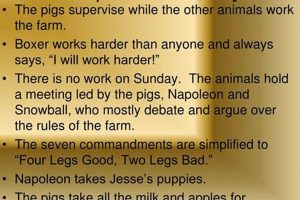
Tip 1: Scrutinize Simplified Slogans. Be wary of overly simplistic phrases or catchphrases that lack nuance or complexity. Such slogans often obscure underlying issues and prevent deeper understanding. For example, the mantra “Four legs good, two legs bad” prevented the animals from rationally assessing the pigs’ actions.
Tip 2: Question Historical Narratives. Always examine historical accounts for potential biases or omissions. The pigs’ constant rewriting of the farm’s history illustrates how manipulating the past can control the present.
Tip 3: Identify and Analyze Emotional Appeals. Observe how rhetoric utilizes emotional appeals, such as fear or patriotism, to bypass logical reasoning. Squealer’s speeches often manipulated the animals’ emotions to justify the pigs’ actions and stifle dissent.
Tip 4: Verify Information from Multiple Sources. Cross-reference information from various sources to identify inconsistencies or distortions. Relying on a single source, particularly one with a vested interest, can lead to accepting biased or inaccurate information.
Tip 5: Recognize the Creation of Scapegoats. Be alert to the identification of scapegoats or enemies used to divert attention from internal problems. The blaming of Snowball for all the farm’s misfortunes served to unite the animals against a fabricated threat.
Tip 6: Promote Open Dialogue and Debate. Foster environments that encourage diverse perspectives and constructive criticism. Suppressing dissenting opinions allows manipulative rhetoric to flourish unchallenged.
Tip 7: Foster Media Literacy. Develop media literacy skills to critically evaluate the messages being conveyed through various channels. Understanding how information is constructed and disseminated is essential for discerning manipulative tactics.
By implementing these practices, individuals can cultivate resilience against manipulative rhetoric and contribute to a more informed and discerning society. The lessons derived emphasize the critical importance of independent thought, rigorous evaluation, and a commitment to truth-seeking.
These insights serve as a vital reminder of the pervasive nature of manipulative tactics and the importance of constant vigilance in safeguarding intellectual freedom.
1. Simplified slogans

Simplified slogans serve as a core component of persuasive messaging employed throughout Orwell’s allegory. Their concise and easily memorable nature makes them a potent tool for shaping public opinion and reinforcing desired behaviors. Within the context of the farm, these phrases are strategically deployed to manipulate the animal population.
- Reduction of Complexity
Simplified slogans reduce complex issues to easily digestible soundbites. This oversimplification obscures nuances and discourages critical thinking. On the farm, “Four legs good, two legs bad” prevents animals from questioning the pigs’ increasingly human-like behavior, glossing over the problematic nature of their leadership.
- Emotional Appeal
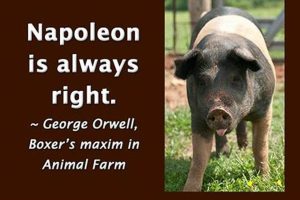
Effective slogans often tap into strong emotions such as fear, loyalty, or resentment. The repetition of these emotion-laden phrases can create a powerful sense of solidarity while simultaneously silencing dissent. Slogans such as “Napoleon is always right” instill blind faith and stifle independent judgment within the animal community.
- Memory and Repetition
The power of slogans lies in their memorability and frequent repetition. Regular exposure to these phrases reinforces their message and normalizes the underlying ideology. The sheep’s incessant bleating of “Four legs good, two legs bad” serves as a constant reminder of the prescribed worldview, effectively suppressing any alternative perspectives.
- Control of Language
By controlling the language used to describe events and ideas, the pigs control the animals’ perceptions. Slogans frame discussions in a way that favors the pigs’ agenda and makes it difficult for the other animals to articulate their concerns. The strategic use of slogans solidifies the pigs’ control over the narrative and their ability to dictate reality.
The deployment of simplified slogans demonstrates a key tactic in controlling thought and shaping behavior within the allegorical framework. These easily digestible phrases, laden with emotional appeals and endlessly repeated, serve to limit critical thinking and reinforce the dominant ideology. The manipulation of language, exemplified by the strategic use of slogans, is a cornerstone of the pigs’ manipulative agenda, underscoring the dangers of uncritical acceptance and the importance of linguistic awareness.
2. Rewriting history

The alteration of past events to suit present agendas is a central element of manipulative rhetoric employed within Orwell’s allegorical novella. The strategic distortion and fabrication of historical accounts serve to control the narrative, maintain power, and shape the animals’ perceptions of reality.
- Erosion of Trust
The systematic altering of historical facts undermines the animals’ trust in their own memories and experiences. As the pigs manipulate records and reinterpret events, the animals begin to doubt their understanding of the past, making them more susceptible to current pronouncements. The manipulation of Snowball’s role, for instance, casts doubt on his character and accomplishments, discrediting any potential resistance to the pigs’ rule.
- Justification of Actions
Historical revisionism provides a means to justify current policies and actions, regardless of their moral implications. By recasting past events in a favorable light, the pigs legitimize their growing power and privileges. For example, the alteration of the Seven Commandments allows the pigs to rationalize their transgressions without directly violating the established principles of Animalism.
- Creation of a Unified Narrative
The construction of a revised history creates a unified narrative that supports the ruling regime’s ideology. Dissenting voices are silenced, and alternative interpretations are suppressed, ensuring that the official version of events prevails. This singular narrative fosters a sense of collective identity and reinforces the pigs’ authority, preventing the animals from questioning the established order.
- Control of Future Expectations
Manipulating the past influences expectations about the future. By presenting a history that supports the pigs’ leadership, the animals are conditioned to accept their continued dominance. This manipulation of temporal perception serves to maintain the status quo and discourage any attempts to challenge the existing power structure. The altered history becomes a self-fulfilling prophecy, reinforcing the pigs’ control over the farm’s destiny.
The act of rewriting history serves as a powerful instrument for maintaining control within the farm’s society. This manipulation ensures that the animals remain compliant and subservient to the ruling pigs, reinforcing the dangers of historical revisionism and the importance of preserving accurate and unbiased accounts.
3. Emotional appeals

Emotional appeals constitute a significant component of persuasive rhetoric within the context of Animal Farm, serving as a potent instrument for manipulating the animal population and solidifying the pigs’ control. These appeals bypass rational thought, targeting the animals’ sentiments to elicit specific responses and behaviors.
- Fear Mongering
The exploitation of fear operates as a primary tactic. Threats, both real and imagined, are employed to instill a sense of vulnerability and dependence on the pigs for protection. The constant reminders of Mr. Jones’s potential return, for instance, create a pervasive atmosphere of anxiety, compelling the animals to accept the pigs’ leadership as a safeguard against external threats. This technique inhibits critical assessment and promotes unquestioning obedience.
- Appeals to Patriotism and Loyalty
Cultivating a sense of collective identity and loyalty to the farm serves as a powerful unifying force. Slogans and ceremonies that evoke patriotic fervor reinforce the animals’ commitment to the collective good, as defined by the pigs. This tactic suppresses individual dissent by framing opposition as a betrayal of the farm’s ideals and fellow animals. The creation of songs and rituals reinforces this sense of belonging and shared purpose, albeit under the pigs’ controlled narrative.
- Demonization of the “Other”
The creation of an external enemy, or “other,” functions as a tool for unifying the animal population against a common target. Snowball, after being expelled, is systematically demonized and blamed for all the farm’s misfortunes. This tactic diverts attention from the pigs’ own shortcomings and consolidates support for their leadership. By constructing a clear dichotomy between “us” (the loyal animals) and “them” (the treacherous enemy), the pigs foster solidarity and suppress internal conflict.
- Playing on Hope and Naivet
Exploiting the animals’ innate desire for a better future, the pigs employ optimistic pronouncements and promises to maintain their support. These promises, often unfulfilled, create a sense of anticipation and deflect criticism of current conditions. The animals’ hope for a utopian society, free from human oppression, blinds them to the pigs’ gradual accumulation of power and privileges. This manipulation of hope underscores the vulnerability of well-intentioned individuals to persuasive rhetoric.
The strategic deployment of these emotional appeals underscores the manipulative nature of the farm’s social structure. By targeting the animals’ fears, loyalties, and hopes, the pigs effectively bypass rational discourse and maintain their dominance. These techniques highlight the insidious power of emotional manipulation in shaping public opinion and suppressing dissent within the allegorical framework.
4. Scapegoat creation

Scapegoat creation functions as a critical instrument within the framework of deceptive communication, enabling the manipulation of public sentiment and the consolidation of power. Within Orwell’s allegorical novella, this technique manifests through the systematic blaming of a designated individual or group for the problems and failures of the collective. This tactic serves to deflect scrutiny from those in positions of authority, creating a unified front against a perceived external threat and reinforcing the existing power structure. The exiling and subsequent demonization of Snowball exemplifies this strategy; he is made culpable for all adversities faced by the farm, effectively absolving the pigs of any responsibility and diverting attention from their growing abuses of power.
The practical application of this strategy transcends the fictional realm, resonating within various historical and contemporary contexts. Totalitarian regimes frequently employ scapegoating to consolidate control by identifying and vilifying minority groups or political opponents, thus creating a climate of fear and repression. The effectiveness of scapegoating rests upon the simplification of complex issues and the exploitation of pre-existing prejudices or anxieties within a population. By focusing blame on a specific target, authorities can rally public support, suppress dissent, and legitimize repressive measures. Examples range from the anti-Semitic propaganda of Nazi Germany to the political purges of Stalinist Russia, illustrating the devastating consequences of scapegoating when employed on a mass scale.
Understanding the dynamics of scapegoat creation is vital for resisting manipulative persuasion. The ability to recognize the signs of scapegoating, such as the oversimplification of complex problems, the demonization of targeted groups, and the absence of critical analysis, enables individuals to resist deceptive narratives and promote rational discourse. By fostering critical thinking and encouraging scrutiny of authority, societies can mitigate the influence of scapegoating and cultivate a more just and equitable environment. The allegorical depiction highlights the importance of critical analysis and independent thought in resisting manipulative tactics and safeguarding against the abuse of power through manufactured division.
5. Suppression of dissent

The suppression of dissent is inextricably linked to the deployment of persuasive techniques within George Orwell’s allegorical work. Persuasive rhetoric functions not only to persuade but also to preempt and eliminate opposition. The pigs’ control over the farm’s narrative necessitates the silencing of any voices that challenge their authority or expose their manipulation. Dissent, in its various forms, represents a threat to the established power structure, and its eradication becomes a prerequisite for the successful implementation and maintenance of skewed narratives. This can take shape through a multitude of forms; physical removal, re-education or simply the ability to make one the outcast in their local environment.
Within the farm, various tactics contribute to silencing opposition. Squealer’s persuasive rhetoric often serves to discredit dissenting voices, portraying them as misguided, disloyal, or even aligned with external enemies. Intimidation and the threat of violence, carried out by the dogs, further discourage the animals from expressing their concerns or challenging the pigs’ decisions. The control of information and the restriction of communication channels also prevent the formation of collective resistance. The pigs’ monopoly on education and their manipulation of historical records ensure that the animals remain ignorant of alternative perspectives, thereby reinforcing their dependence on the official narrative. All while creating a safe space for this to grow.
The deliberate squashing of alternate viewpoints is a critical mechanism for sustaining skewed rhetoric and controlling the population. The examples serve as a cautionary tale about the fragility of truth and the dangers of unchecked power. Recognizing the tactics employed to suppress dissent is crucial for fostering critical thinking, promoting open dialogue, and safeguarding against manipulative persuasion. The suppression of dissent allows deceitful communications to flourish unchallenged, highlighting the importance of protecting freedom of speech and promoting intellectual independence.
6. Controlled information

The deliberate management and dissemination of information represent a cornerstone of persuasive rhetoric evident throughout Orwell’s allegorical narrative. This control directly enables the spread of manipulative communication by shaping perceptions, limiting alternative viewpoints, and consolidating power within the ruling regime. The manipulation of knowledge serves as a crucial precondition for the effectiveness of misleading discourse, as it creates an environment where alternative perspectives are suppressed and official narratives are unquestioningly accepted. Without tightly regulated messaging, propaganda’s effectiveness diminishes significantly, as individuals are exposed to diverse sources and are thus more likely to engage in critical analysis. Within the farm’s context, the pigs’ dominance relies heavily on their ability to regulate the flow of facts, thereby shaping the animals’ understanding of reality and limiting their capacity for independent thought.
Practical applications of controlled information can be observed in various historical and contemporary settings. Totalitarian regimes, for example, often employ strict censorship and state-controlled media to propagate a unified ideological message and suppress dissenting voices. The Soviet Union’s control over information during the Cold War illustrates this phenomenon, where the government manipulated news and historical accounts to promote its communist ideology and demonize the West. Similarly, in modern disinformation campaigns, social media platforms are exploited to spread false or misleading information, often with the intent of influencing public opinion or undermining democratic institutions. The control of information, therefore, serves as a vital component in these manipulative strategies, enabling the dissemination of misleading narratives and the suppression of alternative perspectives.
Understanding the connection between controlled information and persuasive rhetoric is essential for fostering a discerning and informed populace. Recognizing the tactics employed to regulate the flow of knowledge, such as censorship, propaganda, and the manipulation of media, empowers individuals to critically evaluate information and resist manipulative persuasion. By promoting media literacy, encouraging diverse sources of information, and safeguarding freedom of expression, societies can mitigate the negative effects of controlled messaging and create an environment where truth and transparency prevail. Therefore, the fight against deception begins with the recognition and dismantling of efforts to control information, empowering individuals to think critically and resist the influence of propaganda.
Frequently Asked Questions on the Manipulation of Information in Orwell’s Animal Farm
The following questions address common inquiries regarding the strategic manipulation of information within George Orwell’s allegorical novella, focusing on its pervasive impact on the depicted society.
Question 1: How does the use of simplified slogans contribute to the effectiveness of manipulative rhetoric within the text?
Simplified slogans reduce complex issues to easily digestible soundbites, bypassing critical analysis and encouraging uncritical acceptance. The repetition of these phrases normalizes the underlying ideology and suppresses alternative viewpoints. Examples include “Four legs good, two legs bad.”
Question 2: In what ways does the rewriting of history facilitate the pigs’ control over the other animals?
Altering past events undermines the animals’ trust in their own memories and experiences. By manipulating records and reinterpreting historical facts, the pigs create a revised narrative that justifies their actions and maintains their authority. This distortion erodes trust.
Question 3: How do emotional appeals influence the animals’ behavior and perceptions?
Emotional appeals target the animals’ fears, loyalties, and hopes, bypassing rational thought and eliciting specific responses. The pigs employ fear mongering, patriotic fervor, and the demonization of external enemies to manipulate the population and consolidate support for their rule. The utilization of emotions discourages analytical thinking.
Question 4: What role does scapegoat creation play in maintaining the pigs’ dominance?
Scapegoat creation deflects blame for the farm’s problems onto a designated individual or group, such as Snowball. This tactic diverts attention from the pigs’ shortcomings and consolidates support for their leadership by fostering a sense of collective unity against a perceived threat.
Question 5: Why is the suppression of dissent so crucial for the success of persuasive rhetoric?
Suppression of dissent eliminates any voices that challenge the ruling regime’s authority or expose their manipulative tactics. By silencing opposition, the pigs maintain control over the narrative and prevent the formation of collective resistance. It allows misleading communication to flourish unchallenged.
Question 6: How does the control of information contribute to the overall manipulation of the farm’s population?
Controlling the flow of information allows the pigs to shape the animals’ understanding of reality, limit their exposure to alternative viewpoints, and reinforce their dependence on the official narrative. This manipulation of knowledge is essential for the effective dissemination of slanted rhetoric and the maintenance of power.
Understanding the mechanics of manipulative rhetoric, as exemplified within the text, serves as a crucial tool for fostering critical thinking, promoting media literacy, and safeguarding against deception in various contexts.
This understanding emphasizes the value of independent thought and a commitment to truth-seeking.
The Enduring Relevance of Propaganda in Animal Farm
This exploration has demonstrated the pervasive nature of manipulative rhetoric within Orwell’s allegory. The analysis of simplified slogans, rewritten history, emotional appeals, scapegoat creation, suppression of dissent, and controlled information has revealed the insidious mechanisms by which power is maintained through the distortion of truth. The text serves as a stark illustration of the vulnerability of societies to deceptive communication and the dire consequences that follow.
The lessons derived from Animal Farm remain acutely relevant in contemporary society, where misinformation and manipulation are rampant. The vigilance, critical thinking, and media literacy are essential tools for resisting the influence of skewed narratives. Safeguarding intellectual freedom and fostering a commitment to truth are paramount in preserving democratic values and preventing the erosion of reason. The enduring significance of this allegory lies in its ability to illuminate the dangers of unchecked power and the necessity of unwavering resistance to manipulative persuasion.