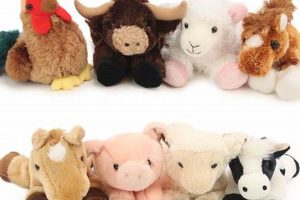
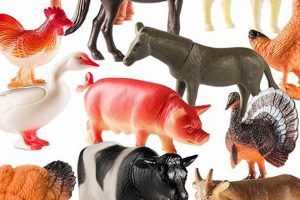
The translation of livestock into the Spanish language yields several terms used to identify creatures commonly raised on agricultural lands. These terms are fundamental for communication in agricultural settings, veterinary contexts, and language learning scenarios. For example, a cow is “vaca,” a pig is “cerdo,” and a chicken is “gallina.” Understanding these Spanish equivalents is crucial for anyone interacting with Spanish-speaking farmers or engaging with agricultural information in the Spanish language.
Knowledge of the Spanish terms for domestic animals is beneficial for several reasons. It facilitates international collaboration in agricultural research and trade. Additionally, it improves communication and understanding within communities where Spanish is spoken. Historically, livestock have played a significant role in Spanish-speaking cultures, impacting cuisine, traditions, and economic activities. A strong grasp of related vocabulary is therefore advantageous for comprehending cultural nuances.
The subsequent discussion will detail specific terms for a variety of domestic creatures, their common uses, and related linguistic considerations. This exploration aims to provide a foundational understanding of this specialized Spanish vocabulary. This knowledge is directly applicable in fields such as agriculture, language studies, and international business.
Consejos sobre animales de granja en espaol
Understanding the Spanish lexicon pertaining to livestock requires attention to detail and consistent practice. The following tips offer guidance on acquiring and retaining this vocabulary effectively.
Tip 1: Utilize Flashcards. Flashcards are an effective tool for memorizing new terms. Include images of the animal on one side and the Spanish translation on the other. Regular review sessions will reinforce learning.
Tip 2: Learn Gendered Nouns. In Spanish, nouns have grammatical gender (masculine or feminine). Note the gender of each animal term as “el cerdo” (masculine pig) or “la gallina” (feminine hen). Correct gender usage is essential for grammatical accuracy.
Tip 3: Practice Pronunciation. Spanish pronunciation differs from English. Pay attention to the correct pronunciation of each term. Audio resources, such as online dictionaries or language learning apps, can be beneficial.
Tip 4: Study Related Verbs. Learn verbs commonly associated with these animals. For instance, “ordear” (to milk), “criar” (to raise), or “alimentar” (to feed). This expands vocabulary and contextual understanding.
Tip 5: Contextualize Learning. Study the terminology within the context of farm-related scenarios. Read articles about agriculture in Spanish, watch documentaries about farming in Spanish-speaking countries, or engage in conversations with native speakers about rural life.
Tip 6: Focus on Regional Variations. The Spanish language varies across regions. Certain terms for domestic animals may differ between Spain and Latin America. Be aware of these variations and specify the regional context when communicating.
Tip 7: Leverage Mnemonic Devices. Employ mnemonic devices to aid in memorization. For example, associate “vaca” (cow) with the English word “vacant” (referring to an empty pasture). Such associations can enhance recall.
By incorporating these strategies into one’s learning approach, acquisition of the Spanish terms for agricultural animals can be significantly enhanced. Consistent effort and focused practice are paramount for achieving fluency in this specialized vocabulary.
This focused approach provides a solid foundation for further exploration of agricultural terminology in the Spanish language. The next section will delve into the practical application of this vocabulary in real-world settings.
1. Nouns

Within the realm of agricultural vocabulary in Spanish, the fundamental component lies in identifying the specific nouns used to designate various domestic creatures. A firm grasp of these names constitutes the bedrock upon which all further understanding is built, providing the essential terminology for describing, discussing, and managing livestock.
- Core Vocabulary Acquisition
Learning the nouns for individual animals is the primary step. These include terms such as “vaca” (cow), “cerdo” (pig), “gallina” (chicken), “oveja” (sheep), “caballo” (horse), and “cabra” (goat). Without this core vocabulary, communication regarding livestock is fundamentally impossible. This baseline knowledge enables basic identification and categorization of farm animals.
- Distinction between Sex and Age
The Spanish language frequently utilizes distinct nouns to differentiate between the sex and age of domestic animals. For instance, a male pig is “verraco,” while a young pig is “lechn.” Similarly, a female cow is a “vaca,” but a young female cow is a “ternera.” The capacity to employ these more specific terms enhances precision in agricultural discourse, permitting more accurate descriptions and assessments of livestock populations.
- Pluralization and Grammatical Gender
Understanding the rules of pluralization and grammatical gender is crucial for correct usage. Animal nouns are either masculine (“el caballo”) or feminine (“la vaca”). Plural forms are created by adding “-s” or “-es” to the singular form, depending on the noun’s ending (“los caballos,” “las vacas”). Erroneous pluralization or gender agreement can lead to miscommunication and a perception of linguistic incompetence.
- Application in Agricultural Practices
Knowledge of animal nouns is integral to various agricultural practices. Farmers, veterinarians, and agricultural workers must be capable of accurately identifying and referring to different types of livestock. This includes reporting animal health, managing breeding programs, and marketing agricultural products. Precise terminology reduces ambiguity and supports efficient operation of agricultural enterprises.
In summation, mastery of animal nouns in Spanish provides the essential foundation for effective communication and operation within the agricultural sector. A thorough comprehension of these terms, inclusive of gender, pluralization, and variations relating to sex and age, underpins successful engagement with agricultural communities and practices in Spanish-speaking regions.
2. Gender
Grammatical gender significantly influences the accurate use of Spanish terms for domestic animals. Unlike English, Spanish nouns are inherently masculine or feminine, impacting the articles (el, la, los, las) and adjectives used to describe them. Proper grammatical agreement is not merely a matter of linguistic correctness; it is essential for clear and unambiguous communication regarding farm animals.
- Gender Assignment and Animal Terms
In Spanish, many animal nouns have a fixed grammatical gender, often unrelated to the animal’s biological sex. For example, “la vaca” (the cow) is feminine, regardless of whether one is referring to a specific female cow. Some animal terms may have distinct forms for male and female, such as “el toro” (the bull) and “la vaca” (the cow). Correct gender assignment is crucial for subsequent grammatical agreement.
- Article Usage and Gender
The definite articles “el” (masculine singular), “la” (feminine singular), “los” (masculine plural), and “las” (feminine plural) must agree with the gender and number of the animal noun. For instance, it is correct to say “el caballo blanco” (the white horse) but incorrect to say “la caballo blanco.” Inaccurate article usage indicates a fundamental misunderstanding of grammatical gender in Spanish.
- Adjective Agreement and Description
Adjectives used to describe domestic animals must agree in gender and number with the noun they modify. If describing a female pig, one would say “la cerda grande” (the big sow), where “grande” takes the feminine form to match “cerda.” Using the masculine form, “el cerdo grande,” would be appropriate for a male pig. Failure to adhere to adjective agreement results in grammatically incorrect and potentially confusing descriptions.
- Implications for Clarity and Accuracy
Grammatical gender agreement ensures clarity and avoids ambiguity. In agricultural contexts, where precise communication is paramount, correct gender usage is not simply a matter of style but a necessity for conveying accurate information. Incorrect gender agreement can lead to misinterpretations regarding the sex, age, or characteristics of livestock, potentially impacting animal management and breeding decisions. Accurate gender agreement demonstrates proficiency and facilitates effective communication among Spanish speakers in the agricultural domain.
The interconnection between grammatical gender and animal terms in Spanish highlights the need for rigorous attention to detail. Mastery of these grammatical principles is necessary for those who seek to engage in meaningful communication and professional interaction with Spanish-speaking communities in agricultural or veterinary fields.
3. Verbs

The accurate designation of verbs connected to activities performed with or by livestock is crucial for precise communication concerning domestic animals in the Spanish language. Understanding the specific verbs used in agricultural contexts allows for detailed descriptions of animal husbandry practices and related activities.
- Basic Animal Care Verbs
A fundamental understanding includes the verbs related to basic animal care. Examples are alimentar (to feed), regar (to water), and cuidar (to care for). These verbs are universally applicable to various types of livestock and form the basis for describing routine animal management. Their correct usage indicates a basic competence in agricultural terminology.
- Verbs Specific to Animal Species
Beyond general care, certain verbs pertain specifically to particular animal species. For example, ordear (to milk) applies exclusively to dairy animals such as cows and goats, while esquilar (to shear) refers to sheep. Cabalgar (to ride) is associated with horses, burros, and other animals used for transport. Correctly using these species-specific verbs shows a deeper understanding of animal husbandry.
- Verbs Related to Animal Reproduction
Animal reproduction involves a unique set of verbs critical for breeding and livestock management. Inseminar (to inseminate) relates to artificial insemination, while parir (to give birth) describes the act of an animal delivering offspring. Castrar (to castrate) refers to the removal of male reproductive organs, and amamantar (to nurse) refers to feeding young with milk. Proper use of these verbs is essential for discussions about animal breeding and population control.
- Verbs Pertaining to Animal Processing
When discussing animal processing, a different set of verbs becomes relevant. Sacrificar (to slaughter) denotes the killing of an animal for consumption, while despiezar (to butcher) refers to the process of cutting up an animal carcass into different cuts of meat. Empaquetar (to package) is used in the context of preparing meat products for distribution. These verbs are crucial for understanding the steps involved in meat production and distribution processes.
The correct application of verbs associated with domestic animals enhances the clarity and accuracy of communication in Spanish. By mastering these verbs, one can engage in more sophisticated discussions about animal care, breeding, processing, and related agricultural practices.
4. Adjectives

Precise specification of domestic animal breeds in Spanish necessitates the utilization of descriptive adjectives. These adjectives serve not only to distinguish between various breeds but also to convey critical information about the animal’s physical characteristics, origin, and purpose.
- Identification of Physical Traits
Adjectives defining physical traits are essential for breed identification. Terms such as negro (black), blanco (white), manchado (spotted), grande (large), and pequeo (small) can be combined with the animal’s noun to provide a basic description. For instance, ” vaca negra” (black cow) or ” caballo blanco” (white horse). More specific adjectives may describe particular markings or conformations characteristic of certain breeds.
- Geographic Origin and Breed Names
Many breed names directly incorporate the geographic region of origin, functioning as adjectives. Examples include ” oveja merina” (Merino sheep) from Spain, where ” merina” acts as both the breed name and an adjective. Similarly, ” caballo andaluz” (Andalusian horse) references the Andalusia region. Knowing these adjectival forms provides insights into the animal’s heritage and geographic distribution.
- Purpose-Related Descriptors
Adjectives can also denote the primary purpose for which a breed is raised. ” Gallina ponedora” (laying hen) indicates a chicken breed specifically bred for egg production, where ” ponedora” describes the hen’s function. ” Toro de lidia” (bullfighting bull) specifies bulls bred for bullfighting. These descriptors communicate critical information about the economic value and intended use of the animals.
- Adjectival Agreement and Accuracy
Adjectives must agree in gender and number with the animal noun they modify. For example, if describing several black cows, the correct phrase is ” vacas negras,” where ” negras” is the feminine plural form of ” negro.” Failure to adhere to these grammatical rules results in inaccurate descriptions and can lead to confusion. Attention to detail in adjectival agreement demonstrates linguistic competence and facilitates clear communication.
The nuanced application of adjectives in Spanish allows for the precise characterization of domestic animal breeds, conveying vital information regarding their physical attributes, origins, and intended purposes. Mastering this adjectival vocabulary enables more effective communication within agricultural and veterinary settings.
5. Regionalisms

The Spanish language, spoken across numerous countries and regions, exhibits significant lexical variation, particularly evident in the terms used for domestic animals. This phenomenon, known as regionalism, arises from diverse historical, cultural, and environmental influences, resulting in multiple words for the same animal depending on the geographic location. The consequence of ignoring such variations is a high probability of miscommunication and misunderstanding, especially in professional contexts like agriculture and veterinary science. Understanding these lexical variations is, therefore, an essential component of mastering the Spanish terminology for domestic creatures.
The effects of regionalism can be observed through various examples. The word for “turkey,” for instance, differs substantially across Spanish-speaking regions. In Spain, the standard term is “pavo,” whereas in Mexico, “guajolote” is more commonly used. In parts of South America, “gallipavo” or other regional alternatives might be preferred. Similarly, the word for “piglet” can vary, with “cochino,” “cerdito,” or “lechn” being used depending on the country. In practical terms, a veterinarian trained in Spain might use “pavo” when discussing poultry, while a Mexican farmer might expect to hear “guajolote.” Such discrepancies can lead to confusion about the specific animal being referenced, potentially affecting diagnoses and treatment plans.
In conclusion, lexical variations represent a significant challenge in the effective use of the Spanish language, especially when discussing agricultural animals. Awareness of these regionalisms is crucial for facilitating clear and accurate communication across diverse Spanish-speaking communities. Overcoming this challenge requires ongoing exposure to different dialects, a willingness to adapt one’s vocabulary based on context, and, importantly, a conscious effort to learn and recognize the alternative terms used in various regions. This knowledge strengthens professional relationships and minimizes the likelihood of miscommunication in international agricultural settings.
6. Idioms
Idiomatic expressions incorporating domestic animal terms represent a distinct layer of complexity within the broader context of Spanish agricultural vocabulary. These phrases, which employ figurative language rather than literal meaning, are deeply embedded in the cultural fabric of Spanish-speaking communities. As a result, a direct translation of these expressions often fails to convey their intended significance, potentially leading to misinterpretations and communication breakdowns, particularly in casual or colloquial contexts. Understanding these idiomatic expressions is crucial for achieving a more profound and culturally sensitive comprehension of agricultural discourse in Spanish.
The use of farm animal terms in Spanish idioms is prevalent. Examples include “estar como una cabra” (to be like a goat), signifying eccentricity or madness, or “buscarle tres pies al gato” (to look for three feet on a cat), meaning to complicate a simple matter unnecessarily. Similarly, “dormir como un lirn” (to sleep like a dormouse) describes someone who sleeps soundly and for a long time, and “ser un perro” (to be a dog) can mean to be lazy or to have bad intentions, depending on the context. The effect of these expressions depends heavily on context, and they enrich the communication, as they reveal culturally specific attitudes toward these animals. Literal translations would obscure the true meaning, causing a misunderstanding of both the statement and the speaker’s intention. This underlines the importance of understanding figurative expressions in Spanish beyond literal definitions of its composite words.
In summary, mastery of Spanish agricultural language demands familiarity with idiomatic expressions incorporating domestic animal terms. Knowledge of these figurative phrases and their subtle connotations is integral to effective communication and the accurate interpretation of cultural nuances within Spanish-speaking communities. By recognizing the figurative language in such idiomatic usages, individuals can both enhance their comprehension of the language and deepen their appreciation of the cultural values reflected in its expressions.
7. Usage

The effectiveness of knowing terms for domestic animals in Spanish depends entirely on the ability to apply that knowledge appropriately within diverse contexts. The mere memorization of vocabulary is insufficient; practical application requires an understanding of how and when to use specific terms, phrases, and grammatical structures in real-world situations. Correct contextual usage reduces ambiguity, improves communication efficiency, and demonstrates a deeper comprehension of the language and its cultural nuances. Incorrect application, conversely, can lead to misunderstandings, misinterpretations, and even offense, undermining the intended message and potentially damaging professional relationships.
Practical applications of this contextual understanding are varied and impactful. In veterinary medicine, for example, a veterinarian must accurately describe an animal’s condition to a Spanish-speaking farmer, using precise terminology and avoiding colloquialisms that could be misinterpreted. Similarly, agricultural researchers collaborating with Spanish-speaking colleagues need to use the appropriate regional terms for different livestock breeds when discussing research findings or implementing breeding programs. In international trade, knowing the proper terminology for different cuts of meat or types of dairy products is critical for negotiating contracts and ensuring accurate labeling. Without this contextual awareness, errors in communication could lead to financial losses or regulatory issues. Even in casual settings, such as visiting a farm in a Spanish-speaking country, knowing the local terms for animals enhances the experience and fosters a deeper connection with the culture.
In summary, the successful integration of “livestock vocabulary in Spanish” into meaningful communication necessitates adept contextual application. Mastering relevant terminology is the first step, but comprehending how these terms function within the specific setting, whether veterinary, agricultural, commercial, or social, elevates competence and efficacy. This comprehensive approach allows one to engage confidently and effectively within Spanish-speaking communities, fostering clearer understanding and stronger professional partnerships. The challenge lies in continuously expanding knowledge of these terms and continually honing contextual awareness in various professional environments to be prepared for many real-world scenarios.
Frequently Asked Questions
This section addresses common inquiries and clarifies misconceptions regarding the Spanish terminology for domestic animals, providing precise answers grounded in linguistic and agricultural expertise.
Question 1: Does the term “animales de granja” encompass all creatures residing on a farm?
The term “animales de granja” generally refers to livestock raised for agricultural purposes, such as meat, milk, eggs, or wool. While wild animals may occasionally be present on farms, they are typically not included within this designation.
Question 2: Are there differences in the Spanish terms for animals between Spain and Latin America?
Significant regional variations exist in the Spanish lexicon for farm animals. For instance, the word for “turkey” differs between Spain (“pavo”) and Mexico (“guajolote”). Recognizing these regionalisms is crucial for effective communication.
Question 3: How does grammatical gender impact the use of animal names in Spanish?
In Spanish, all nouns have grammatical gender (masculine or feminine). The definite articles (el, la, los, las) and adjectives used to describe animals must agree in gender and number with the corresponding noun. This grammatical agreement is essential for accuracy.
Question 4: What is the correct way to pluralize animal names in Spanish?
The pluralization of animal names in Spanish follows standard grammatical rules. Typically, an “-s” is added to nouns ending in a vowel, and “-es” is added to nouns ending in a consonant. Irregular plural forms may also exist and should be noted.
Question 5: How can one effectively learn the Spanish terms for farm animals?
Effective learning strategies include utilizing flashcards, studying grammatical gender, practicing pronunciation, and contextualizing vocabulary within realistic agricultural scenarios. Immersion in Spanish-language agricultural resources is also beneficial.
Question 6: Are there any specific verbs commonly associated with particular types of farm animals in Spanish?
Indeed, certain verbs are predominantly associated with particular species. “Ordear” (to milk) applies to dairy animals, while “esquilar” (to shear) refers to sheep. Learning these species-specific verbs enhances communication precision.
Mastering the Spanish terminology for farm animals necessitates a comprehensive understanding of vocabulary, grammar, and regional variations. Consistent practice and contextual awareness are key to achieving fluency and accuracy in this domain.
The following section will further refine understanding by [insert topic].
Farm Animals in Spanish
The preceding exposition has provided a detailed exploration of the Spanish terminology for domestic animals, emphasizing the multifaceted aspects essential for effective communication within agricultural contexts. From foundational vocabulary and grammatical considerations to the nuances of regional variations and idiomatic expressions, a comprehensive understanding is paramount for those engaging with Spanish-speaking communities in agricultural pursuits. The accurate and appropriate use of these terms reflects not only linguistic competence but also cultural sensitivity, fostering clearer understanding and enhanced professional relationships.
The ongoing advancement of globalization necessitates a continued commitment to refining intercultural communication skills. The significance of mastering specialized vocabulary, such as that pertaining to “farm animals in Spanish,” extends beyond mere linguistic proficiency. It represents a critical investment in fostering collaboration, promoting sustainable agricultural practices, and ensuring the responsible stewardship of global resources. Further research and dedicated study are encouraged to solidify expertise in this vital area.