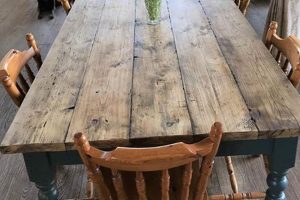
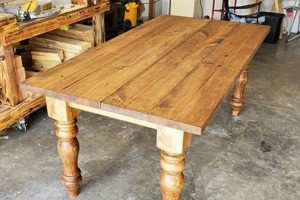
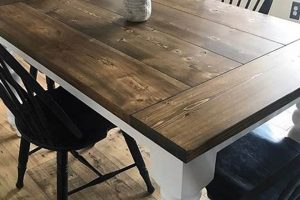
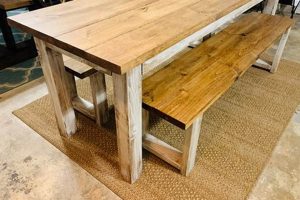
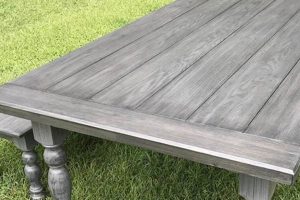
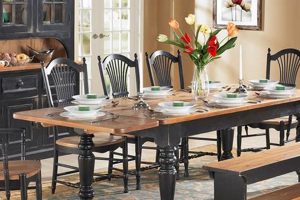
Substantial supports for rustic dining surfaces, characterized by their significant dimensions and robust construction, serve as foundational elements for furniture intended to evoke a rural aesthetic. These components, often square or rectangular in profile with considerable width and depth, provide a visually weighty base. As an illustration, consider a thick, squared timber post, unadorned and exhibiting the natural grain of the wood, firmly anchoring a plank tabletop.
The importance of these structural features lies in their contribution to both the stability and the visual character of the furniture piece. They imbue a sense of permanence and sturdiness, aligning with the design principles of practicality and durability often associated with farmhouse styles. Historically, such components reflect the availability of readily sourced, large-dimension lumber and emphasize functionality over intricate ornamentation, a hallmark of utilitarian design.
Understanding the attributes of these elements is crucial when selecting materials, choosing construction methods, and considering the overall proportions of the furniture. The following sections will explore these aspects in greater detail, examining wood species, joinery techniques, and design considerations relevant to the construction and integration of these components into a completed furniture design.
Considerations for Robust Table Supports
Selecting and implementing substantial table supports requires careful planning and execution to ensure both structural integrity and aesthetic harmony. The following tips address key factors in their design and construction.
Tip 1: Material Selection is Paramount: Hardwoods such as oak, maple, or ash are generally preferred for their strength and durability. Consider the grain pattern and color of the wood to complement the tabletop and overall design. For example, a knotty pine may be suitable for a more rustic aesthetic, while a clear maple presents a cleaner, more contemporary farmhouse style.
Tip 2: Accurate Dimensioning is Essential: Precise measurements are critical to maintain stability and visual balance. The cross-sectional dimensions must be sufficient to support the weight of the tabletop and anticipated load. A minimum thickness of 4×4 inches (actual dimension) is generally recommended for tables intended for heavy use.
Tip 3: Joinery Techniques Must Ensure Strength: Mortise and tenon joints, properly sized and executed, provide exceptional structural rigidity. Consider using through-tenons for a visible detail that showcases craftsmanship. Dowel joints, while simpler, may require additional reinforcement for heavier tables.
Tip 4: Surface Finishing Impacts Durability and Aesthetics: A durable finish, such as a polyurethane or varnish, protects the wood from moisture, scratches, and stains. The finish should be compatible with the chosen wood species and desired aesthetic. Oil-based finishes can enhance the natural grain, while water-based finishes offer greater environmental friendliness.
Tip 5: Proportion and Placement Affect Visual Harmony: The size and positioning should be proportional to the tabletop dimensions. Avoid supports that appear too small or too large for the overall table. Positioning them too close to the edge can compromise stability, while placing them too far inward can detract from the aesthetic.
Tip 6: Consider Tapering for Visual Lightness: While substantial, a slight taper on the supports can introduce a degree of visual refinement. A subtle taper towards the bottom creates the illusion of lightness without sacrificing structural integrity. Ensure the taper is uniform and consistent across all supports.
Tip 7: Addressing Wood Movement is Critical: Wood expands and contracts with changes in humidity. Employ joinery techniques that allow for this natural movement to prevent cracking or warping. Avoid rigidly fixing the tabletop directly to the supports; instead, use cleats or slotted aprons that permit expansion and contraction.
Proper selection, construction, and finishing are vital for creating robust and aesthetically pleasing table supports. Adherence to these principles ensures the longevity and visual appeal of the finished furniture piece.
The following section will explore the design considerations for integrating these elements into a cohesive farmhouse table design.
1. Material Strength

The selection of materials possessing adequate strength is a fundamental consideration in the construction of substantial supports for farmhouse tables. The robustness and longevity of the furniture are directly contingent upon the capacity of the chosen material to withstand applied loads and resist deformation over time.
- Load-Bearing Capacity
Material strength dictates the maximum weight the supports can bear without failure. Hardwoods, such as oak, maple, and walnut, are commonly favored due to their high compressive and bending strengths. Softwoods, while potentially suitable for purely decorative applications, generally lack the requisite load-bearing capacity for structural table supports. The intended use of the table, including the expected weight of items placed upon it, must be carefully considered when selecting a material with appropriate load-bearing characteristics.
- Resistance to Deformation
Even under normal loading conditions, table supports are subjected to constant stress. Materials with insufficient strength may exhibit excessive deformation, leading to instability and eventual structural failure. The modulus of elasticity, a measure of a material’s stiffness, is a critical factor in determining its resistance to deformation. Materials with a high modulus of elasticity, such as steel or certain dense hardwoods, will exhibit minimal deformation under load, maintaining the table’s stability and level surface.
- Impact Resistance
Substantial table supports are frequently subjected to impact forces, such as accidental bumps or dropped objects. Materials with high impact resistance, measured by their capacity to absorb energy without fracturing, are essential for maintaining structural integrity. Hardwoods generally exhibit superior impact resistance compared to softwoods or brittle materials, safeguarding the supports from damage under everyday use. Surface treatments and finishes can also contribute to overall impact resistance.
- Durability and Longevity
The long-term performance of substantial table supports is directly related to the durability and resistance to degradation of the chosen material. Factors such as resistance to moisture, insect infestation, and rot are crucial considerations. Wood species naturally resistant to decay, or those treated with preservatives, are often preferred. The selection of a durable material ensures the supports maintain their structural integrity and aesthetic appeal over an extended lifespan, contributing to the overall value and utility of the furniture.
The preceding considerations highlight the critical role of material strength in the design and construction of robust farmhouse table supports. Selecting materials with appropriate load-bearing capacity, resistance to deformation and impact, and inherent durability is paramount for ensuring the structural integrity, longevity, and overall value of the finished furniture piece.
2. Dimensional Stability
Dimensional stability, referring to a material’s ability to maintain its size and shape when subjected to changes in environmental conditions, particularly humidity and temperature, is critically important in the context of substantial farmhouse table supports. The large cross-sectional dimensions inherent in such components render them particularly susceptible to the effects of wood movement. Instability in these members can compromise the structural integrity of the entire table, leading to warping, cracking, and joint failure.
The cause-and-effect relationship is direct: fluctuations in ambient humidity cause wood fibers to absorb or release moisture, resulting in expansion or contraction across the grain. Because supports of this size have a larger surface area exposed to these environmental variations, the magnitude of movement is amplified. The result can be significant stress on joinery points and an uneven table surface. As an example, consider a table constructed with kiln-dried oak supports during a dry winter. If subsequently placed in a humid summer environment, the supports will absorb moisture, expand, and potentially disrupt the connections with the tabletop. This is especially problematic where traditional joinery methods like mortise and tenon are employed, as excessive expansion can strain the joint beyond its capacity.
Achieving dimensional stability in chunky farm table supports necessitates careful material selection and construction techniques. Proper kiln-drying of the lumber to an appropriate moisture content for the anticipated environment is essential. Employing joinery methods that allow for wood movement, such as slotted aprons or breadboard ends on the tabletop, can mitigate the stresses caused by dimensional changes. Additionally, the application of a durable, moisture-resistant finish can slow the rate of moisture absorption and desorption, contributing to greater stability. Ignoring the principles of dimensional stability in the design and construction of these elements will inevitably result in a compromised and short-lived furniture piece.
3. Joinery Integrity
The structural soundness of substantial supports for farmhouse tables hinges directly on the integrity of the joinery employed. These legs, due to their significant mass and the loads they bear, necessitate exceptionally robust connections to the table’s apron and tabletop. Compromised joinery undermines the stability of the entire piece, leading to racking, wobbling, and ultimately, structural failure. A direct causal relationship exists: deficient joinery will invariably result in a weakened table. As an example, consider a large oak table with thick legs connected via inadequately sized dowel joints. Over time, the repetitive stresses of everyday use can cause the dowels to loosen, leading to a noticeable wobble and a compromised seating experience.
The importance of joinery integrity is amplified by the inherent characteristics of wood, namely its susceptibility to movement with changes in humidity. The substantial dimensions of the legs mean that even slight expansion or contraction can exert considerable force on the joints. This necessitates joinery methods that not only provide initial strength but also accommodate seasonal wood movement. Time-tested techniques such as mortise and tenon, properly sized and executed, offer both mechanical strength and the ability to withstand the stresses induced by wood movement. Through-tenons, in particular, provide exceptional resistance to racking forces, while allowing for visual expression of the craftsmanship. The choice of glue is equally critical; high-quality wood glues provide superior bonding strength and resistance to moisture, ensuring the long-term integrity of the joints.
In summary, the connection between substantial supports and robust joinery is inextricable. The structural success of the table is dependent upon the selection and proper execution of joinery techniques that can withstand both static loads and the dynamic stresses induced by wood movement. The utilization of appropriately sized mortise and tenon joints, combined with high-quality adhesives, represents a practical and effective approach to ensuring the long-term stability and functionality of farmhouse tables constructed with heavy-duty supports. Neglecting this fundamental principle will inevitably result in a furniture piece that is structurally unsound and aesthetically compromised.
4. Visual Weight
The perceived mass or heaviness of an object, termed “visual weight,” is a crucial design consideration, particularly regarding substantial supports on farmhouse tables. A direct correlation exists between the physical dimensions of table supports and their apparent visual weight. Supports with larger cross-sections inherently convey a greater sense of mass, contributing significantly to the overall aesthetic impression of the furniture piece. The selection of supports with appropriate visual weight is critical for achieving balance and harmony within the design.
Inappropriate visual weight can disrupt the aesthetic balance. For instance, a delicate tabletop paired with excessively large supports can appear bottom-heavy and ungainly, while disproportionately small supports may seem inadequate and visually unstable. The principle dictates that the visual weight of the legs should be commensurate with the size and style of the tabletop and the surrounding environment. Consider a rustic farmhouse dining table with a thick, reclaimed wood top; substantial, squared supports in a similar material would visually reinforce the rustic aesthetic and convey a sense of sturdiness. Conversely, sleeker, more tapered supports might better complement a lighter, more refined tabletop, creating a more balanced and elegant design.
Achieving appropriate visual weight requires careful consideration of various design elements, including the dimensions, shape, material, and finish of the supports. Light-colored materials or those with a smooth, reflective finish tend to appear visually lighter than darker, more textured materials. The degree of ornamentation or detailing on the supports also impacts their perceived mass. The proper management of visual weight through these elements ensures the supports contribute positively to the overall aesthetic and functional integrity of the farmhouse table.
5. Surface Texture
The tactile and visual quality of the exterior layer significantly influences the aesthetic impact and perceived character of robust supports for farmhouse tables. The surface finish, whether rough-hewn or meticulously smoothed, directly contributes to the overall impression of rustic charm or refined elegance.
- Raw and Untreated Surfaces
Unprocessed timber surfaces, characterized by saw marks, knots, and natural imperfections, amplify the rustic aesthetic. This finish imparts a sense of authenticity and connection to the material’s origin. Examples include supports crafted from reclaimed barn beams, retaining the weathered texture and coloration acquired over years of exposure. The inherent variations in the wood grain and surface irregularities become integral design elements, highlighting the material’s history and natural beauty. This choice is ideally suited for environments emphasizing a rugged, utilitarian aesthetic.
- Smooth and Polished Surfaces
A smooth, polished surface presents a more refined and contemporary interpretation of the farmhouse style. This finish typically involves sanding, filling imperfections, and applying multiple coats of varnish or lacquer to achieve a flawless, reflective surface. Examples include supports crafted from hardwoods like maple or cherry, finished with a clear coat to accentuate the wood’s natural grain pattern. The smooth texture enhances the tactile experience and contributes to a sense of understated elegance. This finish is well-suited for interiors seeking a balance between rustic charm and modern sophistication.
- Textured and Distressed Surfaces
Deliberately aged or distressed surfaces offer a compromise between raw and polished finishes, imparting a sense of history and character without sacrificing smoothness. This can be achieved through various techniques, including sanding, scraping, and applying stains or glazes to mimic the effects of natural weathering. Examples include supports finished with milk paint, then lightly sanded to reveal underlying layers of color, creating a worn and textured appearance. The distressed finish adds visual interest and a tactile dimension, softening the starkness of new materials and contributing to a more inviting and comfortable atmosphere.
- Painted or Coated Surfaces
Applying paint or other coatings offers opportunities to introduce color, protect the wood, and manipulate the perceived texture of the supports. A matte paint finish can create a soft, muted appearance, while a glossy paint finish adds vibrancy and reflectivity. Examples include supports painted in a classic white or cream color, providing a clean and timeless aesthetic. Alternatively, supports can be coated with textured paints or faux finishes to simulate the appearance of stone, metal, or other materials. The selection of paint or coating depends on the desired aesthetic effect and the level of protection required for the wood.
In conclusion, the surface texture of substantial farmhouse table supports serves as a key element in defining the overall style and character of the furniture piece. From raw and untreated timber to smooth and polished hardwoods, each surface finish imparts a unique aesthetic and tactile experience. Careful consideration of the surface texture is essential for achieving a harmonious and visually appealing design that reflects the intended environment and personal preferences.
6. Style Harmony
Style harmony, in the context of substantial supports for farmhouse tables, denotes the cohesive integration of these elements with the overall design aesthetic of the furniture and the surrounding environment. The visual impact of these supports must align with, and enhance, the intended style to create a unified and aesthetically pleasing composition.
- Proportional Alignment
Maintaining proportional congruity between the supports and the tabletop, as well as the overall dimensions of the room, is fundamental. Oversized supports beneath a delicate tabletop create visual imbalance, while diminutive supports under a large, heavy tabletop appear inadequate. For instance, a thick, live-edge wood tabletop necessitates commensurately substantial supports to achieve a balanced aesthetic, whereas a thinner, more streamlined tabletop benefits from supports with a lighter visual profile.
- Material Consistency
Employing materials that complement each other enhances stylistic cohesion. The supports’ material, finish, and texture should harmonize with the tabletop and surrounding decor. Pairing reclaimed wood supports with a similarly aged and weathered tabletop reinforces a rustic aesthetic. Conversely, utilizing sleek, painted supports alongside a glossy, modern tabletop creates a more contemporary look. The choice of hardware and any decorative elements should also maintain material consistency to ensure a unified design.
- Color Palette Integration
Coordinating the color of the supports with the overall color scheme of the room contributes to style harmony. Supports can either blend seamlessly with the surroundings or serve as deliberate accent pieces. Neutral-colored supports, such as natural wood tones or muted grays, often provide a versatile backdrop that allows other elements to take center stage. Boldly colored supports can introduce visual interest and complement existing accent colors within the room. Consideration must be given to the undertones of the wood and paint colors to ensure a cohesive and balanced color palette.
- Form and Detailing Concordance
The shape and detailing of the supports should align with the overall design style. Simple, squared supports reinforce a minimalist or utilitarian aesthetic, while turned or tapered supports add a touch of elegance or sophistication. Decorative elements, such as carvings or metal accents, should be consistent with the chosen style. A farmhouse table with intricately carved supports might be well-suited for a traditional or formal dining room, while a table with clean, unadorned supports would be more appropriate for a modern or industrial setting.
These facets underscore the interconnectedness of substantial supports and style harmony. Through careful consideration of proportion, materials, color, and detailing, it is possible to seamlessly integrate robust supports into a cohesive and visually appealing design. Whether the goal is to create a rustic, modern, or traditional farmhouse table, achieving style harmony ensures that the supports contribute positively to the overall aesthetic and functional integrity of the furniture piece.
Frequently Asked Questions
The following addresses common inquiries regarding the selection, construction, and maintenance of substantial supports for farmhouse tables.
Question 1: What minimum dimensions are recommended for substantial supports?
For tables intended for regular use, a minimum dimension of 4×4 inches (actual dimension) is generally advised. This ensures adequate load-bearing capacity and stability.
Question 2: Which wood species are best suited for constructing robust table supports?
Hardwoods such as oak, maple, ash, and walnut are preferred due to their superior strength and durability. Softwoods are generally unsuitable for load-bearing supports.
Question 3: How can wood movement be addressed in the construction of substantial supports?
Employ joinery techniques that allow for expansion and contraction, such as slotted aprons or breadboard ends. Proper kiln-drying of the lumber is also essential.
Question 4: What joinery methods are most effective for attaching substantial supports to a tabletop?
Mortise and tenon joints, properly sized and executed, provide exceptional strength and stability. Through-tenons offer enhanced resistance to racking forces.
Question 5: How does the surface finish impact the durability of substantial table supports?
A durable finish, such as polyurethane or varnish, protects the wood from moisture, scratches, and stains, extending the lifespan of the supports.
Question 6: How can visual harmony be achieved when selecting table supports?
Consider the proportions, materials, color palette, and detailing of the supports in relation to the tabletop and the surrounding environment to ensure a cohesive aesthetic.
Proper selection, construction, and finishing are crucial for creating robust and aesthetically pleasing table supports. Adherence to these principles ensures the longevity and visual appeal of the finished furniture piece.
The following section will explore the best practices and potential design pitfalls associated with crafting substantial farmhouse tables.
Conclusion
The preceding exploration has illuminated the multifaceted considerations inherent in the design and construction of substantial supports for farmhouse tables. Material strength, dimensional stability, joinery integrity, visual weight, surface texture, and style harmony collectively determine the structural integrity, aesthetic appeal, and long-term viability of these critical components.
The principles outlined herein serve as a foundational resource for achieving excellence in farmhouse table design. Careful consideration of these factors is essential for crafting furniture that not only withstands the test of time but also embodies the enduring charm and functionality characteristic of the farmhouse aesthetic. Future endeavors should focus on further refining joinery techniques, exploring sustainable material options, and innovating designs that seamlessly blend tradition with contemporary sensibilities.