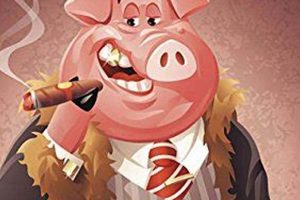
The concluding section of Orwell’s allegorical novella depicts the ultimate corruption of the revolution’s ideals. Years have passed, and the original generation of animals, those who remembered the Rebellion, have mostly died or faded away. The pigs, now indistinguishable from the humans, have consolidated their power and reversed the original tenets of Animalism.
Its significance lies in its chilling depiction of how easily revolutions can be betrayed and how power corrupts, even when initially motivated by noble intentions. It underscores the dangers of unchecked authority and the importance of vigilance in preserving freedom and equality. The historical context reflects Orwell’s critique of the Soviet Union and other totalitarian regimes.
This final segment focuses on the complete erasure of the animals’ initial hopes and dreams, highlighting themes of societal decay, the manipulation of language, and the cyclical nature of oppression. The pigs’ transformation and the animals’ inability to recognize the difference between them and humans serve as a stark warning about the fragility of revolutionary movements.
Insights for Comprehending the Text’s Conclusion
The following observations offer strategies for a deeper understanding of the concluding narrative and its implications.
Tip 1: Analyze the Transformation of the Pigs: Observe the incremental shift in the pigs’ behavior and appearance. This culminates in their physical and ideological indistinguishability from humans, revealing the ultimate betrayal of the revolution’s principles.
Tip 2: Evaluate the Manipulation of Language: Scrutinize how language is used to distort history and control the other animals. The rewriting of the Seven Commandments demonstrates the power of propaganda in maintaining dominance.
Tip 3: Recognize the Loss of Collective Memory: Note how the passage of time and the death of the original revolutionaries contribute to the animals’ inability to recall the initial aims of the Rebellion. This highlights the importance of preserving historical truth.
Tip 4: Identify the Cyclical Nature of Power: Understand how the oppression experienced under Mr. Jones is ultimately replicated by the pigs, suggesting a recurring pattern of exploitation in societal structures.
Tip 5: Examine the Symbolism of the Card Game: Consider the card game between the pigs and humans as a representation of the merging of corrupt power structures, symbolizing the final reconciliation of exploitative forces.
Tip 6: Consider the Role of Benjamin: Reflect on the character of Benjamin, whose cynical observation of events highlights the dangers of apathy and inaction in the face of injustice. His understanding, yet unwillingness to intervene significantly, provides a crucial perspective.
The insights offered aim to facilitate a comprehensive understanding of the themes of corruption, betrayal, and the cyclical nature of power, demonstrating the cautionary message conveyed through the concluding events.
By focusing on these strategic points, one can more fully appreciate the lasting impact of the narrative and its resonance with real-world sociopolitical dynamics.
1. Indistinguishable pig-human

The phrase “indistinguishable pig-human,” explicitly depicted in its final scene, represents the ultimate outcome and damning indictment of the revolution. Within this chapter, the pigs have completed their transformation, both physically and ideologically, to resemble the humans they initially overthrew. This transformation signifies the total corruption of Animalism and the complete reversal of the original revolutionary goals. The cause of this outcome is the gradual accumulation of power by the pigs, fueled by manipulation, exploitation, and the systematic rewriting of history. The animals’ inability to differentiate between the pigs and humans highlights the erasure of the principles upon which the rebellion was founded.
The “indistinguishable pig-human” state is not merely a physical resemblance; it embodies the adoption of human vices and oppressive tactics. The pigs engage in activities previously condemned, such as drinking alcohol, sleeping in beds, and trading with humans. This complete assimilation demonstrates the intoxicating influence of power and its capacity to erode even the most idealistic intentions. A parallel can be drawn to historical instances where revolutionary movements, initially driven by a desire for equality, ultimately succumb to authoritarianism, mirroring the very systems they sought to replace. This transformation echoes the rise of Stalinism after the Russian Revolution, where the Soviet state adopted oppressive measures similar to those of the Tsarist regime.
The practical significance of understanding the “indistinguishable pig-human” lies in its cautionary message about the dangers of unchecked authority and the importance of maintaining vigilance against the erosion of fundamental principles. The chapter serves as a stark reminder that revolutions can be betrayed, and that the pursuit of power, without ethical constraints, can lead to a replication of the very injustices they were meant to overcome. The narrative cautions against complacency and emphasizes the need for constant scrutiny of those in power to prevent the perversion of revolutionary ideals.
2. Forgotten Rebellion

The gradual erosion of collective memory regarding the initial Rebellion forms a cornerstone of the tragic conclusion depicted. The inability of the animals to recall the original principles upon which Animal Farm was founded directly enables the pigs’ consolidation of power and the perpetuation of inequality. The passage of time, coupled with deliberate manipulation of history, results in a profound distortion of truth.
- The Erosion of Eyewitness Accounts
As the original revolutionaries age and die, firsthand accounts of the Rebellion become increasingly scarce. This loss of direct memory weakens the animals’ ability to challenge the pigs’ revisionist narratives. For example, without living witnesses to contradict Squealer’s pronouncements, the animals accept the altered versions of events as fact, facilitating the pigs’ control over the farm’s history.
- Squealer’s Manipulation of Historical Narratives
Squealer’s role as the pigs’ propagandist is crucial in rewriting history to suit their agenda. He skillfully distorts the events of the Rebellion, subtly altering the animals’ understanding of the past. This manipulation ensures that the pigs’ actions are perceived as consistent with the original principles, even when they directly contradict them. A real-world analogy is the manipulation of historical narratives by totalitarian regimes to maintain control and suppress dissent.
- The Absence of Written Records
The lack of reliable and accessible written records of the Rebellion contributes to the animals’ vulnerability to manipulation. Without a clear documented account, the pigs can easily fabricate and disseminate false information. This underscores the importance of preserving accurate historical records to prevent the distortion of truth for political purposes. Historical societies and archives play a similar role in preserving factual accounts against revisionism.
- The Acceptance of Revised Commandments
The gradual alteration of the Seven Commandments symbolizes the animals’ acceptance of the pigs’ distorted reality. The final commandment, “All animals are equal, but some animals are more equal than others,” encapsulates the complete betrayal of the Rebellion’s initial ideals. The animals’ inability to recognize the contradiction highlights the extent to which their memories have been manipulated and their critical thinking abilities suppressed. This mirrors the acceptance of propaganda in societies where critical thought is discouraged.
The “Forgotten Rebellion” is not merely a historical event; it is a process of continuous manipulation and distortion that culminates in the animals’ complete subjugation. This erasure of memory directly facilitates the pigs’ transformation into “indistinguishable pig-human” figures, solidifying the chapter’s grim message about the fragility of revolutions and the enduring power of manipulation. The chapter serves as a stark reminder of the importance of preserving historical truth and maintaining vigilance against those who seek to distort it for their own gain.
3. Revised Commandments

The altered maxims represent a pivotal element within the concluding segment of the narrative. These changes embody the pigs’ incremental yet systematic dismantling of the original revolutionary ideals. The modifications serve as concrete evidence of the pigs’ manipulative control over language and, consequently, over the animals’ perception of reality. The revision of the commandments is not merely a superficial alteration; it signifies a fundamental shift in the power dynamic and the abandonment of the egalitarian principles upon which Animal Farm was founded. A direct causal relationship exists between the revised commandments and the pigs’ rise to absolute authority. As the animals accept these altered principles, they unwittingly surrender their capacity to resist the pigs’ exploitation.
The alteration of the commandment “No animal shall sleep in a bed” to “No animal shall sleep in a bed with sheets” exemplifies this process. This seemingly minor change allows the pigs to justify their comfortable lifestyle while maintaining the illusion of adherence to the original principles. Similarly, the adaptation of “No animal shall drink alcohol” to “No animal shall drink alcohol to excess” enables the pigs to indulge in their vices without facing censure. The ultimate culmination of this process is the reduction of all commandments to the single statement: “All animals are equal, but some animals are more equal than others.” This pronouncement encapsulates the complete subversion of the revolution’s aims, explicitly acknowledging the inherent inequality that now defines Animal Farm. Historically, similar tactics have been employed by autocratic regimes to legitimize their power and suppress dissent through the manipulation of laws and propaganda.
Understanding the role of the revised commandments offers a crucial insight into the mechanics of totalitarian control. By controlling language and rewriting history, oppressive regimes can manipulate public opinion and maintain their grip on power. The revised commandments serve as a microcosm of this process, demonstrating how seemingly minor alterations in language can have profound consequences for the distribution of power and the preservation of freedom. The narrative highlights the importance of critical thinking, vigilance, and the preservation of accurate historical records as essential safeguards against the erosion of fundamental principles. The chilling conclusion underscores the inherent vulnerability of revolutionary movements to corruption and the enduring challenge of maintaining equality in the face of ambition.
4. Squealer's Propaganda

The dissemination of propaganda, primarily orchestrated by Squealer, is instrumental in the tragic outcome depicted in the final portion of the narrative. His persuasive rhetoric and manipulative tactics are vital in shaping the animals’ perception of reality, ultimately enabling the pigs’ consolidation of power and the complete subversion of revolutionary ideals.
- Distortion of Historical Events
Squealer routinely revises the history of Animal Farm to align with the pigs’ current agenda. For example, he alters accounts of the Battle of the Cowshed to diminish Snowball’s role and exaggerate Napoleon’s. This manipulation ensures that the animals perceive the pigs as consistently acting in their best interests, even when their actions contradict the original principles of Animalism. A historical parallel can be drawn to the Soviet Union’s rewriting of history to demonize political opponents and glorify the Communist Party.
- Justification of Inequality
Squealer employs sophisticated rhetorical techniques to justify the pigs’ privileged status and the increasing disparities between them and the other animals. He argues that the pigs require extra nourishment and resources to maintain their intellectual capacity and effectively lead the farm. This rationale, while self-serving, is presented as a necessary sacrifice for the greater good of Animal Farm. This justification mirrors the rationalizations used by elite classes throughout history to defend their disproportionate access to wealth and power.
- Use of Statistics and Fabricated Data
Squealer frequently presents misleading statistics and fabricated data to create the illusion of progress and prosperity on Animal Farm. He announces inflated production figures and claims of improved living conditions, even as the animals’ rations are reduced and their workload increases. This tactic serves to mask the true state of affairs on the farm and prevent the animals from recognizing the extent of their exploitation. The use of misleading statistics is a common propaganda technique employed by governments and organizations to manipulate public opinion.
- Control of Language and Information
Squealer’s control over language and information is critical to his success as a propagandist. He strategically uses euphemisms and ambiguous terms to obfuscate the truth and deflect criticism. He also controls the flow of information, ensuring that the animals are only exposed to narratives that support the pigs’ agenda. This control over language is reminiscent of “Newspeak” in Orwell’s Nineteen Eighty-Four, where language is deliberately simplified to limit the range of thought and expression.
The effectiveness of Squealer’s propaganda directly contributes to the tragic outcome in the concluding segment. By controlling the animals’ perception of reality, he enables the pigs to consolidate their power, rewrite history, and ultimately transform Animal Farm into a mirror image of the oppressive society they initially sought to overthrow. The narrative serves as a stark warning about the dangers of unchecked propaganda and the importance of critical thinking in resisting manipulation.
5. Oppression's Cycle
The concluding segment powerfully illustrates the cyclical nature of oppression, a central theme interwoven throughout the entirety of the allegorical narrative. This recurrence of subjugation emphasizes the fragility of revolutions and the ease with which power can corrupt, leading to the replication of the very injustices the revolution sought to eradicate. This chapter depicts a grim return to, or rather a continuation of, exploitative power dynamics.
- The Replication of Tyrannical Rule
The initial rebellion was motivated by the desire to overthrow Mr. Jones’s exploitative regime. However, the pigs, through their gradual accumulation of power, replicate many of the same oppressive tactics used by their former human oppressors. This includes the imposition of long working hours, the rationing of food, and the use of violence to suppress dissent. Real-world examples of this phenomenon can be seen in various revolutions where newly established regimes adopt authoritarian measures mirroring those of the overthrown powers. This underscores the inherent challenge of breaking free from established patterns of dominance and submission.
- The Abuse of Power and Privilege
In the concluding section, the pigs enjoy a life of luxury and privilege, while the other animals toil under harsh conditions. They consume the best food, sleep in beds (despite the initial commandment), and engage in trade with humans, all of which were prohibited under the initial principles of Animalism. This abuse of power mirrors the exploitative practices of the pre-rebellion regime, demonstrating the cyclical nature of inequality. Throughout history, ruling classes have often exploited their positions of power to secure personal advantages at the expense of the general population, perpetuating cycles of oppression.
- The Manipulation of Information and Control of Narratives
Squealer’s role in manipulating information and controlling the narrative is essential to maintaining the pigs’ oppressive rule. He distorts historical events, fabricates statistics, and employs propaganda to ensure that the animals remain compliant and unaware of the true state of affairs. This control of information echoes the tactics used by totalitarian regimes to suppress dissent and maintain their grip on power. Examples include the censorship and propaganda used in Nazi Germany and the Soviet Union to control public opinion and silence opposition.
- The Acceptance of Inequality as the Norm
By the end, the animals have become so accustomed to the pigs’ oppressive rule that they accept inequality as the norm. The revised commandment, “All animals are equal, but some animals are more equal than others,” reflects this normalization of inequality. The animals are unable to recognize the extent of their exploitation and have lost the ability to challenge the pigs’ authority. This acceptance of inequality is a key factor in perpetuating the cycle of oppression, as it prevents the oppressed from effectively resisting their oppressors. This phenomenon is observed in societies where systemic inequalities become deeply entrenched and accepted as the natural order.
These aspects collectively demonstrate how the concluding section underscores the disheartening recurrence of oppression. The chapter serves as a cautionary tale, highlighting the challenges of breaking free from established patterns of dominance and the persistent threat of power corrupting those who initially sought to overthrow injustice. The narrative reinforces the need for vigilance, critical thinking, and the continuous pursuit of equality to prevent the cyclical nature of oppression from perpetuating itself.
6. Lost Animalism

The dissipation of Animalism forms the tragic core of the final chapter. This ideological abandonment is not a sudden event, but rather a gradual erosion of the initial revolutionary principles, directly leading to the dystopian reality depicted in the conclusion. The initial tenets equality, freedom from human tyranny, self-governance, and the rejection of human vices are systematically dismantled, ultimately leaving the animals in a state arguably worse than their pre-rebellion existence. The importance of “Lost Animalism” as a component lies in its function as the catalyst for the complete corruption of the farm, illustrating that even the noblest of intentions can be perverted when vigilance and adherence to fundamental principles are abandoned.
The abandonment manifests in several interconnected ways. The pigs’ adoption of human behaviors, such as walking on two legs, sleeping in beds, drinking alcohol, and engaging in trade, directly contradicts the original tenets. The systematic rewriting of the Seven Commandments to justify these actions further exemplifies the ideological decay. The other animals, largely unable to read or remember the original principles, become increasingly susceptible to Squealer’s propaganda and manipulation. This demonstrates the critical role of education and collective memory in preserving revolutionary ideals. Historical parallels exist in many revolutions where initial idealistic goals are compromised or abandoned due to internal power struggles, corruption, and the erosion of revolutionary fervor. The French Revolution, for instance, devolved into the Reign of Terror and ultimately the Napoleonic dictatorship, illustrating a similar trajectory of betrayed ideals.
Understanding the connection between this ideological demise and its consequences offers a crucial insight into the fragility of revolutionary movements. It underscores the importance of continuous vigilance, active participation, and unwavering commitment to core values in safeguarding against the perversion of revolutionary aims. The concluding events serve as a chilling reminder that revolutions are not one-time events, but rather ongoing processes that require constant effort to maintain their integrity. Ultimately, the final scenes’ depiction stands as a powerful statement on the dangers of ideological corruption and the tragic consequences of “Lost Animalism.”
7. Benjamin's cynicism

The character of Benjamin, the cynical donkey, provides a crucial perspective on the events unfolding in the final chapter. His long life and keen observation offer a stark contrast to the naivety and gullibility of the other animals. Benjamin’s persistent skepticism serves as a lens through which the reader can more critically examine the corruption and betrayal that permeates the conclusion of the narrative.
- Awareness of Injustice
Benjamin, unlike many of the other animals, possesses the intellectual capacity to understand the injustices perpetrated by the pigs. He recognizes the manipulation, the distortion of history, and the exploitation of the working animals. However, his cynicism prevents him from actively challenging the pigs’ authority. This awareness, coupled with inaction, underscores the dangers of apathy in the face of oppression. Historical parallels can be drawn to intellectuals and observers in totalitarian regimes who recognize the injustices but remain silent due to fear or resignation.
- Skepticism Towards Revolutions
Benjamin’s inherent skepticism extends to revolutions in general. He maintains that “things never had been, nor ever could be much better or much worsehunger, hardship, and disappointment being, so he said, the unalterable law of life.” This perspective suggests a deep-seated belief that power structures will inevitably lead to exploitation, regardless of the initial revolutionary aims. This viewpoint reflects a broader philosophical skepticism regarding the possibility of achieving utopian societies and the inherent limitations of human nature.
- Inability to Effect Change
Despite his understanding, Benjamin remains largely passive, offering warnings and observations but rarely taking direct action. While he briefly attempts to teach the other animals to read, his efforts are limited and ultimately unsuccessful. This inability to effect meaningful change highlights the limitations of intellectual awareness without the will or capacity to act. It also reflects the challenges faced by individuals who recognize injustice but lack the power or influence to challenge it effectively. The role of dissenting intellectuals in oppressive societies often mirrors this struggle.
- Witness to the Final Corruption
Benjamin is one of the few animals alive in the final chapter who remembers the original principles of Animalism. He witnesses the complete transformation of the pigs into indistinguishable pig-human figures, symbolizing the ultimate betrayal of the revolution. His cynicism, validated by these events, serves as a bleak commentary on the cyclical nature of power and the ease with which revolutionary ideals can be corrupted. His presence in the final scene reinforces the sense of disillusionment and hopelessness that permeates the conclusion.
Benjamin’s cynicism, therefore, functions as a critical element within the closing chapter. It provides a counterpoint to the naive optimism of the other animals and underscores the cautionary message about the dangers of unchecked power and the fragility of revolutionary ideals. His perspective forces the reader to confront the bleak reality that even with awareness and understanding, significant change may remain elusive.
Frequently Asked Questions Regarding the Concluding Events
The following questions and answers address common points of inquiry and potential misunderstandings concerning the terminal portion of the allegorical work.
Question 1: Why are the pigs and humans indistinguishable at the end?
This indistinguishability symbolizes the complete corruption of the revolution’s ideals. The pigs have adopted the behaviors and values of their former oppressors, demonstrating the cyclical nature of power and the ease with which revolutions can be betrayed.
Question 2: What is the significance of the revised commandments?
The altered maxims exemplify the pigs’ manipulative control over language and history. They demonstrate how power can be used to distort truth and justify inequality, ultimately leading to the subversion of the revolution’s initial aims.
Question 3: How does Squealer contribute to the animals’ oppression?
Squealer’s role as a propagandist is critical in shaping the animals’ perception of reality. He employs distortion, fabrication, and manipulation to maintain the pigs’ authority and prevent the animals from recognizing the extent of their exploitation.
Question 4: What is the purpose of Benjamin’s cynicism?
Benjamin’s cynicism provides a critical perspective on the events unfolding on Animal Farm. His skepticism and awareness of injustice highlight the dangers of apathy and the limitations of intellectual understanding without action.
Question 5: Why does the Rebellion ultimately fail?
The Rebellion’s failure stems from a combination of factors, including the pigs’ gradual accumulation of power, the animals’ lack of education and critical thinking skills, and the erosion of collective memory. These factors create an environment in which manipulation and oppression can thrive.
Question 6: What is the main message conveyed?
The chapter conveys a cautionary message about the dangers of unchecked power and the fragility of revolutionary ideals. It underscores the importance of vigilance, critical thinking, and the continuous pursuit of equality to prevent the perversion of revolutionary aims.
This examination has addressed common inquiries about the allegorical resolution.
A deeper understanding of the conclusion can be attained through additional exploration.
Concluding Observations on the Terminal Chapter
The preceding analysis has explored the multifaceted significance. The pigs’ transformation into indistinguishable pig-human figures, the manipulation of language through revised commandments, Squealer’s role as a propagandist, the forgotten rebellion, the cyclical nature of oppression, the loss of Animalism, and Benjamin’s cynical perspective collectively paint a bleak picture of revolutionary failure. These elements underscore the dangers of unchecked power, the fragility of ideals, and the importance of vigilance against manipulation.
The concluding section serves as a powerful reminder of the enduring challenges in achieving true equality and justice. The narrative urges a continued examination of power structures and a steadfast commitment to preserving the principles of fairness, critical thought, and historical accuracy. The text’s enduring relevance lies in its capacity to provoke reflection on the sociopolitical dynamics that shape societies and the individual responsibility in safeguarding against oppression and the betrayal of revolutionary aspirations.