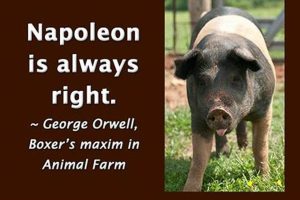
Phrases uttered by the character Boxer in George Orwell’s Animal Farm provide significant insights into the themes of the novel, particularly regarding the exploitation of the working class and the dangers of blind faith in leadership. These pronouncements, often simple and repetitive, reveal Boxer’s unwavering dedication and naive optimism, characteristics that ultimately contribute to his tragic fate. For example, his steadfast belief in the pigs’ authority is encapsulated in his famous lines, “I will work harder” and “Napoleon is always right.”
The importance of analyzing Boxer’s lines lies in their ability to illuminate the manipulative strategies employed by the ruling pigs. They expose how propaganda and the suppression of critical thinking can lead to the subjugation of an entire population. Furthermore, the historical context of Animal Farm, a satire of the Russian Revolution, imbues Boxer’s declarations with a deeper meaning. They represent the unwavering support of the proletariat for the Bolsheviks, a support that was ultimately betrayed. His unwavering loyalty, though admirable in its own right, becomes a tool used against him, highlighting the tragic consequences of unquestioning obedience.
The subsequent sections will delve further into specific utterances, examining their individual significance and their contribution to the overall narrative arc of the farm. The analysis will focus on how these statements underscore the novel’s critiques of totalitarian regimes and the importance of individual agency in resisting oppression. The character’s personal beliefs, as revealed through his verbal expressions, are central to understanding the book’s core message.
Analyzing Boxer’s Sayings in Animal Farm
Understanding the pronouncements of the character Boxer within George Orwell’s Animal Farm requires careful consideration of their context and implications. The following points offer guidance for interpreting his words and their significance within the broader narrative.
Tip 1: Recognize the Irony: Boxer’s simple statements, such as “I will work harder,” are often laden with irony. While they demonstrate his commitment, they also highlight his naivety and inability to recognize the pigs’ exploitation. Analyzing these statements requires acknowledging the gap between his intentions and the actual consequences of his actions.
Tip 2: Contextualize Within the Revolution’s Trajectory: Each declaration should be examined in relation to the evolving power dynamics on the farm. His early expressions of hope and belief contrast sharply with the increasing oppression and inequality that follow. Track how the meaning of his words changes as the pigs consolidate their control.
Tip 3: Identify Themes of Exploitation and Class Division: Boxer’s sayings directly relate to the novel’s exploration of exploitation. His unwavering labor benefits the pigs while he receives minimal reward. Focus on how his words expose the unfair distribution of resources and the suppression of the working class.
Tip 4: Analyze the Impact of Propaganda: Consider how the pigs’ propaganda shapes Boxer’s perceptions. His belief that “Napoleon is always right” demonstrates the effectiveness of manipulation and the dangers of unquestioning obedience. His sayings are not solely his own thoughts but are also influenced by the prevailing narrative crafted by the ruling class.
Tip 5: Connect to Historical Parallels: Understand the historical context of the Russian Revolution. Boxer represents the loyal proletariat who supported the Bolsheviks. His fate mirrors the betrayal of the working class and the rise of a totalitarian regime. His utterances become more resonant when viewed through this historical lens.
Tip 6: Note the Repetitive Nature: The repetitive nature of Boxer’s key phrases underscores his limited perspective and reinforces the idea of him being a simple, hardworking animal. This repetition serves to highlight his tragic flaw: his inability to question authority or recognize his own exploitation.
Tip 7: Examine the Contrast with Other Characters: Contrast Boxer’s beliefs and pronouncements with those of characters like Benjamin or Clover. These characters possess a greater awareness of the situation on the farm. This comparison highlights the consequences of blind faith versus critical thinking.
Boxer’s sayings provide a window into the novel’s central themes. Analyzing them with careful attention to context, irony, and historical parallels allows for a deeper understanding of Animal Farm‘s critique of power, exploitation, and the dangers of blind faith.
This exploration of the character’s key phrases offers a foundation for further analysis of the novel’s enduring message.
1. Unwavering Loyalty

The character’s utterances in Animal Farm are inextricably linked to the theme of unwavering loyalty. This dedication, manifested in phrases such as “I will work harder” and “Napoleon is always right,” forms a cornerstone of his identity and actions within the narrative. The cause of this devotion stems from a combination of naivety, physical strength, and a genuine desire to contribute to the betterment of the farm community. However, the effect of this loyalty is ultimately detrimental, leading to exploitation and eventual demise. This loyalty, therefore, functions as a critical component of the character, shaping his decisions and defining his tragic arc.
Consider historical parallels where unwavering loyalty to a leader or ideology has resulted in similar outcomes. The blind faith exhibited by some segments of the population during totalitarian regimes serves as a relevant example. Like Boxer, these individuals, driven by a sincere belief in the promised benefits of the system, contributed to their own oppression by uncritically accepting the directives of those in power. The character’s declarations, therefore, serve as a cautionary tale against the dangers of unthinking obedience and the importance of critical evaluation.
Understanding the connection between unwavering loyalty and these specific sayings has practical significance in analyzing power dynamics and manipulative strategies. Recognizing how appeals to loyalty can be used to exploit individuals allows for a more nuanced understanding of political rhetoric and social movements. This understanding encourages a critical examination of authority and a promotion of independent thought, mitigating the risk of falling prey to similar forms of manipulation. The tragedy underscores the importance of balancing loyalty with critical thinking to avoid exploitation.
2. Naive Optimism

Naive optimism, a persistent belief in the positive potential of circumstances despite evidence to the contrary, is a core component of the pronouncements made by the character in George Orwell’s Animal Farm. This trait, manifested in affirmations like “I will work harder” even when demonstrably overworked and underfed, reveals a fundamental disconnect between the character’s perception and the reality of his exploitation. The cause of this stems from a limited worldview shaped by physical labor and a lack of critical thinking skills. The character genuinely believes in the principles of Animalism and the leadership of the pigs, failing to recognize the corruption and self-serving motives that drive their actions. The importance of this perspective is that it allows the pigs to maintain control, as his unwavering support legitimizes their authority and discourages dissent among the other animals.
The practical consequence of such optimism is the perpetuation of the farm’s oppressive system. The character’s tireless work ethic, fueled by this unwavering belief, provides the labor necessary for the pigs to consolidate their power and indulge in luxury. His pronouncements, therefore, are not merely expressions of hope but active contributions to his own subjugation. Consider similar examples from history, such as the enthusiastic support given to charismatic but ultimately destructive leaders. The initial optimism surrounding revolutionary movements can, without critical evaluation and vigilance, be manipulated to establish even more oppressive regimes. Understanding this dynamic is essential for recognizing and resisting similar forms of exploitation in various social and political contexts.
In summary, the character’s utterances reveal the dangers of naive optimism when divorced from critical analysis and awareness of power dynamics. His unwavering faith in the revolution, despite the evidence of corruption and inequality, ultimately leads to his tragic fate. The character serves as a cautionary figure, highlighting the necessity of balancing hope with a realistic assessment of circumstances and the importance of questioning authority to prevent exploitation and maintain individual agency. The message lies in recognizing the potential for good intentions to be manipulated, reinforcing the importance of informed and critical engagement with the world.
3. Proletariat Representation

The utterances from the character in George Orwell’s Animal Farm serve as a powerful representation of the proletariat, the working class, within a revolutionary context. His simple yet profound sayings encapsulate the hopes, struggles, and ultimate exploitation of this demographic. The character embodies the idealized worker: strong, dedicated, and believing in the promise of a better future through collective effort. Understanding the character’s phrases requires recognizing this symbolic role and its implications for the novel’s critique of revolutionary ideals gone awry.
- Unquestioning Labor
The character’s repeated assertion, “I will work harder,” epitomizes the proletariat’s commitment to labor as a means of achieving social progress. This phrase, however, also highlights the inherent danger in prioritizing productivity without questioning the fairness of the system. In real-world scenarios, the emphasis on relentless work can lead to worker burnout, wage stagnation, and a disregard for basic rights. Within the context of Animal Farm, it underscores the character’s willingness to be exploited for the benefit of the ruling pigs, who appropriate the fruits of his labor.
- Blind Faith in Leadership
The characters declaration that “Napoleon is always right” represents the proletariat’s tendency to place blind faith in charismatic leaders, particularly during times of social upheaval. This unwavering belief, while initially driven by a desire for stability and direction, can be easily manipulated. Historically, many revolutionary movements have witnessed the rise of authoritarian figures who exploit the trust of their followers to consolidate power. In Animal Farm, the characters loyalty to Napoleon allows the pigs to gradually dismantle the principles of Animalism and establish a totalitarian regime.
- Suppression of Intellectualism
The lack of complex or nuanced statements from the character reflects the suppression of intellectualism within the working class. His strength lies in physical labor, not critical thinking or political analysis. This intellectual deficit makes him vulnerable to propaganda and manipulation. Throughout history, oppressive regimes have often discouraged education and critical inquiry among the working class to maintain control. Within the narrative, the character’s inability to understand the pigs’ deception contributes directly to his exploitation.
- Tragic Sacrifice
The ultimate fate of the character, sold to the glue factory despite his years of loyal service, embodies the tragic sacrifice of the proletariat. His unwavering commitment to the revolution ultimately leads to his own demise, highlighting the inherent risks of placing faith in a system that does not prioritize the well-being of its workers. This outcome resonates with historical examples of revolutionary movements that have betrayed their working-class supporters. In Animal Farm, the characters ending serves as a stark warning against the dangers of unchecked power and the importance of safeguarding the rights of the working class.
The character’s statements, viewed through the lens of proletariat representation, offer a profound critique of revolutionary ideals and the potential for exploitation within supposedly egalitarian societies. The character’s commitment, loyalty, and ultimate sacrifice underscore the novel’s message about the importance of vigilance, critical thinking, and the protection of individual rights against the encroachment of power.
4. Exploitation Indicator

The pronouncements of the character Boxer in Animal Farm function as potent indicators of exploitation, revealing the insidious ways in which the ruling pigs manipulate and control the working animals. These utterances, seemingly simple affirmations of loyalty and hard work, expose the stark disparity between the character’s contributions and the benefits he receives, thereby highlighting the systemic injustice inherent in the farm’s evolving social structure.
- Disproportionate Labor and Reward
The characters insistent declaration, “I will work harder,” exemplifies the core imbalance of labor and reward that defines exploitation. While he dedicates himself tirelessly to the farm’s projects, often pushing himself to physical exhaustion, he receives only meager rations and inadequate living conditions. In real-world contexts, this imbalance is mirrored in situations where workers are compelled to labor for long hours under harsh conditions for minimal compensation, often lacking basic protections and benefits. Within Animal Farm, this indicator exposes the pigs’ self-serving appropriation of the fruits of the animals’ collective labor, directly contravening the initial egalitarian principles of the revolution.
- Uncritical Acceptance of Authority
The phrase “Napoleon is always right” serves as a critical indicator of the exploitation stemming from uncritical acceptance of authority. The character’s unwavering belief in Napoleon’s leadership blinds him to the pigs’ growing corruption and self-interest. This dynamic finds parallels in historical instances where authoritarian regimes have maintained power through propaganda and the suppression of dissent, fostering a culture of unquestioning obedience. The result, both in Animal Farm and in real-world scenarios, is the erosion of individual agency and the perpetuation of injustice.
- Sacrifice of Personal Well-being for Collective Goals
The character’s relentless dedication to the farm, even at the expense of his own health and well-being, underscores another facet of exploitation. He prioritizes the “collective good,” as defined and manipulated by the pigs, over his personal needs, ultimately leading to his tragic demise. This self-sacrificing attitude is often exploited in various contexts, from nationalistic fervor that encourages soldiers to risk their lives for abstract ideals to corporate cultures that demand excessive dedication from employees to maximize profits. This indicator underscores the importance of balancing collective goals with individual rights and well-being.
- Dehumanization Through Simplification
The limited vocabulary and repetitive nature of the characters key statements reflect a process of dehumanization that facilitates exploitation. By reducing him to a simple, hardworking animal, the pigs are able to disregard his individual needs and concerns. This echoes historical instances where oppressed groups have been systematically dehumanized through propaganda and social ostracization, making it easier for those in power to justify their exploitation and mistreatment. In the story, this indicator serves to highlight the loss of individuality under a totalitarian regime, and therefore, the need to value the intrinsic worth of every individual.
These indicators, evident in the characters simple yet poignant pronouncements, collectively reveal the insidious nature of exploitation in Animal Farm. The tragedy serves as a cautionary tale, highlighting the importance of vigilance, critical thinking, and the protection of individual rights in the face of unchecked authority. Understanding the elements of the characters quotes enables recognition of similar patterns of exploitation in various social and political contexts.
5. Tragic Irony

The utterances within Animal Farm, particularly those associated with the character Boxer, are inextricably linked to the concept of tragic irony. Tragic irony exists when the audience or reader possesses knowledge that a character lacks, creating a dramatic contrast between the character’s intentions and the actual outcome of their actions. In the case of this character, his unwavering faith in the principles of Animalism and the leadership of Napoleon, expressed through simple declarations, stands in stark contrast to the eventual betrayal and exploitation he experiences. The reader, aware of the pigs’ growing corruption and the farm’s descent into totalitarianism, recognizes the futility of the characters efforts, creating a sense of impending doom and highlighting the tragedy of his misplaced trust. The character’s phrases are therefore rendered ironic because their intended meaning a commitment to collective progress is diametrically opposed to their actual effect: the reinforcement of the pigs oppressive regime. The characters belief in Napoleon is a critical example here.
The importance of tragic irony as a component of the character’s verbal expressions lies in its capacity to amplify the novel’s critique of totalitarianism and the dangers of blind faith. The characters repeated pledge to “work harder,” while seemingly virtuous, becomes a symbol of his own exploitation, underscoring the pigs’ manipulation of the working class. Consider, for example, historical parallels such as the Soviet Union under Stalin, where fervent belief in the communist ideology often led to the persecution and demise of loyal citizens. In both cases, the tragic irony stems from the individuals’ unwavering commitment to a system that ultimately betrays them. The tragic irony underscores the contrast between the character’s perception and reality.
Understanding the connection between the concept and the character has practical significance for analyzing power dynamics and manipulative rhetoric in various social and political contexts. Recognizing how appeals to loyalty and collective goals can be used to mask exploitation allows for a more critical assessment of political discourse and social movements. By identifying the elements of tragic ironythe characters limited knowledge, the audiences superior understanding, and the resulting gap between intention and outcomeit becomes possible to deconstruct manipulative narratives and promote critical thinking. This understanding can prevent repeating the characters tragic destiny of being a pawn in an unfair system.
Frequently Asked Questions Regarding Boxer’s Utterances in Animal Farm
The following addresses common inquiries and misconceptions surrounding the pronouncements of the character in George Orwell’s Animal Farm. The aim is to provide clarity and context for understanding the significance of the characters verbal expressions within the broader themes of the novel.
Question 1: What is the primary significance of the phrase “I will work harder”?
The phrase encapsulates the character’s unwavering dedication to the collective good of Animal Farm. However, it also symbolizes the exploitation of the working class, as his relentless labor disproportionately benefits the pigs while offering minimal personal gain. This phrase highlights the dangers of prioritizing relentless work ethic without questioning the system’s fairness.
Question 2: How does the statement “Napoleon is always right” contribute to the novel’s themes?
This statement exemplifies the dangers of blind faith in leadership and the suppression of critical thinking. The character’s unwavering belief in Napoleon enables the pigs’ gradual consolidation of power and the erosion of Animalism’s original principles. It illustrates how propaganda and manipulation can lead to the subjugation of an entire population.
Question 3: Does the character’s vocabulary reflect his social status within the farm?
Yes, the character’s limited vocabulary and simple language reflect his position as a member of the working class and the suppression of intellectualism within the farm. His strength lies in physical labor rather than critical analysis, making him vulnerable to manipulation and propaganda. This aspect emphasizes the importance of education and intellectual development in resisting oppression.
Question 4: How do the characters sayings relate to the historical context of the Russian Revolution?
The pronouncements serve as allegorical representations of the proletariat’s support for the Bolsheviks during the Russian Revolution. His unwavering loyalty and dedication mirror the initial enthusiasm of the working class, while his eventual betrayal reflects the disillusionment and exploitation that followed the revolution’s descent into totalitarianism.
Question 5: In what way does the character embody tragic irony?
The character’s adherence to Animalism’s ideals is tragically ironic, as his actions inadvertently contribute to his own exploitation. His belief that his hard work will benefit the collective good is ultimately undermined by the pigs’ corruption, leading to his demise. The importance lies in recognizing the gap between his intention and the true consequences of his efforts.
Question 6: What is the overall message conveyed through the characters phrases?
The utterances collectively convey a cautionary message about the dangers of unchecked power, blind faith, and the exploitation of the working class. They emphasize the importance of vigilance, critical thinking, and the protection of individual rights in preventing the recurrence of similar tragedies. It is a call to protect the defenseless against manipulative authorities.
In summary, analyzing the characters phrases provides a valuable insight into the themes of exploitation, power, and the subversion of revolutionary ideals that underlie George Orwell’s Animal Farm. They help to underscore the necessity of safeguarding individual freedoms, maintaining a skeptical awareness of authority, and being a participant, not simply an observer.
The subsequent sections will focus on identifying specific instances where the character’s verbal expressions directly influence the unfolding events on Animal Farm.
Boxer Quotes from Animal Farm
The analysis of the character’s sayings within George Orwell’s Animal Farm reveals their multifaceted significance. These phrases, seemingly simple pronouncements of loyalty and dedication, function as powerful indicators of exploitation, naive optimism, and the subversion of revolutionary ideals. They underscore the dangers of blind faith in leadership and the importance of critical thinking in preventing the abuse of power. The phrases expose the tragic irony inherent in the character’s unwavering commitment to a system that ultimately betrays him, and highlight the role that the proletariat frequently fulfill in revolutions.
The examination of the character’s key phrases provides valuable insight into the dynamics of power, manipulation, and social injustice. Continued reflection on these elements is essential for recognizing and resisting similar patterns in contemporary society, and preventing an unjust, cruel world. The character’s fate serves as a persistent reminder of the need for vigilance and critical engagement in safeguarding individual rights against oppressive forces. These aspects should be observed carefully.