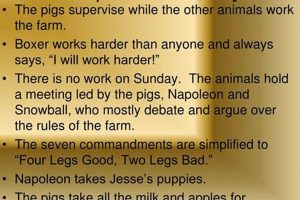
The specific word choices and linguistic techniques employed within Orwell’s allegorical novella are vital to understanding its thematic concerns. Examples include loaded terms that manipulate the animals, slogans used for propaganda, and euphemisms that mask cruel realities. Understanding these words and phrases is paramount to grasping the narrative’s satirical commentary on totalitarian regimes. For instance, the constant repetition of “Four legs good, two legs bad” serves as a simplistic, easily digestible piece of propaganda designed to control the sheep.
A comprehensive understanding of the linguistic landscape within the text allows for a deeper appreciation of its political message. It illuminates how language can be weaponized for manipulation, control, and the distortion of truth. The historical context of the novella, reflecting the rise of Stalinism, makes the precise deployment of manipulative language all the more relevant. By analyzing the vocabulary, readers gain insight into the techniques used to perpetuate power and suppress dissent, not just in the fictional setting, but also in real-world scenarios.
This analysis of linguistic elements forms the bedrock for understanding the novel’s broader themes of power, corruption, and social injustice. Subsequent sections will delve into specific examples and the impact these linguistic choices have on character development, plot progression, and the overall message of the narrative.
The following guidance focuses on enhancing comprehension of the significant terminology within Orwell’s work, aiding in a more profound understanding of its themes and characters.
Tip 1: Identify Loaded Language: Pay close attention to words and phrases that carry strong emotional connotations. For example, the term “Comrade” is used to foster a sense of unity and equality, while simultaneously masking the growing inequalities.
Tip 2: Analyze Euphemisms: Recognize instances where unpleasant realities are disguised with milder terms. “Readjustment of rations,” for instance, masks the starvation imposed on the animals.
Tip 3: Track Propaganda Slogans: Note the repetitive use of simplistic slogans designed to control the masses. “Four legs good, two legs bad” illustrates how complex ideas are reduced to easily digestible, albeit inaccurate, statements.
Tip 4: Examine Shifts in Meaning: Observe how the meaning of words changes over time to suit the pigs’ agenda. The word “voluntary” being applied to labor illustrates this manipulation.
Tip 5: Decipher Irony: Be aware of instances where words are used in a manner contrary to their intended meaning. The renaming of “Animal Farm” to “Manor Farm” at the end highlights the complete reversal of the revolution’s ideals.
Tip 6: Consider the Context: Always interpret the employed vocabulary within the broader historical context of the Russian Revolution and the rise of totalitarianism. This contextualization significantly enriches the analysis.
Tip 7: Explore the Use of Animal Imagery: Analyze how the descriptions of different animals and their behaviours contribute to the symbolic representation of various human characteristics and societal roles.
These guidelines, when diligently applied, provide a robust framework for unraveling the complexities of the narrative and appreciating the author’s masterful use of language to convey profound political messages.
Applying this knowledge will allow for a more complete appreciation of the themes explored throughout the work.
1. Propaganda terminology

The effective dissemination of propaganda hinges upon carefully selected vocabulary, a technique prominently displayed within Animal Farm. The vocabulary employed by the pigs isn’t merely descriptive; it’s strategically designed to manipulate, control, and ultimately, maintain their power. This strategic vocabulary is thus intrinsic to the novel’s broader linguistic landscape.
The use of slogans, like “Four legs good, two legs bad,” provides a simplistic, easily digestible message, preventing critical thought and fostering unquestioning obedience. Euphemisms, such as referring to reduced food rations as “readjustments,” mask the true extent of the animals’ suffering and prevent rebellion. The constant use of “Comrade,” though initially intended to foster equality, becomes a tool for creating a false sense of unity while the pigs consolidate power. The alteration of the Seven Commandments exemplifies a blatant manipulation of language to justify the pigs’ actions. This linguistic manipulation is not unique to the fictional world. Historical parallels exist in the Soviet Union and other totalitarian regimes, where language was routinely distorted to serve political ends. Understanding the precise propaganda terminology used in Animal Farm reveals the mechanics of manipulation and the importance of critical thought.
The ability to identify and analyze propaganda terminology within Animal Farm enables a more profound understanding of the novel’s core themes. Recognizing the techniques of linguistic manipulation present in the narrative allows readers to apply these insights to contemporary issues, fostering critical evaluation of information and safeguarding against the dangers of unquestioning acceptance of authority. The examination of vocabulary within this context is essential for understanding the novel’s warning about the abuse of power and the erosion of truth through language.
2. Euphemistic language

Euphemistic language constitutes a critical element within the broader Animal Farm vocabulary. It serves as a primary tool by which the ruling pigs distort reality, obscure unfavorable truths, and maintain control over the animal population. The employment of euphemisms is not merely incidental; it is a deliberate strategy to mask the brutality and injustice that gradually define the pigs’ regime. The practical significance of recognizing this element lies in understanding how language can be weaponized to manipulate perception and suppress dissent.
Consider the phrase “readjustment of rations” as a prime example. Rather than acknowledging the decreasing food supply and increasing hunger experienced by the animals, the pigs employ this euphemism to soften the impact of their policies. This linguistic maneuver serves a dual purpose: it minimizes the perceived severity of the situation and prevents the animals from recognizing the pigs’ incompetence or self-serving behavior. Similarly, the phrase “voluntary labor” is used to describe the grueling and often unpaid work demanded of the animals, obscuring the exploitative nature of their forced contributions. Historical parallels can be drawn to totalitarian regimes that routinely employed euphemisms to conceal their oppressive practices. For instance, during the Stalinist era, political purges were often framed as “administrative measures” or “necessary corrections,” effectively sanitizing the reality of mass executions and imprisonment.
Understanding the role of euphemistic language within Animal Farm provides a crucial insight into the mechanisms of political manipulation and control. By recognizing how language can be used to obscure reality and maintain power, readers can develop a more critical perspective on political discourse and resist the seductive allure of deceptive rhetoric. The challenge lies in remaining vigilant and discerning, consistently questioning the underlying motives and implications of the language used by those in authority. In essence, a thorough understanding of euphemistic language within the text underscores the novel’s enduring relevance as a cautionary tale about the dangers of unchecked power and the importance of linguistic awareness.
3. Loaded nouns

Within the comprehensive “animal farm vocabulary,” the presence and function of loaded nouns are noteworthy. These nouns, imbued with significant emotional or ideological weight, serve as subtle yet potent tools for shaping perception and reinforcing the narrative’s allegorical intent. Their usage directly affects how readers and, more importantly, the animals within the story understand the unfolding events and power dynamics. The initial, seemingly innocuous adoption of terms like “Comrade” establishes a sense of egalitarianism and shared purpose. However, as the narrative progresses, the meaning of “Comrade” becomes increasingly hollow, used to mask the stark inequalities and exploitative practices implemented by the pigs. This transformation exemplifies the power of loaded nouns to manipulate and control.
The noun “Animalism,” representing the foundational principles of the revolution, is similarly loaded. It initially embodies ideals of freedom and self-governance. Yet, the pigs gradually distort its tenets to justify their authoritarian rule. The constant invocation of “Animalism” provides a veneer of legitimacy for their actions, obscuring the reality of their betrayal of the original principles. Real-world historical parallels exist in the use of terms like “democracy” or “freedom” by authoritarian regimes to legitimize oppressive practices. The strategic deployment of loaded nouns within “animal farm vocabulary” underscores the broader theme of how language can be weaponized to maintain control and suppress dissent. The very names given to the farms reflect this concept. “Manor Farm,” under Mr. Jones, connotes ownership and exploitation. The shift to “Animal Farm” signals freedom, but the ultimate return to “Manor Farm” highlights the cyclical nature of power and oppression.
In summary, loaded nouns function as essential components of the broader “animal farm vocabulary,” contributing significantly to the novel’s satirical commentary on totalitarianism. Recognizing their strategic usage is critical for understanding how language can be manipulated to control thought and behavior. The impact of such nouns stems from their ability to evoke strong emotions and ideological associations, effectively shaping the narrative’s reception and reinforcing its cautionary message about the dangers of unchecked power. Successfully interpreting “Animal Farm” requires acute awareness of the subtle yet pervasive influence of these deliberately loaded terms.
4. Animal symbolism

Animal symbolism is intrinsically interwoven with “animal farm vocabulary” in Orwell’s allegorical work. The deliberate choice of specific animals to represent certain human traits and social classes is amplified and clarified through the vocabulary associated with each animal. The following points illustrate this connection.
- Pigs as the Corrupt Elite
The pigs, embodying the manipulative and power-hungry political class, are consistently associated with vocabulary connoting intelligence, authority, and privilege. Terms like “leadership,” “management,” and sophisticated vocabulary relating to organization and control are exclusively applied to them. This linguistic association reinforces their dominance and legitimizes their increasingly authoritarian actions. The animal’s symbolic representation, thus, is solidified by the language surrounding it.
- Sheep as the Unthinking Masses
The sheep, symbolizing the easily swayed populace, are linked to repetitive, simplistic phrases and a limited “animal farm vocabulary.” Their constant bleating of slogans like “Four legs good, two legs bad” demonstrates their lack of independent thought and susceptibility to propaganda. This limited vocabulary not only defines their intellectual capacity within the narrative but also underscores their function as a tool for the pigs to maintain control. The symbol is enhanced by this diminished language capability.
- Boxer the Horse as the Loyal Worker
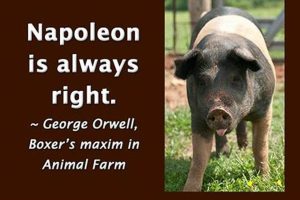
Boxer, the hardworking and loyal horse, is characterized by a limited but earnest vocabulary focused on diligence and dedication. His repeated maxims, “I will work harder” and “Napoleon is always right,” showcase his unwavering commitment to the revolution, even as it deteriorates. This restricted vocabulary, coupled with his physical strength, highlights the exploitation of the working class by those in power. The equine symbol is thus reinforced by his labor-centric language.
- Benjamin the Donkey as the Cynical Intellectual
Benjamin, the cynical donkey, possesses a more sophisticated “animal farm vocabulary” than most other animals but rarely uses it to challenge the pigs directly. His quiet skepticism and awareness of the pigs’ manipulation are reflected in his sardonic observations and understated pronouncements. This contrast between his understanding and his inaction highlights the role of intellectuals in allowing totalitarian regimes to flourish. The asinine symbol gains complexity through this blend of understanding and quiet despair.
In conclusion, the animal symbolism within Orwell’s narrative is not merely a superficial device; it is deeply intertwined with the specific vocabulary assigned to each animal. This linguistic association reinforces their symbolic representation, thereby amplifying the novel’s critique of power, manipulation, and social inequality. A comprehensive understanding of “animal farm vocabulary” therefore necessitates a thorough analysis of how specific linguistic choices contribute to the development and reinforcement of the animal symbolism at the heart of the narrative.
5. Irony markers

The presence of irony within Animal Farm is not merely stylistic; it is deeply intertwined with the novels vocabulary. Specific words, phrases, and linguistic patterns serve as irony markers, signaling a discrepancy between surface meaning and underlying reality. These irony markers are crucial components of the overall “animal farm vocabulary,” enabling the reader to recognize the satirical critique of totalitarian regimes. The effectiveness of Orwell’s satire depends heavily on the readers ability to identify these markers, revealing the corruption and betrayal of the revolution’s initial ideals. The constant use of the term “Comrade” becomes increasingly ironic as the pigs establish a hierarchical society based on exploitation. Initially intended to signify equality, it morphs into a hollow term, masking the stark inequalities that emerge.
Another example lies in the pigs’ manipulation of language to justify their actions. The alteration of the Seven Commandments, such as adding “but some animals are more equal than others” to the commandment “All animals are equal,” exemplifies a deliberate use of language to invert meaning. This alteration is a clear marker of irony, exposing the pigs’ hypocrisy and betrayal of the revolution’s principles. The animals’ inability to recognize the irony in these alterations underscores their lack of critical thinking and susceptibility to manipulation. The renaming of Animal Farm back to Manor Farm at the conclusion of the narrative presents a final, potent example of linguistic irony. This action signifies the complete reversal of the revolution, with the pigs becoming indistinguishable from the human oppressors they initially sought to overthrow. The name, therefore, becomes an irony marker, encapsulating the failure of the revolution.
In conclusion, the strategic placement and manipulation of irony markers within the “animal farm vocabulary” are fundamental to the novel’s satirical impact. Identifying these markers allows for a deeper understanding of the political critique and exposes the dangers of unchecked power and linguistic manipulation. The ability to recognize these linguistic cues is essential for fully appreciating the complexity and enduring relevance of Orwell’s work. The careful analysis of these markers allows for a heightened awareness of how language can be twisted to conceal truth and perpetuate injustice.
Frequently Asked Questions
The following section addresses common queries and misconceptions concerning the linguistic elements and terminology employed within George Orwell’s Animal Farm. Understanding these aspects is crucial for a comprehensive interpretation of the novel’s themes and allegorical significance.
Question 1: What is meant by “animal farm vocabulary” in the context of literary analysis?
The term “animal farm vocabulary” refers to the specific word choices, linguistic techniques, and patterns of speech utilized by George Orwell in Animal Farm. It encompasses not only individual word meanings but also the strategic deployment of language to convey themes of power, manipulation, and social injustice.
Question 2: Why is the vocabulary of “Animal Farm” considered important?
The vocabulary is integral to understanding the novel’s allegorical critique of totalitarian regimes. Orwell strategically employs language to illustrate how power can be maintained through manipulation, propaganda, and the distortion of truth. Analyzing the vocabulary allows for a deeper appreciation of the novel’s political message.
Question 3: How does propaganda manifest itself through the vocabulary within “Animal Farm”?
Propaganda is evident in the simplistic slogans, repetitive phrases, and loaded terms used to control the animals’ thoughts and actions. Examples include “Four legs good, two legs bad” and the constant invocation of “Animalism” to justify the pigs’ actions. These linguistic techniques prevent critical thought and promote unquestioning obedience.
Question 4: What role do euphemisms play in the “animal farm vocabulary”?
Euphemisms serve to mask unpleasant realities and maintain the pigs’ authority. Phrases such as “readjustment of rations” conceal the starvation imposed on the animals, while “voluntary labor” obscures the exploitative nature of their forced contributions. These euphemisms distort the animals’ perception of their circumstances.
Question 5: How is animal symbolism reflected in the language used within “Animal Farm”?
The vocabulary associated with each animal reinforces its symbolic representation. The pigs are linked to language of leadership and control, while the sheep are characterized by simple slogans and repetitive phrases. Boxer’s vocabulary is focused on hard work and obedience, highlighting the exploitation of the working class.
Question 6: In what ways does irony contribute to the meaning of “Animal Farm” through its vocabulary?
Irony is a pervasive element, signaled by specific words and phrases that reveal a discrepancy between surface meaning and underlying reality. The alteration of the Seven Commandments and the renaming of the farm back to “Manor Farm” are key examples of linguistic irony, exposing the pigs’ hypocrisy and the failure of the revolution.
In summary, the meticulous analysis of “animal farm vocabulary” provides crucial insights into the novel’s political allegory and its enduring relevance as a cautionary tale about the dangers of unchecked power and the manipulation of language.
The following sections will explore the lasting impact of this particular vocabulary.
Conclusion
The preceding analysis has underscored the critical importance of “animal farm vocabulary” in understanding Orwell’s enduring allegory. Through careful examination of propaganda terminology, euphemistic language, loaded nouns, animal symbolism, and irony markers, the text’s satirical critique of totalitarianism is rendered more acute. Each linguistic element serves to amplify the novel’s themes of power, manipulation, and social injustice, demonstrating how language can be wielded to control thought and distort reality.
Given the power to control and subvert reality through strategically utilized vocabulary, the reader is prompted to remain vigilant, critically evaluating the language employed by those in positions of authority. A rigorous examination of linguistic choices promotes intellectual independence and a resistance to manipulation, ensuring that the lessons of Animal Farm remain relevant in contemporary society. The ability to discern and dissect such language is vital for safeguarding against the erosion of truth and the perpetuation of injustice.