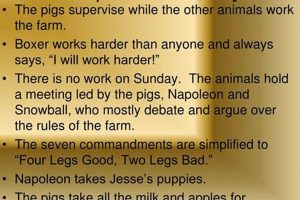
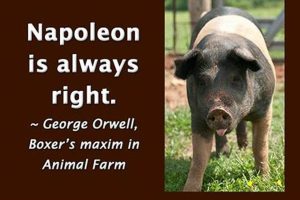
Chapter 9 of George Orwell’s Animal Farm provides an account of the farm’s deteriorating conditions and the increasing disparity between the ruling pigs and the other animals. This portion of the narrative details the manipulation of information, the worsening food shortages, and the relentless exploitation of the working animals, particularly Boxer, as the pigs consolidate their power. A detailed recounting of this chapter highlights the pigs’ gradual transformation into a totalitarian regime.
Understanding the details presented within this chapter is essential for grasping the overarching themes of the novel, including the corruption of revolutionary ideals and the dangers of unchecked authority. It illuminates the cynical manipulation of language and the gradual erosion of the principles upon which the farm was founded. Analysis of this specific part of the story offers a crucial lens through which to examine the historical context of the Russian Revolution and the subsequent rise of Stalinism.
Therefore, an exploration of the events, characters, and symbolism contained within this segment allows for a complete comprehension of Orwell’s critique of power, propaganda, and social injustice, and their impact on the naive populace. Such an exploration reveals a deeper understanding of the author’s warnings against totalitarian tendencies.
Approaching Chapter 9 of Animal Farm
Analyzing Chapter 9 requires a focused approach to fully comprehend its significance within the narrative. Careful consideration of specific elements will enhance understanding.
Tip 1: Focus on Boxer’s Decline: Boxer’s physical deterioration is central. Analyze how his unwavering loyalty is exploited by the pigs for their benefit, disregarding his well-being.
Tip 2: Examine the Rationing System: Note the subtle changes in food distribution. While Squealer announces increased rations, the other animals experience genuine hunger, highlighting the manipulation of statistics.
Tip 3: Investigate the Re-Writing of History: Pay attention to how Squealer manipulates the animals’ memories of past events, particularly regarding Snowball, to solidify Napoleon’s authority.
Tip 4: Consider the Significance of Moses: Moses’ return and his stories of Sugarcandy Mountain serve as a distraction for the animals, diverting their attention from the harsh realities of their present lives.
Tip 5: Analyze the Pigs’ Use of Propaganda: Identify specific examples of propaganda, such as songs and slogans, used to maintain control and suppress dissent.
Tip 6: Note the Sale of Boxer: Boxer’s sale to the glue factory is a crucial turning point. It reveals the pigs’ complete betrayal of the original principles of Animalism and their utter disregard for the other animals.
Tip 7: Study the Pigs’ Increasing Humanization: Observe how the pigs increasingly adopt human behaviors, such as wearing clothes and drinking alcohol, blurring the lines between oppressor and oppressed.
Effective study of Chapter 9 necessitates careful observation of the details and how these details contribute to the broader themes of the novel: the corruption of power, the manipulation of language, and the betrayal of revolutionary ideals.
Applying these strategies allows for a more in-depth understanding of this critical juncture in the storyline.
1. Boxer's failing strength
In the context of Chapter 9, Boxer’s weakening physical state serves as a central element, epitomizing the exploitation and ultimate betrayal that define the pigs’ rule on Animal Farm. His relentless dedication and unwavering belief in the revolution are systematically abused, leading to his tragic downfall and highlighting the chapter’s themes of manipulation and broken promises.
- Exploitation of Labor
Boxer’s tireless work ethic becomes a tool for the pigs’ enrichment. Despite his declining health, he is continually pushed to perform increasingly demanding tasks, exemplified by his tireless efforts to rebuild the windmill. This mirrors the exploitation of the proletariat in totalitarian regimes, where individual well-being is sacrificed for the collective goals dictated by the ruling class.
- Erosion of Idealism
Boxer’s simple faith in the revolution and his unwavering commitment to the slogan “I will work harder” blind him to the pigs’ corruption. His inability to recognize the disparity between the original ideals and the farm’s current state demonstrates how propaganda and blind loyalty can be used to maintain control. This directly contributes to the chapter’s broader critique of the perversion of revolutionary principles.
- Symbolism of Physical Decline
Boxer’s deteriorating condition visually represents the overall decay of Animal Farm’s initial utopian vision. His weakening body mirrors the farm’s descent into poverty and oppression, serving as a stark reminder of the broken promises and unrealized dreams of the revolution. His failing health is a direct consequence of the pigs’ mismanagement and selfish pursuit of power.
- Ultimate Betrayal
The pigs’ decision to sell Boxer to the glue factory marks the ultimate betrayal of the animals’ trust and solidarity. His sale demonstrates their complete disregard for the principles of Animalism and their willingness to sacrifice even their most loyal supporters for personal gain. This act epitomizes the chapter’s overarching theme of corruption and the triumph of self-interest over collective welfare.
The tragic arc of Boxer’s decline in Chapter 9 encapsulates the chapter’s primary themes: the exploitation of the working class, the corruption of revolutionary ideals, and the ultimate betrayal of the animal’s collective trust. His story serves as a powerful indictment of totalitarian regimes and the dangers of unchecked power.
2. Ration manipulation evident
Within the narrative of Animal Farm Chapter 9, the manipulation of rations is a critical component, directly illustrating the pigs’ consolidation of power and the deterioration of living conditions for the other animals. This manipulation is not merely a matter of resource scarcity, but a deliberate strategy employed to maintain control through unequal distribution and the dissemination of false information.
- Control Through Scarcity
The pigs systematically reduce the rations allocated to the working animals, creating a state of constant hunger and dependence. This scarcity effectively limits the animals’ physical strength and ability to resist the pigs’ authority. The less food the animals receive, the more reliant they become on the pigs for their survival, solidifying the pigs’ control over their lives.
- Propaganda and False Accounting
Squealer, acting as the pigs’ mouthpiece, consistently announces increases in rations, even as the animals experience the opposite. He uses complex figures and manipulated statistics to create the illusion of abundance, misleading the animals into believing that conditions are improving. This echoes historical instances of governments using propaganda to conceal economic hardships and maintain public support.
- Disproportionate Distribution
While the other animals endure reduced rations, the pigs live in relative comfort, consuming the best food and resources available on the farm. This unequal distribution highlights the pigs’ self-serving nature and their betrayal of the original principles of Animalism, where all animals were supposed to be equal. The pigs’ privileged position reinforces their dominance and creates a clear hierarchy within the farm.
- Suppression of Dissent
Any murmurs of discontent regarding the rationing system are quickly silenced by the pigs through threats and intimidation. The animals are discouraged from questioning the official narrative, and those who dare to speak out risk punishment. This suppression of dissent prevents the animals from organizing resistance and challenges the pigs’ authority, reinforcing their control over the farm’s resources and the animals’ lives.
The manipulation of rations in Chapter 9 is not simply a logistical issue; it’s a calculated tactic used by the pigs to maintain their dominance. It highlights the insidious nature of totalitarian control, where information is distorted, resources are unequally distributed, and dissent is suppressed to ensure the ruling class’s continued power. This element of the chapter is critical for understanding Orwell’s critique of power dynamics and the dangers of unchecked authority.
3. Moses' return significant

Moses’ reappearance in Chapter 9 constitutes a significant element within the chapter’s overall narrative. His presence directly impacts the animals’ psychological state, serving as a mechanism for control and distraction. The timing of his return, coinciding with the farm’s most dire conditions, is particularly noteworthy. He resurfaces when the animals are overworked, underfed, and disillusioned, offering them solace through tales of Sugarcandy Mountain, a fantastical afterlife where life is easy and plentiful. This contrasts starkly with the harsh reality of Animal Farm, providing a form of escapism that undermines any potential rebellion or critical thinking.
The pigs, initially opposed to Moses’ influence, now tolerate, and even encourage, his presence. This tolerance is strategic. By allowing Moses to spread his message of a blissful afterlife, the pigs effectively suppress the animals’ desire for a better life in the present. Moses’ return, therefore, does not offer genuine hope but rather serves as a tool to maintain the pigs’ power. Historically, such tactics have been employed by oppressive regimes, using religion or other forms of escapism to pacify populations and prevent them from challenging the status quo. This is analogous to rulers promising rewards in the afterlife to distract from injustices in the present, a strategy observed throughout history in various political and social contexts.
In summary, the significance of Moses’ return in Chapter 9 is not in any genuine benefit to the animals, but rather in his function as a distraction and a tool of control wielded by the pigs. His tales of Sugarcandy Mountain provide a false hope that discourages the animals from addressing the very real problems they face, thus reinforcing the pigs’ authority. Understanding this manipulation is crucial to grasping the chapter’s thematic focus on the perversion of revolutionary ideals and the insidious nature of totalitarian rule.
4. Sale to glue factory

The sale of Boxer to the glue factory constitutes a pivotal and devastating event within the ninth chapter of Animal Farm. This event is intrinsically linked to a comprehensive recapitulation of that chapter, serving as the ultimate symbol of the pigs’ betrayal of the revolution’s original ideals. It represents not merely the loss of a single animal, but the complete abandonment of the principles of Animalism and the establishment of a totalitarian regime built on exploitation and deceit.
Boxer, a tireless and loyal workhorse, embodies the proletariat. His unwavering dedication and strength are instrumental in building the farm and furthering the pigs’ agenda. As his body deteriorates from years of overwork and inadequate care, the pigs, rather than providing him with the promised retirement, sell him to a knacker for profit. This act reveals the pigs’ complete disregard for the welfare of the animals and their willingness to sacrifice even the most devoted for personal gain. This resonates with historical examples where ruling elites have exploited the working class, discarding them when their usefulness is exhausted, mirroring the treatment of laborers during the Industrial Revolution and in various totalitarian regimes.
The sale of Boxer to the glue factory serves as the ultimate illustration of the chapter’s themes: the corruption of power, the manipulation of language, and the betrayal of trust. It highlights the distance between the initial utopian vision of Animal Farm and the grim reality of its totalitarian present. Understanding this event is crucial for comprehending the overall message of Animal Farm: a warning against the dangers of unchecked authority and the importance of vigilance in preserving revolutionary ideals. The tragedy of Boxer serves as a cautionary tale about the vulnerability of the naive and the ruthlessness of those who seek to control them.
5. Pigs' human corruption
The progression of the pigs’ behavior in Animal Farm, particularly evident in Chapter 9, is central to understanding the novel’s critique of power. Their gradual adoption of human traits signifies a complete reversal of the revolution’s initial goals and underlines the chapter’s themes of exploitation, betrayal, and the insidious nature of totalitarianism.
- Adoption of Human Habits and Luxuries
Chapter 9 witnesses the pigs engaging in activities previously condemned as human vices. They consume alcohol, sleep in beds, and wear clothesactions initially declared forbidden under Animalism. This appropriation of human luxuries symbolizes their detachment from the other animals and their consolidation of power. Such behavior creates a visible divide, reinforcing the pigs’ superior status and undermining the principle of equality. In historical parallels, ruling classes often adopt lifestyles distinct from the masses, emphasizing their privilege and control over resources.
- Manipulation of Language and Propaganda
The pigs utilize language to distort reality and maintain their control, a practice that intensifies in Chapter 9. Squealer’s manipulation of statistics to create the illusion of prosperity, even as the other animals starve, exemplifies this. The alteration of the Seven Commandments further demonstrates their disregard for the original principles. This manipulation parallels historical instances of totalitarian regimes using propaganda to rewrite history and control public perception, silencing dissent and preserving their authority.
- Economic Exploitation and Trade
The pigs’ engagement in trade with neighboring farms, a practice initially forbidden, becomes increasingly prominent in Chapter 9. This commercial activity enriches the pigs while the other animals endure hardship. The sale of Boxer to the glue factory for profit is the most egregious example of this exploitation, demonstrating the pigs’ willingness to sacrifice even their most loyal supporters for financial gain. Historically, exploitative economic practices have been a hallmark of oppressive regimes, prioritizing the enrichment of the ruling class at the expense of the general population.
- Suppression of Dissent and Violence
The pigs’ increasing reliance on violence and intimidation to suppress any form of dissent becomes more pronounced in Chapter 9. The dogs, acting as their enforcers, maintain order through fear, preventing any challenge to their authority. This suppression echoes the tactics used by totalitarian regimes to silence opposition and maintain control through fear and repression. The absence of true freedom of speech or assembly allows the pigs to solidify their power and prevent any meaningful resistance.
The pigs’ descent into human corruption, clearly manifested in Chapter 9, serves as a stark warning against the dangers of unchecked power. Their gradual adoption of human traits, coupled with their manipulation, exploitation, and suppression, transforms Animal Farm from a utopian dream into a dystopian reality. This transformation underscores the chapter’s central message: that power corrupts, and those who seize it are prone to betray the very ideals they initially espoused.
Frequently Asked Questions Regarding Chapter 9 of Animal Farm
This section addresses common inquiries concerning Chapter 9 of George Orwell’s Animal Farm, providing detailed explanations and contextual insights.
Question 1: What is the significance of Boxer’s sale in Chapter 9?
Boxer’s sale to the glue factory represents the ultimate betrayal of the animals’ trust and the complete corruption of the revolution’s initial ideals. It demonstrates the pigs’ willingness to sacrifice even their most loyal supporters for personal gain, underscoring the chapter’s themes of exploitation and moral decay.
Question 2: How does the manipulation of rations contribute to the chapter’s themes?
The manipulation of rations serves as a tool for control. By systematically reducing the animals’ food supply while simultaneously announcing increases through propaganda, the pigs maintain power through dependence and misinformation. This illustrates the chapter’s focus on inequality and the distortion of truth.
Question 3: Why is Moses’ return to Animal Farm significant in Chapter 9?
Moses’ return offers a false sense of hope to the overworked and underfed animals, diverting their attention from the harsh realities of their present lives. His tales of Sugarcandy Mountain provide a form of escapism that discourages critical thinking and rebellion, thus serving the pigs’ interests.
Question 4: In what ways do the pigs’ actions in Chapter 9 reflect human corruption?
The pigs’ adoption of human habits, such as sleeping in beds, drinking alcohol, and wearing clothes, symbolizes their detachment from the other animals and their consolidation of power. These actions signify a complete reversal of the revolution’s initial principles of equality and self-sufficiency.
Question 5: What role does Squealer play in Chapter 9?
Squealer functions as the pigs’ propagandist, manipulating language and statistics to deceive the other animals. He disseminates false information about rations, rewrites history to favor Napoleon, and justifies the pigs’ actions, thereby maintaining their control and suppressing dissent.
Question 6: How does Chapter 9 contribute to the overall message of Animal Farm?
Chapter 9 provides a critical depiction of the farm’s descent into totalitarianism, illustrating the consequences of unchecked power, the dangers of propaganda, and the betrayal of revolutionary ideals. It serves as a cautionary tale about the importance of vigilance and the need to safeguard against corruption.
Chapter 9’s significance lies in its depiction of the complete corruption of revolutionary ideals, emphasizing the dangers of unchecked authority and the power of propaganda to maintain control. The events of this chapter underscore the importance of critical thinking and vigilance in preserving freedom and equality.
Considering these points facilitates a deeper appreciation for the novel’s enduring relevance. Further reading of Orwell’s other works provides additional context and insights.
Concluding Remarks on Chapter 9 of Animal Farm
This exploration of Animal Farm Chapter 9 has highlighted the chapter’s critical role in illustrating the complete subversion of the revolution’s initial goals. The decline of Boxer, the manipulation of rations, the opportunistic return of Moses, the ultimate betrayal of Boxer’s sale, and the overt humanization of the pigs collectively underscore the corruption of power. The analysis emphasizes the techniques employed to maintain control: propaganda, distortion of history, and the exploitation of the vulnerable.
Comprehension of the details presented in Animal Farm ch 9 summary facilitates a deeper understanding of Orwell’s cautionary narrative. The events of this chapter serve as a potent reminder of the fragility of revolutionary ideals and the perpetual need for vigilance against those who would seek to manipulate and control. Its lessons remain relevant, urging continued critical examination of power structures and societal dynamics to prevent the recurrence of similar dystopian outcomes.