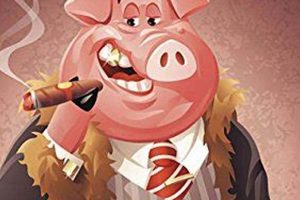
Chapter 2 of George Orwell’s allegorical novella depicts the immediate aftermath of the animals’ successful rebellion against Mr. Jones. It details the organization of the farm under the pigs’ leadership and their initial attempts to establish a society based on the principles of Animalism. A key event is the renaming of Manor Farm to Animal Farm, symbolizing a decisive break from the prior human-dominated regime. The chapter also introduces the core tenets of Animalism, summarized in the Seven Commandments, meant to guide their new social order.
The significance of this portion of the narrative lies in its portrayal of revolutionary ideals and their practical application. The chapter highlights the challenges inherent in establishing a utopian society, particularly the potential for power imbalances and the distortion of original principles. The formation of Animalism and the early attempts at collective farming underscore the themes of social equality and the animals’ aspirations for a better life, free from human oppression. Historically, the events mirror the Russian Revolution and the subsequent rise of totalitarian regimes under the guise of socialist ideals.
The subsequent analysis will delve into specific aspects of this segment, exploring the roles of key characters, the implementation of Animalism, and the foreshadowing of future conflicts that arise from the pigs’ growing dominance and the gradual erosion of the revolution’s initial promise.
Analyzing Key Aspects
This section provides guidance on interpreting crucial elements present in the specified chapter of Orwell’s work.
Tip 1: Identify the Core Principles of Animalism: Examine the Seven Commandments closely. These precepts are the foundation of the animals’ new society and reflect their initial aspirations for equality and freedom. Note any ambiguity or potential for misinterpretation within these commandments, as they will become central to the narrative’s later developments.
Tip 2: Analyze the Roles of the Key Characters: Pay close attention to the actions and motivations of the pigs, particularly Napoleon and Snowball. Their differing approaches to leadership and their emerging power dynamics foreshadow future conflicts. Also, observe how characters like Boxer and Clover embody the working class and their unwavering loyalty to the revolution.
Tip 3: Evaluate the Significance of the Farm’s Renaming: The transition from Manor Farm to Animal Farm is a symbolic act. Consider what this act represents in terms of breaking with the past and establishing a new identity. The name change encapsulates the animals’ desire for self-determination and their rejection of human control.
Tip 4: Assess the Initial Attempts at Collective Farming: Observe the successes and failures of the animals’ efforts to organize and manage the farm themselves. The challenges they face in coordinating labor and distributing resources highlight the complexities of implementing a socialist system.
Tip 5: Consider the Foreshadowing of Future Conflicts: Look for subtle clues that hint at the power struggles and betrayals to come. The seeds of corruption and inequality are sown early in the revolution, and careful observation will reveal the potential for the pigs’ eventual dominance.
Tip 6: Connect to Historical Context: Relate the events and themes to the Russian Revolution and the rise of totalitarianism. Understanding the historical parallels enhances the interpretation of Orwell’s allegorical narrative.
Understanding these aspects allows for a deeper appreciation of the chapter’s narrative significance and its contribution to the overall themes of the novella. Careful analysis reveals the complexities of revolutionary ideals and the potential for their corruption.
The subsequent analysis will address other critical aspects within this chapter, solidifying a full grasp of the chapters role in the narrative.
1. Revolution's immediate aftermath

The immediate aftermath of the revolution depicted in the specified chapter establishes the foundation upon which the new society of Animal Farm is built. It is within this period of transition and upheaval that the initial power structures, ideologies, and social dynamics are formed, significantly shaping the subsequent events and themes of the narrative.
- Establishment of New Leadership
Following the expulsion of Mr. Jones, the pigs quickly assume leadership roles, demonstrating an early aptitude for organization and planning. They position themselves as the intellectual leaders of the farm, delegating tasks and guiding the other animals. This sets the stage for their eventual dominance and highlights the inherent potential for hierarchy even within a supposedly egalitarian system. A real-world parallel can be drawn to the Bolsheviks’ rise to power following the Russian Revolution, where a vanguard party led the transition from Tsarist rule to a communist state.
- Formulation of Animalism
The Seven Commandments of Animalism are created and prominently displayed. These commandments encapsulate the animals’ ideals of equality, freedom, and opposition to human oppression. They are intended to serve as the guiding principles of the new society. However, the simplicity of the commandments also makes them vulnerable to manipulation and reinterpretation, as evidenced later in the story. Similar to revolutionary manifestos, Animalism provides a framework for social change, but its implementation is fraught with challenges and contradictions.
- Initial Attempts at Collective Labor
The animals enthusiastically undertake the task of harvesting the crops, demonstrating their commitment to collective labor and self-sufficiency. This initial period of unity and cooperation reflects the optimism and idealism that often accompany revolutionary movements. However, the chapter also hints at potential challenges, such as the animals’ varying levels of intelligence and their differing contributions to the collective effort. The early successes in communal farming mirror the initial gains often experienced in socialist experiments, before the inherent inefficiencies and power struggles begin to undermine them.
- Symbolic Acts of Transformation
The renaming of Manor Farm to Animal Farm is a powerful symbolic act, representing a complete break from the past and the establishment of a new identity. The burning of the farm implements, whips, and other symbols of human oppression further reinforces this sense of liberation and self-determination. These acts of symbolic destruction and reconstruction are common features of revolutionary periods, signifying the overthrow of the old order and the creation of a new one.
These facets of the revolution’s immediate aftermath are crucial for understanding the subsequent developments in the specified chapter. The establishment of the pigs’ leadership, the formulation of Animalism, the initial attempts at collective labor, and the symbolic acts of transformation all contribute to the formation of the new society and set the stage for the conflicts and betrayals that ultimately undermine the animals’ revolutionary ideals. The seeds of corruption and inequality are sown in this initial period, highlighting the inherent challenges of implementing utopian visions in practice.
2. Animalism's Seven Commandments

The genesis and initial propagation of Animalism’s Seven Commandments within the specified chapter are foundational to understanding the trajectory of the animals’ revolution. These commandments serve as the ideological bedrock of the newly established Animal Farm, outlining the principles that purportedly govern their utopian society. Their existence and subsequent manipulation are intrinsically linked to the chapter’s core themes of power, equality, and the corruption of revolutionary ideals.
- Foundation of Equality
The commandments, in their original form, are designed to ensure equality among all animals and to prevent the re-establishment of human-like exploitation. For example, “Whatever goes upon two legs is an enemy” establishes a clear division between the animals and their former oppressors. This commandment aims to eliminate any hierarchical structures reminiscent of the previous regime. Similarly, the principle of “All animals are equal” serves as the cornerstone of the new social order. Historically, revolutionary movements often establish similar declarations of equality to dismantle existing power structures. However, the ambiguity and potential for subjective interpretation inherent in such broad statements create vulnerabilities that are exploited later in the narrative.
- Prohibition of Human Habits
Several commandments explicitly forbid the adoption of human habits, such as wearing clothes, sleeping in beds, drinking alcohol, and killing other animals. These prohibitions are intended to prevent the animals from becoming like their former oppressors and to maintain their distinct identity. For example, the commandment against sleeping in beds is later amended to “No animal shall sleep in a bed with sheets,” demonstrating the gradual erosion of the original principles. In societal contexts, such prohibitions reflect an attempt to establish a new cultural identity by rejecting the practices of the old regime. However, the selective enforcement and reinterpretation of these rules illustrate the hypocrisy and corruption that can emerge within revolutionary movements.
- Declaration of Animal Superiority
The final commandment, “All animals are equal,” is seemingly straightforward. However, it is ultimately subverted by the pigs, who secretly add “but some animals are more equal than others.” This amendment reveals the pigs’ gradual consolidation of power and their willingness to betray the founding principles of Animalism. The manipulation of this commandment highlights the dangers of unchecked authority and the distortion of revolutionary ideals for personal gain. Historically, similar betrayals have occurred in numerous revolutions, where initial promises of equality are abandoned in favor of authoritarian rule.
- Narrative Foreshadowing
The establishment of the Seven Commandments in this chapter serves as a crucial element of foreshadowing. It allows the reader to anticipate the eventual corruption of the revolution and the pigs’ gradual assumption of absolute power. The commandments provide a clear benchmark against which the animals’ subsequent actions can be measured, revealing the extent to which the original principles have been compromised. The existence of these formalized rules provides a structure for the eventual subversion of the system from within. They are not simply guidelines; they are a written record of the original intent, making their alteration all the more impactful.
The Seven Commandments, therefore, are not merely abstract principles. They are active elements that directly influence the events in the specified chapter and the entirety of the narrative, highlighting the complex interplay between ideology, power, and the inevitable corruption of revolutionary ideals. The specified chapter introduces these principles, establishing their initial importance before demonstrating how they can be manipulated to create a new form of oppression, mirroring historical trends.
3. Pigs' emergent leadership
The emergence of the pigs as leaders in the specified chapter is a pivotal development that establishes the power dynamics within Animal Farm. Their ascendance is not through democratic election but rather a gradual assumption of control predicated on perceived intellectual superiority. This initial power grab sets in motion a chain of events that ultimately leads to the corruption of the revolution and the establishment of a totalitarian regime. The pigs’ ability to read and write becomes a significant advantage, allowing them to organize and manipulate the other animals. This echoes historical situations where a small, educated elite seized control following revolutionary upheaval, often exploiting the less informed populace.
The pigs’ manipulation of the Seven Commandments exemplifies the practical consequences of their emergent leadership. Initially, the commandments are intended to guarantee equality and prevent exploitation. However, the pigs subtly alter these rules to suit their own needs, demonstrating their growing dominance and disregard for the original principles of Animalism. For instance, their eventual claim that “All animals are equal, but some animals are more equal than others” directly contradicts the fundamental ideals of the revolution. Real-world examples include the Soviet Union under Stalin, where the Communist Party elite enjoyed privileges unavailable to ordinary citizens, thus betraying the principles of equality espoused by Marxism.
The pigs’ emergent leadership in the specified chapter is not merely a narrative detail; it is the catalyst for the story’s central themes of power, corruption, and the failure of utopian ideals. Understanding this connection is crucial for grasping Orwell’s commentary on the Russian Revolution and the dangers of unchecked authority. While the specific events are fictional, the underlying dynamics reflect the historical realities of many revolutions, emphasizing the importance of vigilance and the protection of individual rights against those who seek to consolidate power.
4. Farm renaming significance

The renaming of Manor Farm to Animal Farm in chapter 2 represents a symbolic rupture with the past, a deliberate erasure of the previous human-dominated regime, and the formal inauguration of a new social order governed by the animals themselves. This act of renaming is not a mere cosmetic change; it is a fundamental component of the chapter, signifying the animals’ assertion of ownership and autonomy. The rejection of the name “Manor Farm” signifies a rejection of the entire system of human control, exploitation, and oppression that it represents. The adoption of “Animal Farm,” on the other hand, is meant to encapsulate the idea of a community owned and operated by animals, for animals, based on the principles of Animalism. In a broader historical context, revolutionary name changes are common, as they signify a definitive break from the old regime and the establishment of a new identity. For example, the renaming of St. Petersburg to Leningrad in the Soviet Union reflected the communist government’s commitment to erasing Tsarist symbols and establishing a proletarian identity.
The significance of the farm renaming extends beyond mere symbolism. It creates a tangible representation of the animals’ revolutionary success and serves as a rallying point for their collective identity. The name “Animal Farm” becomes a constant reminder of their newfound freedom and equality. The very sound of the name reinforces the idea that the farm now belongs to them and that they are capable of self-governance. The effectiveness of this symbolic act hinges on its universal adoption and acceptance among the animals. However, as the story progresses, the gradual erosion of the revolution’s ideals and the pigs’ manipulation of language undermine the intended meaning of “Animal Farm,” highlighting the inherent fragility of revolutionary symbols when confronted with power and corruption. The symbolic power of a name can be seen in the historical renaming of Rhodesia to Zimbabwe, representing the end of colonial rule and the establishment of an independent African nation.
In conclusion, the renaming of the farm in the specified chapter is not simply a superficial detail but a critical element that encapsulates the essence of the animal revolution and foreshadows its subsequent trajectory. It underscores the animals’ initial aspirations for self-determination, the challenges inherent in implementing utopian ideals, and the ever-present threat of power corruption. This symbolic act, while initially empowering, ultimately becomes another tool that is used by the pigs to solidify their control, illustrating the complex relationship between language, power, and the fate of revolutions.
5. Early collaborative efforts

Within “animal farm ch 2,” early collaborative efforts are crucial to the initial success and subsequent narrative arc of the animal revolution. The animals’ enthusiastic participation in the harvest immediately following the expulsion of Mr. Jones demonstrates their commitment to the ideals of Animalism and the concept of self-governance. This initial cooperation showcases the animals’ capacity to organize and work together efficiently, achieving a greater output than they did under human management. This success serves as tangible proof of the revolution’s potential, bolstering morale and solidifying their belief in a brighter, more equitable future. However, these collaborative efforts are not without their nuances. The chapter subtly reveals differences in individual contributions and abilities, hinting at the potential for future inequalities and power imbalances. For instance, the pigs’ intellectual capacity allows them to direct and organize the labor, while Boxer’s immense strength is essential for physical tasks. This division of labor, though seemingly benign at first, lays the foundation for the pigs’ eventual dominance and the exploitation of the other animals’ labor. Historical examples of successful revolutions often begin with periods of intense collaboration and unity, as seen in the early days of the Russian Revolution, where peasants and workers united to overthrow the Tsarist regime. However, these periods of unity are often short-lived, as internal power struggles and ideological differences emerge, leading to conflict and ultimately, the betrayal of the revolution’s initial goals.
The initial period of collaborative effort highlights the importance of shared goals and a common enemy in fostering unity. The animals’ shared experience of oppression under Mr. Jones provides a strong impetus for cooperation and a willingness to contribute to the collective good. This sense of shared purpose allows them to overcome their individual differences and work together towards a common goal. However, as the memory of Mr. Jones fades and the animals become accustomed to their new lives, the initial sense of unity begins to erode. The pigs, leveraging their intellectual advantage, gradually consolidate power and manipulate the other animals, undermining the principles of equality and mutual cooperation. This transition highlights the challenges of maintaining revolutionary ideals over time and the importance of establishing safeguards against the abuse of power. Practically, understanding the dynamics of early collaborative efforts in “animal farm ch 2” allows for a more nuanced interpretation of the subsequent events. It underscores the importance of recognizing the subtle ways in which power can be accumulated and the potential for revolutionary ideals to be distorted for personal gain.
In summary, the early collaborative efforts depicted in “animal farm ch 2” are both a testament to the power of collective action and a cautionary tale about the fragility of revolutionary ideals. While the initial cooperation demonstrates the animals’ capacity for self-governance, it also foreshadows the potential for future inequalities and the abuse of power. The chapter serves as a microcosm of larger historical trends, highlighting the challenges of maintaining revolutionary fervor over time and the importance of establishing safeguards against corruption and the erosion of democratic principles. Recognizing the inherent tensions within these early collaborative efforts is crucial for understanding the subsequent events and the ultimate failure of the animal revolution. The narrative suggests that while a common enemy can unite disparate groups, the long-term success of any revolution depends on the ability to maintain a commitment to its founding principles and to prevent the concentration of power in the hands of a select few.
6. Snowball vs. Napoleon
The initial seeds of the Snowball vs. Napoleon conflict are subtly sown in the specified chapter. While an overt power struggle is not yet present, the foundational differences in their leadership styles and strategic visions begin to emerge. Snowball’s proactive engagement in organizing committees and promoting literacy contrasts with Napoleon’s focus on consolidating his influence through less overt means. This divergence, though not explicitly adversarial in the early stages, establishes the basis for their later antagonism. The chapter, therefore, serves as a crucial prelude to the open conflict, setting the stage for the ideological and strategic battle that defines much of the subsequent narrative. This dynamic mirrors real-world political scenarios where initial disagreements over policy and vision evolve into intense power struggles between rival factions, often leading to division and instability.
The animals’ differing responses to Snowball and Napoleon further illuminate the significance of their contrasting approaches. Snowball’s enthusiasm and eloquence inspire the animals, fostering a sense of collective empowerment and intellectual growth. Napoleon, on the other hand, cultivates a quieter form of loyalty, possibly appealing to the animals’ more basic needs and instincts. This disparity in their appeal reflects the broader theme of leadership and its impact on societal cohesion. Furthermore, the animals’ inability to discern the true motivations of Snowball and Napoleon underscores the dangers of uncritical acceptance of authority. Similar dynamics are observable in various historical contexts, where charismatic leaders exploit popular sentiment while others manipulate events behind the scenes, ultimately shaping the course of history to suit their own agendas.
The nascent conflict between Snowball and Napoleon in the specified chapter is not merely a personal rivalry; it is a microcosm of the broader struggle for power that defines the novella. Understanding the subtle beginnings of this conflict is essential for grasping the subsequent events and the ultimate failure of the animal revolution. The chapter foreshadows the eventual triumph of Napoleon and the tragic consequences of his totalitarian rule. The ability to recognize these initial signs of discord and power imbalance is crucial for critically analyzing historical and political events, ensuring a more informed understanding of the dynamics that shape societies and determine their fate.
7. Initial societal framework

The initial societal framework established in the specified chapter of Animal Farm is foundational to understanding the novella’s subsequent development. This framework, built on the principles of Animalism, outlines the structure and values intended to govern the newly liberated farm. The framework’s composition, its implementation, and its inherent flaws provide crucial insight into the trajectory of the animal revolution and the ultimate corruption of its ideals.
- The Seven Commandments as Constitution
The Seven Commandments serve as the de facto constitution of Animal Farm, outlining the fundamental rights and responsibilities of its citizens. They codify the core tenets of Animalism, prohibiting exploitation and promoting equality among all animals. These commandments are prominently displayed and intended to guide all aspects of farm life. Historically, newly formed societies often create written constitutions or declarations of principles to establish a legal and moral foundation for their governance. The United States Constitution, for instance, outlined the structure and powers of the federal government and enshrined individual rights. In Animal Farm, the manipulation and eventual alteration of the Seven Commandments by the pigs represents a gradual erosion of the societal framework and the betrayal of the revolution’s original promises.
- Emergence of a Hierarchical Structure
Despite the stated commitment to equality, the specified chapter subtly reveals the emergence of a hierarchical structure, with the pigs assuming leadership roles due to their perceived intelligence and organizational abilities. This initial division of labor, while seemingly pragmatic, lays the groundwork for the pigs’ eventual dominance and exploitation of the other animals. In many historical revolutions, the initial egalitarian ideals are often undermined by the emergence of a ruling elite, who consolidate power and create new forms of inequality. The Bolsheviks in Russia, for instance, initially promised a classless society but ultimately established a one-party state controlled by a privileged few. The hierarchical structure that begins to form in Animal Farm is a precursor to the totalitarian regime that Napoleon later establishes.
- The Role of Education and Propaganda
The pigs’ ability to read and write gives them a significant advantage in shaping the societal framework and controlling information. They are able to interpret and manipulate the Seven Commandments, as well as disseminate propaganda to maintain their authority. This highlights the importance of education and access to information in any society. In totalitarian regimes, the control of information is essential for maintaining power and suppressing dissent. The Nazi regime in Germany, for instance, used propaganda extensively to indoctrinate the population and justify its policies. In Animal Farm, the pigs’ control over education and propaganda allows them to rewrite history and manipulate the other animals’ understanding of events.
- The Economy and Distribution of Resources
The initial societal framework also includes the implementation of a collective economy, where the animals work together to produce food and other resources. The goal is to create a system of equitable distribution, where everyone receives what they need. However, even in the specified chapter, there are hints of potential problems, such as the pigs reserving certain privileges for themselves. In many socialist and communist experiments, the ideal of a centrally planned economy often fails due to inefficiencies, corruption, and lack of incentives. The eventual collapse of the Soviet Union is a prime example. In Animal Farm, the pigs’ gradual control over the economy and their preferential treatment foreshadow the increasing inequality and exploitation that ultimately lead to the farm’s ruin.
These elements of the initial societal framework, as established in the specified chapter, are interconnected and crucial to the narrative’s progression. The Seven Commandments provide the ideological foundation, while the emergence of a hierarchical structure and the pigs’ control over education and the economy undermine the revolution’s original ideals. The specified chapter, therefore, is not merely a description of a new society but a foreshadowing of its inevitable downfall, highlighting the challenges of maintaining revolutionary ideals and the ever-present threat of power corruption. Understanding this initial framework is crucial for interpreting the subsequent events and the overall message of Animal Farm.
Frequently Asked Questions About “Animal Farm Ch 2”
This section addresses common inquiries regarding the key themes, events, and character dynamics presented in the specified chapter of George Orwell’s Animal Farm.
Question 1: What is the primary significance of the renaming of Manor Farm to Animal Farm in this chapter?
The renaming symbolizes a complete break from the past, representing the animals’ rejection of human oppression and their aspiration for self-governance. It signifies the establishment of a new social order based on the principles of Animalism.
Question 2: What role do the Seven Commandments play in shaping the initial societal structure of Animal Farm?
The Seven Commandments serve as the foundational laws of Animal Farm, outlining the core principles of Animalism and establishing a framework for equality and cooperation among the animals. They are intended to prevent the re-establishment of human-like exploitation.
Question 3: How does the specified chapter foreshadow the eventual corruption of the animal revolution?
The chapter subtly introduces elements of inequality and power imbalance, particularly through the pigs’ assumption of leadership roles. These early signs foreshadow the gradual erosion of the revolution’s ideals and the pigs’ eventual totalitarian rule.
Question 4: What are the key differences between Snowball and Napoleon as depicted in this chapter, and how do these differences contribute to the narrative?
Snowball exhibits a more proactive and democratic leadership style, emphasizing education and collective decision-making. Napoleon, on the other hand, displays a more authoritarian approach, prioritizing control and consolidating his own power. These contrasting styles establish the basis for their future conflict and the division of the farm.
Question 5: What is the significance of the animals’ initial success in the harvest after the revolution?
The successful harvest demonstrates the animals’ capacity for self-governance and collective labor, boosting morale and reinforcing their belief in the revolution’s potential. However, it also masks underlying tensions and inequalities that will later surface.
Question 6: How does “animal farm ch 2” reflect historical events or political themes?
The chapter mirrors the early stages of revolutionary movements, particularly the Russian Revolution, highlighting the challenges of implementing utopian ideals and the potential for power struggles and corruption to undermine initial aspirations.
Understanding these key elements within the specified chapter provides a foundation for comprehending the complex themes and tragic trajectory of Animal Farm.
This comprehensive knowledge of this chapter prepares for deeper dives into specific character analyses and symbolic interpretations of key events.
Conclusion
The exploration of “animal farm ch 2” reveals its critical role in establishing the foundation for the allegorical narrative. Key elements such as the renaming of the farm, the formulation of the Seven Commandments, the emergence of the pigs’ leadership, the initial collaborative efforts, and the nascent conflict between Snowball and Napoleon all contribute to the chapter’s thematic significance. The analysis has highlighted the chapter’s foreshadowing of the revolution’s corruption and the eventual triumph of totalitarian rule.
Continued reflection on the dynamics presented in “animal farm ch 2” is crucial for understanding the broader commentary on power, ideology, and the inherent challenges of utopian aspirations. Further scholarly examination of this chapter will undoubtedly yield even deeper insights into Orwell’s enduring critique of revolutionary movements and the potential for their perversion.