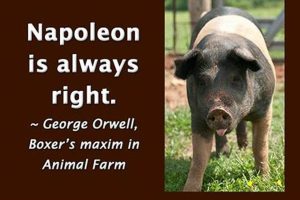
George Orwell’s allegorical novella presents a stark depiction of revolutionary ideals corrupted into totalitarian control. The narrative employs symbolic representations of historical figures and events to illustrate how manipulative communication techniques can be used to establish and maintain power within a society. For instance, the character of Squealer skillfully uses rhetoric and misinformation to justify the pigs’ actions and control the other animals’ perceptions of reality.
The exploitation of language and dissemination of biased information serve as crucial tools for maintaining dominance in the farm’s hierarchical structure. This method allows the ruling class to control information, suppress dissent, and rewrite history to suit their agenda, mirroring similar patterns observed in various political regimes throughout history. The control of the narrative ensures the perpetuation of the leaderships authority, benefiting them at the expense of the general populace.
Consequently, the novel serves as a powerful critique of the ways in which these techniques are employed to manipulate public opinion and consolidate power. Understanding the mechanics of distorted communication, as portrayed in the narrative, provides valuable insights into the preservation of individual autonomy and critical thinking within any social or political context.
Analyzing Narrative Deception
The following points offer insights into recognizing and understanding manipulative techniques within a narrative context, particularly those mirroring societal and political control dynamics.
Tip 1: Identify the Source of Information. Assess who controls the narrative and what biases they might possess. For example, Squealer’s pronouncements always serve the pigs’ interests, distorting facts to maintain their authority.
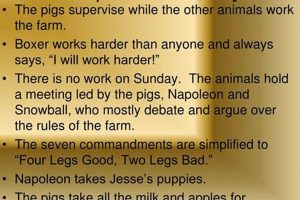
Tip 2: Scrutinize Rhetorical Devices. Pay attention to the use of emotionally charged language, appeals to authority, and simplification of complex issues. Slogans like “Four legs good, two legs bad” exemplify oversimplification designed to discourage critical thought.
Tip 3: Examine the Suppression of Dissent. Note any instances where opposing viewpoints are silenced or marginalized. The expulsion of Snowball demonstrates the elimination of alternative perspectives to consolidate power.
Tip 4: Observe the Manipulation of History. Be aware of how the past is rewritten or reinterpreted to legitimize current actions or policies. The constant revisions to the Seven Commandments illustrate the distortion of historical truths to serve the ruling party.
Tip 5: Recognize the Creation of Scapegoats. Identify individuals or groups blamed for societal problems to divert attention from the actual source of the issues. Snowball’s demonization serves as a classic scapegoat strategy.
Tip 6: Analyze the Use of Fear and Propaganda. Note how fear is employed to maintain control and encourage obedience. Threats of Mr. Jones’ return are used to keep the animals compliant.
Tip 7: Understand the Power of Repetition. Observe how repeated messages, even if false, can become accepted as truth through constant reinforcement. The repeated mantra of “All animals are equal, but some animals are more equal than others” exemplifies this technique.
By applying these considerations, one can develop a more discerning understanding of how manipulative communication strategies function within a narrative, reflecting real-world societal dynamics.
This analytical approach enhances comprehension of the complexities surrounding distorted information and its impact on societal structures.
1. Deceptive Language

Deceptive language, a central element in the dynamics of “Animal Farm,” facilitates the manipulation and control of the animal population. By distorting truth and obscuring motives, the ruling pigs maintain their authority and exploit the other animals. This technique mirrors real-world applications of distorted communication within systems of control.
- Euphemisms and Misleading Terminology
Euphemisms soften harsh realities, masking the true nature of oppressive actions. In “Animal Farm,” terms like “readjustment” of rations conceal the fact that the other animals are starving while the pigs prosper. This is similar to governments using sanitized language to describe military actions or economic policies with adverse consequences.
- Distortion of Facts and Statistics
Manipulating data to create a false narrative is a powerful tool. Squealer routinely presents skewed statistics to convince the animals that production is increasing and life is improving, even when evidence suggests otherwise. Real-world examples include selectively presenting economic data to support a particular political agenda.
- Use of Ambiguity and Vagueness
Ambiguous language allows for multiple interpretations, shielding the speaker from accountability. The pigs’ subtle alterations to the Seven Commandments, such as adding “but some animals are more equal than others,” exploit vagueness to justify their privileges. Corporations often use vague wording in contracts to protect themselves from legal challenges.
- Appeals to Emotion and Propaganda Slogans
Emotionally charged language bypasses rational thought, inciting specific reactions and promoting groupthink. The slogan “Four legs good, two legs bad” simplifies complex issues, discouraging critical analysis and fostering blind obedience. Political campaigns commonly employ emotional appeals and catchy slogans to sway public opinion.
The deceptive language employed by the pigs underscores how manipulation can systematically erode truth and empower those who control communication channels. Through the distortion of language, an initially altruistic vision can become a tool for oppression, demonstrating the critical importance of vigilance and critical thinking in all social and political contexts.
2. Controlled Information

Controlled information is a cornerstone of the manipulative tactics employed on the farm. The pigs, seizing authority, systematically restrict access to knowledge and manipulate the flow of communication to maintain their dominance. This active management of what the other animals know directly shapes their perception of reality, making them susceptible to the pigs’ agenda and hindering any potential resistance. The effect of controlled information is the animals growing dependence on the pigs to interpret the world for them.
The suppression of accurate records and the biased presentation of events are key methods used to control information. Squealer consistently revises historical accounts and distorts production figures to paint a favorable picture of the pigs’ leadership, even when conditions worsen for the other animals. This mirrors tactics used by authoritarian regimes to rewrite history and suppress dissent. For instance, North Koreas tightly controlled media landscape prevents citizens from accessing external information, fostering a cult of personality around the ruling family and inhibiting critical thought. Similarly, the Soviet Union heavily censored publications and controlled the dissemination of news, presenting a sanitized version of reality to its citizens. These examples illustrate the profound impact of information control on a population’s ability to form independent judgments.
In conclusion, controlled information plays a vital role in establishing and perpetuating authoritarian rule within the farm. By manipulating the animals’ understanding of their circumstances, the pigs ensure their continued exploitation. Recognizing the mechanisms of information control is crucial for maintaining individual autonomy and preventing manipulation in any social or political system. The ability to critically evaluate information and seek diverse perspectives are essential defenses against the abuse of power.
3. Rewriting history

Rewriting history functions as a core element within the broader strategy of control, a tactic vividly portrayed in Orwell’s allegorical work. The manipulation of past events serves to legitimize current actions and consolidate power by altering collective memory. This deliberate falsification creates a narrative favorable to the ruling pigs, influencing the other animals’ perception of the present and their anticipation of the future. The effectiveness of this method stems from its ability to undermine objective truth, rendering the population susceptible to manufactured realities. A practical example is the alteration of the Seven Commandments, initially established as ethical guidelines for the animal society, to accommodate the pigs’ increasing privileges. This revisionist approach ensured that their behavior, even when contradicting the founding principles, appeared justifiable within the altered historical context.
The process of rewriting history is not limited to simple factual distortions; it also involves the strategic omission or exaggeration of specific events. Actions by Snowball, for instance, are systematically vilified and attributed with malicious intent, even in cases where evidence supports his contributions to the farm’s welfare. This demonization serves to discredit any potential opposition to Napoleon’s leadership and reinforces the narrative of his unquestionable superiority. The practical significance of understanding this manipulative tactic lies in recognizing its pervasiveness in political discourse. Consider the historical revisionism employed by certain political regimes to downplay or deny atrocities committed under their rule, effectively sanitizing their image and maintaining public support. Such efforts aim to control the collective understanding of the past, thereby shaping present-day attitudes and behaviors.
Ultimately, rewriting history, as depicted in the allegorical narrative, underscores the fragility of truth and the ease with which it can be manipulated for political gain. Recognizing this dynamic empowers individuals to critically examine historical narratives, question the motives behind their presentation, and seek out alternative perspectives. This active engagement with historical information becomes crucial for maintaining an informed and independent citizenry, capable of resisting manipulation and safeguarding against the erosion of objective truth.
4. Fear mongering

Fear mongering, a potent instrument, forms a crucial component within the broader framework. It operates as a catalyst for control, instilling anxiety and insecurity among the animal population, thereby making them more susceptible to manipulation. The constant threat of Mr. Jones’ return serves as a primary example of fear mongering, enabling the pigs to justify their increasingly autocratic rule. By exploiting the animals’ primal fear of human oppression, the pigs convince them to accept diminished rations and suppressed freedoms, arguing that these sacrifices are necessary to prevent a return to the pre-revolution era. The correlation between external threat and internal control is a recurring theme, illustrating how manufactured or exaggerated dangers can be leveraged to consolidate power. The practical significance lies in its universality. Regimes throughout history have employed similar strategies, invoking external threats to justify internal repression, thereby limiting civil liberties and suppressing dissent under the guise of national security.
The effectiveness of fear mongering is amplified by its psychological impact. When individuals are driven by fear, their capacity for rational thought diminishes, making them more likely to accept unsubstantiated claims and follow directives without question. The pigs capitalize on this vulnerability by disseminating misinformation and suppressing alternative viewpoints, further reinforcing the climate of fear. For instance, Squealer frequently reminds the animals of the alleged dangers posed by Snowball, painting him as a traitor and a saboteur, even in the absence of concrete evidence. This relentless campaign of vilification ensures that the animals remain wary of any deviation from the pigs’ prescribed path. The historical example of McCarthyism in the United States mirrors this dynamic, where unsubstantiated accusations of communist infiltration created a climate of fear and suspicion, leading to the suppression of dissenting voices and the erosion of civil liberties.
In conclusion, fear mongering serves as a critical mechanism in the maintenance of power and control. By creating a climate of anxiety and insecurity, those in authority can manipulate public opinion, justify oppressive measures, and suppress dissent. Recognizing the tactics and psychological impact of fear mongering is essential for promoting critical thinking, resisting manipulation, and safeguarding individual freedoms. The ability to discern between legitimate threats and manufactured fears is a cornerstone of a healthy and resilient society, enabling citizens to make informed decisions and resist the erosion of democratic principles.
5. Scapegoat Creation

The creation of scapegoats represents a significant component within the manipulative strategies employed. This tactic diverts attention from the true sources of problems, consolidating power by assigning blame to a designated individual or group. In the context of the allegorical narrative, this serves as a key element in the broader system of control.
- Diversion of Responsibility
Attributing blame to a scapegoat allows the ruling class to deflect criticism and evade accountability for their own actions. For example, Snowball is consistently portrayed as the source of all misfortunes on the farm, from the windmill’s collapse to food shortages, despite evidence suggesting otherwise. This deflects scrutiny from the pigs’ mismanagement and self-serving policies. Similarly, political leaders often use scapegoats to deflect responsibility for economic downturns or social unrest, blaming immigrants or foreign powers rather than addressing underlying systemic issues.
- Unification Against a Common Enemy
Identifying a scapegoat fosters a sense of unity and solidarity among the population, albeit based on shared animosity. The animals are encouraged to rally against Snowball, reinforcing their loyalty to Napoleon and solidifying his authority. This dynamic can be observed in various social and political contexts, where the creation of a common enemy, real or perceived, is used to galvanize support and suppress dissent. Nationalistic rhetoric often relies on identifying external threats to promote unity and obedience to the state.
- Justification for Oppression
The demonization of a scapegoat provides a pretext for oppressive measures, justifying the suppression of dissent and the violation of individual rights. Because Snowball is labeled a traitor and a saboteur, the pigs are able to justify their purge of dissenting animals and the imposition of increasingly authoritarian policies. Throughout history, scapegoats have been used to legitimize discrimination, persecution, and even genocide. The Nazi regime’s portrayal of Jewish people as a threat to German society served as a justification for their systematic extermination.
- Erosion of Critical Thinking
The acceptance of a scapegoat narrative discourages critical analysis and independent thought. The animals are conditioned to accept the pigs’ portrayal of Snowball without questioning the evidence or considering alternative perspectives. This erosion of critical thinking facilitates the acceptance of propaganda and the perpetuation of the ruling class’s agenda. In contemporary society, echo chambers and filter bubbles online can reinforce biased narratives and limit exposure to diverse perspectives, making individuals more susceptible to accepting scapegoat ideologies.
The creation of a scapegoat serves as a multifaceted tool for maintaining control. By diverting responsibility, fostering unity against a common enemy, justifying oppression, and eroding critical thinking, the ruling class can manipulate public opinion and consolidate their authority. Recognizing the tactics and consequences is essential for resisting manipulation, promoting critical thought, and safeguarding against the abuse of power in any social or political context.
6. False promises
False promises are integral to the dissemination of manipulative communication within totalitarian systems. In “Animal Farm,” such assurances serve as a critical tool for gaining initial support and maintaining control. The pigs initially promise a utopian society free from human oppression, characterized by equality and prosperity for all animals. This pledge motivates the animals to overthrow Mr. Jones, setting the stage for the pigs’ subsequent rise to power. However, as the pigs consolidate their control, these initial guarantees are systematically abandoned, replaced by increasing inequality, hardship, and oppression. The practical impact of these broken promises is the animals’ disillusionment and eventual acceptance of their subjugated state. Historically, many revolutionary movements have employed similar tactics, promising radical improvements in living conditions and societal structures, only to betray those promises upon achieving power. The Russian Revolution, for instance, initially promised land, peace, and bread, but eventually resulted in a totalitarian regime under Stalin, marked by famine, political repression, and the suppression of individual liberties. This pattern underscores the importance of scrutinizing initial pledges made by those seeking power and recognizing the potential for manipulation.
The effectiveness of false promises is amplified by the pigs’ control over information and their manipulation of language. Squealer, the pigs’ chief propagandist, constantly reinterprets the original revolutionary ideals, justifying the pigs’ actions and obscuring the reality of the animals’ situation. He uses rhetorical devices and distorted statistics to convince the animals that life is improving, even as their rations dwindle and their workload increases. This manipulation of perception prevents the animals from recognizing the extent of their betrayal and inhibits their ability to resist the pigs’ rule. The technique is akin to corporate advertising campaigns that promise unrealistic benefits to consumers or political campaigns that make unachievable pledges to voters. By creating a disconnect between the promised outcome and the actual experience, these methods erode trust and undermine informed decision-making.
In conclusion, the use of false promises constitutes a key component. Such assertions create a foundation for control by initially gaining support and subsequently masking the reality of oppression. The subsequent betrayal of these guarantees, coupled with the manipulation of information, ensures the perpetuation of the pigs’ regime. Understanding the dynamics of false promises is essential for promoting critical thinking, resisting manipulation, and safeguarding against the erosion of individual freedoms. Vigilance, critical analysis, and a commitment to holding those in power accountable are necessary to prevent the recurrence of such patterns within any social or political context.
7. Blind obedience

Blind obedience, a central theme, is inextricably linked to the success of the manipulation depicted within the allegorical narrative. This uncritical adherence to authority, fostered through carefully crafted communication strategies, serves as a cornerstone of the pigs’ totalitarian regime. The pigs’ rise to power and sustained control depend heavily on their ability to cultivate a culture of unquestioning compliance among the other animals. This compliance effectively neutralizes dissent and prevents any meaningful challenge to their authority. The constant repetition of slogans and the suppression of dissenting voices contribute directly to the cultivation of this unthinking allegiance. A key example is Boxer, whose unwavering faith in Napoleon and tireless work ethic, despite mounting evidence of the pigs’ exploitation, exemplifies the dangers of uncritical loyalty. His famous motto, “I will work harder,” embodies the self-sacrificing devotion that sustains the pigs’ exploitative system. This situation mirrors historical instances of cults of personality, where charismatic leaders cultivate unquestioning devotion among their followers, often leading to disastrous consequences. The blind faith reposed in figures like Stalin or Hitler allowed for the implementation of policies based on propaganda rather than reason or ethics.
The propagation of manipulative content reinforces blind obedience by controlling the flow of information and shaping perceptions of reality. Through carefully crafted narratives, the pigs effectively rewrite history, demonize their opponents, and justify their own actions, preventing the other animals from accessing alternative perspectives or critically evaluating the situation. This manipulation is evident in Squealer’s constant revisions of the Seven Commandments to suit the pigs’ self-serving agenda. The animals’ inability to remember the original commandments, coupled with their unquestioning acceptance of Squealer’s explanations, demonstrates the effectiveness of information control in fostering blind obedience. Similarly, totalitarian regimes often rely on state-controlled media to disseminate propaganda and suppress dissenting voices, creating an environment where independent thought is discouraged and unquestioning compliance is rewarded. The practical application of this understanding is evident in media literacy education, which aims to equip individuals with the critical thinking skills necessary to evaluate information, recognize bias, and resist manipulation.
In conclusion, blind obedience functions as a critical enabler of totalitarian control. The cultivation of uncritical adherence to authority, facilitated through manipulation of communication, allows the ruling class to exploit and oppress the population without facing effective resistance. Recognizing the tactics and consequences of such is essential for promoting critical thinking, safeguarding individual liberties, and preventing the recurrence of such patterns within any social or political context. The challenge lies in fostering a culture of healthy skepticism and independent thought, where individuals are empowered to question authority, demand accountability, and resist the allure of simplistic narratives.
Frequently Asked Questions
This section addresses common inquiries regarding the utilization of persuasive communication strategies as depicted in George Orwell’s “Animal Farm.” The aim is to provide clarity on the allegorical representation of societal manipulation and its relevance to real-world scenarios.
Question 1: What specific forms of deceptive communication are exhibited within the narrative?
Deceptive communication manifests through various means, including the distortion of facts, the use of euphemisms to mask harsh realities, and the strategic rewriting of history to legitimize the pigs’ actions. Squealer, the pigs’ spokesperson, consistently employs these techniques to manipulate the other animals’ perceptions of reality.
Question 2: How does the control of information contribute to the pigs’ dominance?
The pigs maintain power by restricting access to information and manipulating the flow of communication. This control prevents the other animals from forming independent judgments, rendering them susceptible to propaganda and hindering any potential resistance to the pigs’ rule.
Question 3: What is the significance of the recurring revisions to the Seven Commandments?
The revisions to the Seven Commandments serve as a prime example of historical revisionism. By altering the foundational principles of the animal society, the pigs legitimize their actions and manipulate the animals’ collective memory to suit their own agenda.
Question 4: In what ways does fear mongering contribute to the pigs’ control?
Fear mongering creates a climate of anxiety and insecurity, making the animals more susceptible to manipulation and control. The constant threat of Mr. Jones’ return enables the pigs to justify oppressive measures, suppressing dissent under the guise of protecting the farm.
Question 5: What role does scapegoat creation play in the manipulation of the animal population?
The creation of scapegoats, particularly the demonization of Snowball, diverts attention from the pigs’ own failings and fosters a sense of unity against a common enemy. This tactic reinforces loyalty to Napoleon and suppresses any potential opposition to his rule.
Question 6: How do false promises contribute to the establishment and maintenance of the pigs’ authority?
False promises, such as the initial pledge of a utopian society, gain the animals’ support in overthrowing Mr. Jones. However, these guarantees are subsequently abandoned as the pigs consolidate their power, leading to disillusionment and eventual acceptance of their subjugated state.
In summary, the utilization of persuasive communication as depicted in “Animal Farm” underscores the fragility of truth and the ease with which it can be manipulated for political gain. Recognizing these dynamics empowers individuals to critically examine information, question the motives behind its presentation, and safeguard against the erosion of objective reality.
Further analysis will explore the enduring relevance of the themes presented and their applicability to contemporary societal challenges.
Conclusion
This analysis has explored how “Animal Farm and Propaganda” intertwine to illustrate the corruption of ideals and the manipulation of populations. The narrative reveals a system where deceptive language, controlled information, rewritten history, fear mongering, scapegoat creation, false promises, and the demand for blind obedience combine to create and maintain a totalitarian regime. These elements, effectively wielded by the pigs, underscore how easily societies can be swayed from principles of equality and freedom into oppressive hierarchies.
The lessons derived from “Animal Farm and Propaganda” remain profoundly relevant. Vigilance against these manipulative tactics is essential for preserving autonomy and fostering a society grounded in truth and critical thought. Individuals must actively engage in analyzing information, challenging narratives, and demanding accountability from those in positions of power to prevent the erosion of objective reality and the recurrence of oppressive systems.