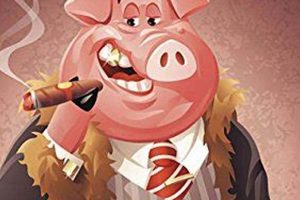
The initial segment of Orwell’s allegorical novella establishes the setting and introduces the key players. It primarily concerns the animals of Manor Farm, who are discontent under the tyrannical rule of Mr. Jones, the neglectful farmer. Old Major, a prize-winning boar, delivers a powerful speech, outlining his vision of a utopian society free from human oppression. He teaches them the song “Beasts of England,” an anthem of rebellion that ignites their revolutionary fervor.
This introductory portion is fundamental because it lays the groundwork for the entire narrative. It establishes the central conflict between the animals and humans, introduces the core themes of oppression, inequality, and revolution, and plants the seeds of future conflict among the animals themselves. The ideals presented by Old Major, while seemingly noble, foreshadow the potential for corruption and the dangers of unchecked power, providing a critical historical context for understanding the trajectory of the farm’s governance.
Following Old Major’s death, the animals, inspired by his vision, begin to strategize and prepare for their uprising. Their efforts ultimately culminate in a successful revolt, leading to the expulsion of Mr. Jones and the renaming of the farm, marking the beginning of a new era, fraught with both promise and peril, and setting the stage for the unfolding drama of the subsequent chapters.
Analyzing the Opening Chapter
Careful consideration of the inaugural segment of Orwell’s work is crucial for a comprehensive understanding of the narrative’s themes and trajectory. The following points offer guidance for a more nuanced analysis:
Tip 1: Identify the Allegorical Significance: Recognize that the characters and events within the chapter are representations of real-world figures and occurrences, particularly relating to the Russian Revolution. For example, Old Major embodies Karl Marx or Vladimir Lenin, while Mr. Jones symbolizes the deposed Tsar Nicholas II.
Tip 2: Analyze the Role of Language: Examine the manner in which language is used to manipulate and control. Old Major’s persuasive rhetoric and the catchy slogan of “Beasts of England” demonstrate the power of language in shaping beliefs and inciting action.
Tip 3: Trace the Development of Themes: Note the introduction of core themes such as oppression, social inequality, and the potential for revolution. The seeds of these themes are sown early, providing a framework for the events that follow.
Tip 4: Examine Character Motivations: Consider the underlying motivations of the various animal characters. Understanding their individual desires and anxieties offers insight into their subsequent actions and the dynamics of the evolving society.
Tip 5: Assess the Foreshadowing: Pay close attention to instances of foreshadowing that hint at future events and the potential for the corruption of the animals’ initial ideals. The pigs’ early dominance and manipulative tendencies are subtle warnings of what is to come.
Tip 6: Evaluate the Symbolism: Decipher the symbolic meaning of objects and settings. Manor Farm itself is a symbol of the state, while the farmhouse represents the seat of power. Analyzing these symbols enhances comprehension of the broader themes.
A thorough examination of these elements will provide a solid foundation for interpreting the complex layers of meaning within the text. The introductory chapter is not merely a starting point but rather a crucial lens through which the entire narrative must be viewed.
The succeeding chapters build upon the foundations established in the opening, further developing the characters, themes, and conflicts introduced here. A deep understanding of the initial segment is therefore essential for grasping the full impact of the allegorical narrative.
1. Oppression by Mr. Jones
The element of oppression by Mr. Jones is not merely a detail within the introductory overview of the novel; it constitutes the very catalyst for the events that unfold within. The neglect, maltreatment, and exploitation experienced by the animals under Jones’s rule directly incite their desire for change and fuel the revolutionary sentiments expressed by Old Major. His chronic drunkenness and indifference to the animals’ basic needs (food, shelter, rest) create an environment of desperation, making them receptive to the promise of a better life through rebellion. Without this foundational oppression, the subsequent speeches and actions of the animals would lack context and motivation.
Consider examples of historical revolutions: socioeconomic disparities and political repression often serve as the primary impetus for upheaval. Similarly, within the narrative, Jones’s actions represent these broader societal injustices. His failure to provide for the animals, despite their labor, parallels the exploitation of the working class. Furthermore, his arbitrary power, reflected in his whip and overall control, mirrors authoritarian regimes. The animals’ suffering functions as a microcosm of societal inequalities that historically lead to revolution, establishing a clear causal link between the oppressor’s actions and the oppressed’s response.
Understanding the significance of Jones’s oppression is crucial for comprehending the entire allegorical structure of the work. It provides the foundation for interpreting the subsequent power dynamics and the animals’ eventual descent into a new form of tyranny. The failure to recognize the profound impact of this initial oppression undermines the ability to analyze the novel’s central themes of revolution, social class, and the corrupting influence of power. Furthermore, it highlights the importance of addressing inequality and preventing the abuse of authority to avoid the consequences witnessed within the animal society.
2. Old Major's revolutionary speech

Old Major’s revolutionary speech is a cornerstone of the introductory overview and is directly responsible for shaping the subsequent events. The speech serves as the ideological genesis, articulating the core grievances against human oppression and proposing a vision of animal autonomy. It directly incites the desire for change among the animals, transforming their previously passive acceptance of their plight into active resentment and a yearning for revolution. Without Old Major’s articulation of their suffering and his proposal of an alternative, the animals would likely have continued to endure Mr. Jones’s mistreatment without organized resistance.
The persuasive nature of Old Major’s words stems from his appeal to the animals’ shared experiences of exploitation and his promise of a utopian future. He identifies the root cause of their suffering as human greed and selfishness, uniting them under a common enemy. The song “Beasts of England,” introduced during his speech, acts as a rallying cry, solidifying their shared identity and reinforcing their commitment to the cause. This is comparable to the role of pamphlets and speeches in human revolutions, such as Thomas Paine’s “Common Sense” during the American Revolution. These documents provided intellectual justification and emotional motivation for revolutionary action. In essence, Old Major’s speech provides the intellectual and emotional ammunition for the animal rebellion, setting the stage for the overthrow of Mr. Jones and the establishment of Animal Farm.
In conclusion, Old Major’s revolutionary speech is far from a mere narrative element; it is the engine that drives the initial plot and establishes the thematic foundation for the entire work. Its impact on “summary chapter 1 animal farm” is undeniable, transforming the animals from passive sufferers into active revolutionaries. Understanding the content and consequences of the speech is crucial for comprehending the allegorical significance of the narrative and its commentary on the dynamics of power, revolution, and social change. The ability to connect his ideology to the animals’ actions highlights the manipulative power of language, revealing the importance of ideological origins.
3. "Beasts of England" anthem

The “Beasts of England” anthem, introduced within the initial chapter overview, functions as a crucial instrument of revolutionary fervor. It encapsulates the ideals articulated in Old Major’s speech, providing a readily accessible and emotionally charged expression of the animals’ shared grievances and aspirations. The anthem’s simple, yet stirring, lyrics reinforce the themes of freedom, liberation, and the overthrow of human oppression, solidifying the animals’ collective identity and commitment to their cause. It transforms abstract philosophical concepts into a tangible and unifying force, galvanizing them towards revolutionary action. The song serves as the emotional and cultural fuel for the impending rebellion.
The practical significance of the anthem is evident in its ability to transcend species barriers and unite the animals under a common banner. Its easily memorized tune and powerful message are accessible to all, regardless of their individual capabilities or understanding of political theory. It operates as a powerful propaganda tool, effectively disseminating Old Major’s message throughout the farm. Consider its analogy to national anthems in human societies: these songs evoke a sense of patriotism and shared identity, promoting unity and motivating collective action. The “Beasts of England” anthem fulfills a similar role within the animal community, fostering a sense of camaraderie and purpose, essential ingredients for a successful revolution.
In summary, the “Beasts of England” anthem is inextricably linked to the opening overview because it serves as the emotional and cultural embodiment of the revolutionary ideals. Its role in galvanizing the animals and solidifying their commitment to rebellion cannot be overstated. Understanding the anthem’s significance provides a deeper insight into the mechanisms of revolution and the power of propaganda in shaping collective action. Without “Beasts of England”, the initial chapter would lack an important cohesive element, therefore diminishing the power of “summary chapter 1 animal farm” as a whole.
4. Animal farm revolution planning

The element of revolutionary planning, following Old Major’s speech, is a direct consequence of the sentiments expressed in the introductory portion. It demonstrates the transition from theoretical idealism to practical preparation, illustrating how the animals begin to operationalize their newfound desire for freedom. This planning phase is critical for understanding the subsequent success of the rebellion and the power dynamics that emerge after Mr. Jones is overthrown. Without it, the initial events would lack a crucial bridge to the active revolution.
- Formation of Committees
After Old Major’s passing, the pigs, recognized for their intelligence, undertake the organization of the other animals. This involves establishing committees dedicated to specific tasks, such as food production, defense, and education. This division of labor, while initially appearing efficient, also lays the groundwork for the pigs’ eventual consolidation of power. In revolutionary movements, the formation of such groups is common, providing a structure for coordinating efforts and distributing responsibilities. However, these structures can also become breeding grounds for internal power struggles. The implications within the introductory segment are subtle, foreshadowing the pigs’ future dominance.
- Secret Meetings and Ideological Development
The animals conduct clandestine meetings to discuss the principles of Animalism, a simplified version of Old Major’s teachings. These gatherings serve as a forum for spreading revolutionary ideas and reinforcing their commitment to the cause. Such meetings are typical of pre-revolutionary periods, providing a space for dissenters to organize and strategize in secrecy. The danger is that these meetings are inherently susceptible to infiltration and betrayal. Within the introductory context, these meetings represent a period of intense ideological development, ultimately setting the stage for the revolution and the establishment of Animal Farm’s foundational principles.
- Propaganda and Mobilization
The pigs, particularly Squealer, are adept at using propaganda to rally support for the revolution. They simplify complex ideas into easily digestible slogans and utilize emotional appeals to motivate the other animals. This use of propaganda is a recurring feature of revolutionary movements, serving to unite disparate groups and mobilize them towards a common goal. In the initial stages, it appears benign, but it portends the pigs’ later manipulation of information to maintain control. Propaganda is a constant factor found in most of major conflicts
- Overcoming Internal Divisions
The animals face internal divisions based on species, intelligence, and personality. The pigs must navigate these differences to maintain unity and prevent the movement from fracturing. Resolving internal conflicts is a critical challenge for any revolutionary movement, as disunity can undermine their efforts. The chapter only alludes to these issues, but they represent a significant obstacle that the animals must overcome to achieve their goal of overthrowing Mr. Jones. Overcoming these divisions show the reader just how far the animals will go in their pursuit of freedom.
The planning undertaken by the animals is not merely a procedural step in their revolution; it is a complex process that shapes their social dynamics, establishes hierarchies, and lays the groundwork for future conflicts. These events are essential for “summary chapter 1 animal farm”, as they provide insights into the mechanisms of revolution, the nature of power, and the potential for corruption even within idealistic movements. A detailed understanding of this planning phase is crucial for interpreting the allegorical significance of the entire novel.
5. Expulsion of Mr. Jones
The expulsion of Mr. Jones functions as the pivotal event transforming the concept of rebellion into a tangible reality, solidifying its place as a critical component. The entire chapter builds toward this act, starting with the animals’ discontent and culminating in the successful overthrow of their oppressor. This act is the direct manifestation of Old Major’s revolutionary ideals and the planning that ensued. Without the expulsion, the earlier elements would remain abstract aspirations, failing to demonstrate the animals’ capacity for collective action and their commitment to achieving a better life. The significance parallels historical events such as the storming of the Bastille, where a symbolic act of defiance signaled the beginning of a wider revolution.
The practical significance lies in its demonstration of the potential for oppressed groups to seize power and control their own destinies. The success, albeit short-lived, of the expulsion inspires hope and unity amongst the animals, fostering a belief in their collective strength. This understanding resonates across various contexts, from labor movements to civil rights struggles, where marginalized groups have challenged existing power structures. It also demonstrates how even a poorly managed farm is better than when humans are around to control it.
However, this victory also presents inherent challenges. The power vacuum created by Jones’s departure immediately exposes the animals’ lack of experience in self-governance and the potential for internal power struggles. This expulsion, while a triumph, serves as a prelude to the broader themes of corruption, inequality, and the cyclical nature of power. “summary chapter 1 animal farm” is therefore incomplete without an understanding of how it provides context, motivation, and consequence. Thus, the expulsion remains a cornerstone in comprehending Animal Farm’s allegorical narrative.
6. Farm's renaming occurs

The act of renaming the farm from “Manor Farm” to “Animal Farm” is not merely a superficial alteration but rather a symbolic declaration of independence and a fundamental element in the broader overview of the initial chapter. This renaming signifies a complete break from the past, representing the animals’ rejection of human dominance and their aspiration to establish a new social order based on animal equality. Its significance lies in establishing a clear demarcation between the old oppressive regime and the envisioned utopian future, thereby playing a crucial role in encapsulating the overall “summary chapter 1 animal farm”.
- Symbolic Rejection of Human Control
The name “Manor Farm” inherently represents human ownership and control, reflecting the hierarchical power structure under Mr. Jones. By changing the name, the animals symbolically reject this ownership and assert their right to self-determination. The adoption of “Animal Farm” signifies a shift in power dynamics, indicating that the farm now belongs to the animals, not humans. This is similar to the renaming of cities or countries following revolutions, where new names are chosen to reflect the new political order and cultural identity. For example, the renaming of St. Petersburg to Leningrad after the Russian Revolution symbolized a shift away from the Tsarist regime. In the context of Animal Farm, this act is a clear statement of liberation.
- Establishment of a New Collective Identity
The new name “Animal Farm” fosters a sense of collective identity among the animals, uniting them under a shared purpose and a common sense of belonging. It transcends species boundaries, creating a single overarching identity that encompasses all the animals living on the farm. The focus on their shared animality emphasizes their unity against the common enemy, the humans. This can be compared to the formation of national identities, where shared cultural symbols and narratives are used to create a sense of belonging and solidarity among disparate groups. The “Animal Farm” name serves as a constant reminder of their shared identity and the ideals for which they fought, but the change will prove as fragile as the animal’s alliance.
- Reinforcement of Revolutionary Ideals
The renaming reinforces the core principles of Animalism, the philosophical foundation of the revolution. The name explicitly affirms the animals’ commitment to creating a society free from human exploitation and based on equality. It acts as a constant reminder of their revolutionary goals and their dedication to building a better future for all animals. This is similar to the use of slogans and mottos during revolutionary periods, which serve to encapsulate the movement’s core values and inspire continued commitment. The name “Animal Farm” serves as a symbolic representation of their revolutionary ideals, continuously driving forward the initial purpose.
- Foreshadowing of Future Irony
Despite its initial positive connotations, the renaming also foreshadows the future corruption of the animals’ ideals. As the pigs gradually seize power and establish their own form of tyranny, the name “Animal Farm” becomes increasingly ironic, highlighting the gap between the original revolutionary goals and the grim reality of the farm’s oppressive regime. This is an example of dramatic irony, where the audience is aware of the discrepancy between the animals’ initial hopes and their eventual fate. The name transformation is therefore central in illustrating the deceptive nature of power and the subtle way in which revolutionary dreams can devolve into oppressive realities. It adds complexity to the story while also acting as a harbinger of grim events to come in later chapters.
The renaming of the farm, therefore, is much more than a simple act of changing a label. It is a symbolic gesture that encapsulates the animals’ revolutionary aspirations, establishes their collective identity, reinforces their ideals, and foreshadows the future corruption of those very ideals. Its inclusion within the “summary chapter 1 animal farm” provides a comprehensive understanding of the events, setting the stage for the allegorical narrative to unfold, and emphasizing the complex themes of revolution, power, and social change within the context of an animal-dominated society.
7. Seeds of future conflict

The initial chapter provides the foundational context for subsequent struggles and power imbalances within the animal community. Seemingly minor details and nascent inequalities establish a trajectory toward discord, ensuring that the revolutionary fervor does not translate into sustained harmony. Examining these elements is crucial for understanding the “summary chapter 1 animal farm” in its entirety, revealing how early decisions and subtle preferences plant the seeds of later division and betrayal.
- Emergence of Pig Leadership
From the outset, the pigs demonstrate superior intelligence and organizational skills, positioning themselves as the natural leaders of the revolution. While their initial leadership is presented as beneficial, it simultaneously creates an inherent hierarchy. This disparity in intelligence and influence grants the pigs disproportionate control over decision-making and resource allocation, subtly undermining the principle of animal equality. This mirrors historical instances where intellectual elites in revolutionary movements have consolidated power, often leading to new forms of oppression, as seen in the rise of bureaucratic elites following some socialist revolutions. The chapter presents this nascent power imbalance as a subtle but crucial factor in the later exploitation and manipulation of the other animals.
- Unequal Distribution of Labor and Resources
Although the animals initially embrace the principle of “from each according to his ability, to each according to his need,” subtle inequalities in labor distribution are evident. Certain animals, such as Boxer, are celebrated for their strength and willingness to work harder than others, while others contribute less. This disparity, while initially overlooked, provides a justification for the pigs to gradually seize a larger share of resources, arguing that their intellectual labor is more valuable. This parallels the historical exploitation of manual laborers by intellectual or managerial classes, often rationalized by the perceived higher value of mental work. The chapter hints at this future exploitation through the initial discrepancies in work contributions and the implicit acceptance of these inequalities by the other animals.
- Naivet and Lack of Critical Thinking
Many of the animals, particularly the sheep and hens, exhibit a lack of critical thinking and an unquestioning acceptance of the pigs’ leadership. This naivet makes them susceptible to manipulation and propaganda, hindering their ability to recognize and challenge the pigs’ growing dominance. This mirrors the historical susceptibility of uneducated or politically uninformed populations to demagoguery and propaganda, as seen in various authoritarian regimes. The unquestioning obedience of the animals within the introductory chapter establishes a pattern of deference to authority that the pigs will later exploit to maintain control and suppress dissent.
- Ambiguous Definition of “Enemy”
While the animals unite against Mr. Jones, the definition of “enemy” remains somewhat ambiguous. The animals initially define their enemy as all humans. This oversimplification allows the pigs to later manipulate the concept of “enemy” to target specific individuals or groups within the animal community, silencing dissent and consolidating power. This echoes historical instances where revolutionary movements have expanded the definition of “enemy” to encompass internal dissidents or competing factions, justifying political purges and the suppression of opposition. The chapter subtly foreshadows this future manipulation by establishing a broad and somewhat simplistic understanding of who constitutes the “enemy” of Animal Farm.
These seemingly minor factors, present from the outset, collectively contribute to the erosion of the animals’ initial revolutionary ideals and the gradual establishment of a new form of oppression. A comprehensive analysis of “summary chapter 1 animal farm” necessitates recognizing these “seeds of future conflict” and understanding how they ultimately lead to the tragic outcome of the narrative. The initial chapter, therefore, is not merely a chronicle of a successful revolution but rather a cautionary tale about the subtle ways in which power can corrupt and inequality can undermine even the most idealistic movements.
Frequently Asked Questions Regarding the Initial Chapter
The following questions address common inquiries and potential areas of confusion concerning the inaugural chapter of Orwell’s Animal Farm.
Question 1: What is the primary significance of Old Major’s speech?
The speech serves as the ideological cornerstone of the narrative. It outlines the grievances against human oppression, proposes a vision of animal autonomy, and provides the impetus for the subsequent revolution. This speech is critical in understanding the animals’ motivations.
Question 2: Why is the song “Beasts of England” so important?
The anthem encapsulates the ideals of the revolution, acting as a unifying force and reinforcing the animals’ shared commitment to overthrowing human control. It serves as an easily accessible and emotionally resonant expression of their aspirations.
Question 3: What elements within the initial chapter foreshadow future conflicts?
The nascent leadership of the pigs, subtle inequalities in labor distribution, and the naivete of certain animals all contribute to the eventual corruption of the revolutionary ideals and the establishment of a new form of oppression. These subtle dynamics can be easily missed but are critical to the allegory.
Question 4: How does Mr. Jones’s character contribute to the overall narrative?
Mr. Jones embodies the tyrannical oppressor, whose neglect and mistreatment of the animals provide the catalyst for the rebellion. His character is essential for understanding the animals’ initial motivations and the justification for their revolutionary actions.
Question 5: Why is the renaming of the farm to “Animal Farm” so significant?
The name change symbolizes a complete break from the past, representing the animals’ rejection of human control and their aspiration to create a society based on animal equality. The name serves as a constant reminder of their revolutionary goals and the principles of Animalism.
Question 6: To what extent can the introductory events be considered an allegory for historical revolutions?
The events within the first chapter closely mirror the dynamics of real-world revolutions, including the initial stages of revolutionary movements, the rise of ideological leaders, and the potential for corruption and the establishment of new forms of oppression. Recognizing these parallels enhances comprehension of the narrative’s broader commentary on power, social class, and the nature of revolution.
Understanding these key aspects of the initial chapter is crucial for interpreting the allegory and its commentary on power, revolution, and social change. A careful examination of these elements provides a solid foundation for understanding the complex dynamics of the entire narrative.
The succeeding chapters build upon the foundations established in the opening, further developing the characters, themes, and conflicts introduced here. Understanding these building blocks is essential.
Concluding Remarks on the Initial Segment
The preceding exploration has elucidated the significance of the opening portion, revealing its function as a foundational element for the overall narrative. Analysis has demonstrated how the initial conditions, characters, and events establish the central themes of oppression, revolution, and power dynamics. Comprehending these components is essential for accurately interpreting the ensuing events and grasping the allegorical intent.
Thorough consideration of the initial conditions sets the stage for understanding the trajectory of Orwell’s work. Continued reflection on these foundations is encouraged to enhance interpretation of this literary work. The implications of this chapter extend beyond the narrative itself, offering enduring insights into the complexities of social and political structures.