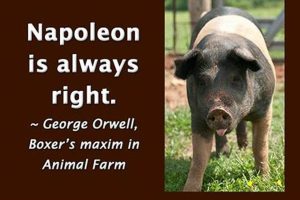
The following analysis focuses on significant statements attributed to the pig leader in George Orwell’s allegorical novella. These pronouncements, often delivered with calculated intent, serve as key indicators of his evolving character and his strategic manipulation of the farm’s ideology. Examining these excerpts provides insights into the consolidation of power and the gradual erosion of the initial revolutionary ideals.
Understanding these pronouncements is crucial for comprehending the novella’s themes of totalitarianism, propaganda, and the corruption of revolutionary principles. They illuminate how language can be used to distort reality, control the populace, and justify oppressive actions. The historical context of the novel, reflecting the rise of Stalinism in the Soviet Union, lends further weight to the analysis of the pig leader’s rhetoric and its devastating consequences.
Therefore, the subsequent discussion will explore specific instances of the pig leader’s declarations, analyzing their impact on the animals and their contribution to the overall message of the story. This will involve examining the context in which these were uttered, the specific vocabulary employed, and the ultimate effect on the societal structure of the farm.
Analyzing Declarations
The following provides analytical tips for understanding significant statements made by the pig leader. Careful consideration of context and subtext offers crucial insights.
Tip 1: Contextualize Utterances: Every declaration should be considered within the immediate events and the broader trajectory of the farm’s socio-political landscape. For example, pronouncements following the expulsion of Snowball should be examined in light of the power vacuum and the propaganda campaign to discredit the rival.
Tip 2: Decipher the Rhetoric: Identify persuasive techniques employed, such as appeals to fear, patriotism, or collective identity. The strategic use of language can reveal the underlying intent to manipulate and control the other animals. Consider the difference between simple statements and those layered with emotional appeals.
Tip 3: Trace the Evolution of Language: Observe how the vocabulary and tone of the pig leader’s declarations change over time. Initially, pronouncements might echo the ideals of Animalism. Later, they might become more authoritarian and self-serving, reflecting the consolidation of power.
Tip 4: Evaluate the Impact on the Animals: Assess how the animals react to these pronouncements. Do they accept them unquestioningly, or is there evidence of dissent or skepticism? The response of the populace reveals the effectiveness of the propaganda and the level of control exerted.
Tip 5: Identify Contradictions: Search for inconsistencies between the leader’s words and actions. Such discrepancies often expose the hypocrisy and self-interest driving the regime. Pay attention to instances where initial promises are broken or revised to suit the ruling class.
Tip 6: Compare to Historical Parallels: Drawing parallels with historical figures and events can deepen the understanding of the pig leader’s strategies. Linking rhetoric to specific totalitarian regimes helps to illuminate the broader themes of the novella.
By applying these analytical approaches, a deeper understanding of how language functions as a tool of manipulation and control can be achieved.
The next section will focus on specific examples from the text, applying these analytical frameworks to real-world instances.
1. Power consolidation

The pig leader’s declarations are inextricably linked to the process of power consolidation on the farm. Initially, his pronouncements were subtle, often veiled in the guise of collective benefit. However, as he strategically eliminated opposition and manipulated information, his became increasingly assertive and self-serving. Each pronouncement became a tool to solidify his authority, gradually eroding the original principles of Animalism and concentrating power in his hands and those of his inner circle.
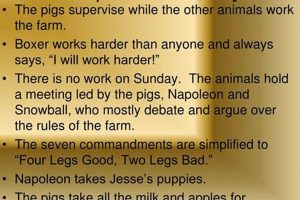
Examining specific instances, such as the revisions to the Seven Commandments or the justifications for unequal distribution of resources, reveals how language was used to legitimize the accumulation of power. Consider the altered commandment regarding sleeping in beds. This was a statement meant to quell dissent and justify the pigs’ increasingly luxurious lifestyle. Furthermore, the narrative surrounding Snowball’s alleged treachery, constantly reinforced through carefully crafted phrases, served to eliminate a potential rival and consolidate the pig leader’s position as the sole authority figure.
Ultimately, the studied declarations illustrate how the pig leader used language to manipulate the animals’ perception of reality, suppress dissent, and establish absolute control over the farm’s resources and direction. His words became laws, and his interpretation of events became the accepted truth, thereby cementing his power and transforming the farm into a totalitarian regime.
2. Propaganda techniques

Declarations disseminated by the pig leader serve as potent instruments of propaganda within the novella. These calculated pronouncements are not merely informative; they are strategically designed to shape perception, manipulate emotions, and control behavior. The employment of propaganda is integral to maintaining the regime, as it enables the distortion of reality, the suppression of dissent, and the justification of actions that contradict the foundational principles of the farm. The manipulation of language is a central tactic. For instance, the repeated assertion that Snowball was a traitor, despite evidence to the contrary, effectively demonized a political opponent and consolidated the pig leader’s authority.
Further examples of propaganda include the manipulation of statistics to create a false impression of prosperity, even as the animals experienced hardship. Squealer’s skillful rhetoric consistently reframed negative realities into positive narratives, thereby pacifying the populace and preventing rebellion. The songs and slogans, initially intended to inspire unity and revolutionary fervor, were repurposed to glorify the pig leader and reinforce the existing power structure. The rewriting of history, particularly concerning the Battle of the Cowshed, further cemented the pig leader’s image as a benevolent protector of the farm. All these tactics, employed through strategic utterances, collectively created a distorted reality where the pigs’ actions were always justified and their authority unquestioned.
The effectiveness of the propaganda underscores a critical theme of the narrative: the vulnerability of a poorly educated populace to manipulation. The animals’ inability to critically analyze information renders them susceptible to the pig leader’s deceptive rhetoric. The result is a society where truth is subjective, determined by the ruling class, and where individual thought is suppressed in favor of collective obedience. Thus, understanding these techniques and his pronouncements provides key insight into how power can be maintained through the manipulation of information and the exploitation of ignorance.
3. Ideological distortion

The pronouncements attributed to the pig leader are fundamentally intertwined with the concept of ideological distortion in the narrative. His statements represent a systematic manipulation of Animalism, the foundational ideology intended to establish equality and freedom. This process of distortion involves reinterpreting core tenets to serve the pigs’ self-interests, justifying their growing privileges, and suppressing any challenge to their authority. The direct effect is the gradual erosion of the revolution’s original intent, culminating in a society that mirrors the oppressive conditions it sought to overthrow.
Specific instances illustrate this ideological subversion. The alteration of the commandment “All animals are equal” to “All animals are equal, but some animals are more equal than others” represents a blatant contradiction of the revolution’s core principle. It normalizes inequality and establishes a hierarchy that prioritizes the pigs. Similarly, the constant revisions of history, particularly the demonization of Snowball, are designed to discredit any alternative ideology and consolidate the pig leader’s control over the narrative. The manipulation of language, employing doublespeak and euphemisms, further obscures the true nature of the regime’s actions. These systematic distortions, expressed through strategic , actively dismantle the idealistic framework, replacing it with a self-serving justification for totalitarian rule. This demonstrates how easily ideological principles can be twisted and exploited to maintain power, a phenomenon with parallels in numerous historical contexts.
In summary, the connection between pronouncements and ideological distortion is critical to understanding the novella’s critique of totalitarianism. The words spoken by the pig leader are not mere pronouncements; they are calculated tools used to erode principles, manipulate perceptions, and ultimately, establish and maintain a system of oppression. Examining specific alterations and manipulations within the context of the revolution highlights how revolutionary ideals can be subverted and twisted to justify authoritarian rule, providing a cautionary tale about the importance of vigilance and critical thinking in safeguarding against ideological manipulation.
4. Fear inducement

Pronouncements attributed to the pig leader in Animal Farm are inextricably linked to the strategic inducement of fear. This fear serves as a primary tool for maintaining control, suppressing dissent, and manipulating the animal population. The declarations are crafted not merely to inform or persuade, but to instill a sense of vulnerability and dependence on the ruling pigs. This reliance on fear distinguishes his regime from one based on genuine consent or shared ideological commitment. For instance, the consistent warnings about the return of Mr. Jones, often amplified after acts of resistance or questioning, created a pervasive sense of threat that discouraged disobedience. The threat of violence, often implied rather than explicitly stated, was ever-present.
The relationship between these utterances and the pervasive atmosphere of fear is evident in the narrative’s progression. Following the expulsion of Snowball, pronouncements regarding his alleged sabotage and treachery became increasingly frequent and vivid. These served to justify the pig leader’s increasingly authoritarian measures and silenced potential critics. The dogs, serving as enforcers, embodied this fear, and their presence was frequently invoked in the pig leader’s speeches to ensure compliance. Moreover, the staged confessions and executions instilled a climate of terror, where any perceived deviation from the pig leader’s dictates was met with severe consequences. The deliberate manipulation of information, coupled with the constant threat of violence, ensured the animals’ subservience and prevented any organized challenge to the pigs’ authority. This allowed to completely rewrite the history and take control on animal farm.
In summary, the use of fear through strategic is a central element of the pig leader’s rule in Animal Farm. The declarations are not merely statements but calculated instruments designed to create a climate of terror, suppress dissent, and maintain absolute control. Understanding this connection is crucial to interpreting the novella’s critique of totalitarian regimes and the dangers of unchecked power. The consequences of unchecked power, as represented through the pig leader, serves as an example of a perverted revolution, a society where the populace is controlled through fear and manipulation.
5. Control mechanisms

Control mechanisms are intrinsically linked to the statements attributed to the pig leader in Animal Farm. These mechanisms, implemented through strategic utterances, serve to manipulate and suppress the animal population, ensuring compliance with the ruling pigs’ agenda. Declarations, therefore, are not merely expressions of policy, but rather active instruments employed to maintain order, enforce obedience, and eliminate dissent. The use of propaganda, misinformation, and the constant rewriting of history, all communicated through pronouncements, collectively function as a sophisticated system of control. Examples include the demonization of Snowball, the manipulation of production figures, and the revision of the Seven Commandments; each of these actions was justified through strategic utterances designed to maintain the pigs’ power. Understanding these mechanisms provides critical insight into the novella’s critique of totalitarianism.
The pig leader’s control, exemplified in specific pronouncements, extends to various aspects of the animals’ lives. The control of information, facilitated through the dissemination of propaganda via declarations, prevents the animals from forming independent opinions. The imposition of strict rules and regulations, justified through pronouncements citing the need for order and efficiency, limits their freedom of action. The manipulation of the animals’ emotions, achieved through pronouncements that evoke fear or patriotism, ensures their unwavering loyalty. The control of labor, achieved through pronouncements emphasizing the importance of hard work and sacrifice, exploits their labor for the benefit of the pigs. Thus, the pig leader’s ability to control the animals’ thoughts, actions, emotions, and labor is directly attributable to the strategic use of his declarations as control mechanisms. These tactics reveal the insidious nature of totalitarian control, demonstrating how language can be weaponized to suppress individual autonomy and enforce collective obedience.
In summary, control mechanisms are an essential component of the pig leader’s regime. His strategic utterances function not merely as communication but as active instruments of manipulation and suppression. The study of these mechanisms, as manifested through , reveals the inner workings of totalitarian control and highlights the dangers of unchecked power. Understanding this connection is critical for interpreting the novella’s cautionary message and recognizing the potential for language to be used as a tool of oppression.
6. Self-preservation

The principle of self-preservation is a central driving force behind many statements attributed to the pig leader. His strategic utterances often prioritize the survival and well-being of himself and his inner circle, even at the expense of the other animals. This inherent self-interest shapes the language employed, the policies enacted, and the overall direction of the farm. Analyzing actions and declarations reveals a consistent pattern: decisions are made and justified primarily to ensure the pigs’ continued dominance and prosperity. For instance, the control of food rations, disguised as a necessary measure for the collective good, ultimately serves to benefit the pigs, ensuring their strength and ability to maintain control. Such examples demonstrate how the drive for self-preservation directly influences the choices and their presentation to the farm.
Further analysis indicates that the pig leader manipulates language to legitimize actions rooted in self-preservation. The revision of the Seven Commandments, as observed, is a prime example. Altering the commandment against sleeping in beds or drinking alcohol allows the pigs to indulge in human luxuries while simultaneously silencing dissent through the revised code. This highlights the manipulative power of language to reframe self-serving actions as necessary or even beneficial for the entire community. The demonization of Snowball, also motivated by self-preservation, removes a potential threat to the pig leader’s authority. By painting Snowball as a traitor, the leader can justify his increasingly authoritarian measures and suppress any opposition. These tactical utterances illustrate the calculated nature of the pig leader’s strategies, where every decision and declaration is carefully weighed against its potential impact on his own survival and power.
In summary, the link between the pig leader’s strategic utterances and the principle of self-preservation is essential for a comprehensive understanding of the novella. The examination reveals that the drive for survival and power underlies many of his choices and shapes the very language he uses. The resulting corruption and oppression serve as a cautionary tale, highlighting the dangers of unchecked power and the importance of vigilance against manipulative rhetoric that prioritizes self-interest over the common good. The study emphasizes the critical need to analyze political discourse for hidden motives and potential self-serving agendas.
7. Revolution betrayal
The corruption of revolutionary ideals, a central theme in George Orwell’s Animal Farm, is directly manifested through the pronouncements of the pig leader. His statements progressively deviate from the original principles of Animalism, ultimately resulting in a society that mirrors the oppressive conditions the revolution sought to overthrow. The actions and utterances undermine the initial promise of equality and freedom, transforming the farm into a totalitarian regime.
- Erosion of Equality
The initial ethos of Animalism promoted equality among all animals. However, the pig leader’s declarations gradually introduce a hierarchical structure, culminating in the infamous phrase, “All animals are equal, but some animals are more equal than others.” This blatant contradiction, expressed through his pronouncements, signifies the complete abandonment of the revolutionary ideal of equality and the establishment of a ruling class.
- Manipulation of Information
A critical aspect of revolution betrayal involves the manipulation of information to maintain control. The pig leader’s statements are carefully crafted to distort reality, suppress dissent, and rewrite history to suit his agenda. The demonization of Snowball, the alteration of production figures, and the revision of the Seven Commandments all exemplify this tactic. Such manipulation, communicated through the , ensures that the animals remain ignorant of the true state of affairs and unable to challenge the pigs’ authority.
- Abuse of Power
The progressive concentration of power in the hands of the pigs is directly correlated with the erosion of revolutionary principles. The pig leader’s decrees become increasingly authoritarian, restricting the animals’ freedoms and exploiting their labor. The use of force, embodied by the dogs, further reinforces the pigs’ dominance. The betrayal of the revolution is thus manifested not only in the distortion of ideology but also in the abuse of power and the suppression of any form of opposition.
- Abandonment of Shared Principles
The original principles of Animalism, intended to guide the farm towards a better future, are progressively abandoned as the pigs prioritize their self-interests. Statements justifying the pigs’ consumption of milk and apples, their sleeping in beds, and their engaging in trade with humans all demonstrate this betrayal. The sacrifices made during the revolution are rendered meaningless as the pigs embrace the very behaviors they initially condemned, proving that some will continue to become corrupted in the face of great power.
The betrayal of the revolution, as depicted through the actions and statements, serves as a cautionary tale about the corrupting influence of power and the importance of vigilance in safeguarding against ideological subversion. The progression reveals how a noble cause can be twisted and exploited, leading to a society even more oppressive than the one it sought to replace. The animal farm napoleon quotes embody this devolution, offering a stark warning about the dangers of totalitarianism and the fragility of revolutionary ideals.
Frequently Asked Questions Regarding “Animal Farm Napoleon Quotes”
This section addresses frequently encountered inquiries pertaining to significant statements attributed to the pig leader in George Orwell’s allegorical novella, Animal Farm. The following questions aim to provide clarity and context, facilitating a deeper understanding of the pig leader’s role and the thematic significance of his pronouncements.
Question 1: Why is the analysis of Animal Farm Napoleon quotes important for understanding the novel?
The analysis of the pig leader’s is crucial because they serve as primary indicators of his character development, manipulative strategies, and the overall corruption of the revolution’s initial ideals. They reveal the mechanisms through which power is consolidated and dissent is suppressed, providing insights into the novella’s central themes.
Question 2: How did the pig leader’s pronouncements contribute to the manipulation of the other animals?
His statements were often carefully crafted to distort reality, appeal to emotions, and exploit the animals’ limited understanding of political concepts. By controlling the narrative and shaping perceptions, the pig leader was able to maintain authority and prevent any organized challenge to his rule.
Question 3: What is the significance of the altered commandment, “All animals are equal, but some animals are more equal than others?”
This altered commandment epitomizes the ideological betrayal at the heart of the novella. It exposes the hypocrisy of the ruling pigs and signifies the complete abandonment of the revolutionary principle of equality. This demonstrates the lengths the ruling class will go to maintain power.
Question 4: What role did propaganda play in the pig leader’s regime, and how was it reflected in his pronouncements?
Propaganda was a central tool used to control the populace. The pig leader’s utterances, often delivered by Squealer, consistently reframed negative realities into positive narratives, demonized Snowball, and promoted a false sense of unity and progress. Manipulation was key.
Question 5: How do the statements made relate to the historical context of the Russian Revolution and Stalinism?
The novella serves as an allegory for the Russian Revolution, and the pig leader is often interpreted as a representation of Joseph Stalin. His declarations and actions mirror the tactics employed by Stalin to consolidate power, eliminate opposition, and establish a totalitarian regime. This is where the animal farm napoleon quotes come into the equation.
Question 6: Beyond historical context, what broader lessons can be gleaned from analyzing these statements in Animal Farm?
The analysis provides valuable insights into the dangers of unchecked power, the importance of critical thinking, and the fragility of revolutionary ideals. It serves as a cautionary tale about the potential for language to be used as a tool of manipulation and oppression in any political context.
In summary, examining these is crucial for understanding the core themes of Animal Farm and for recognizing the potential for corruption and manipulation within political systems.
The subsequent discussion will shift to exploring the enduring relevance of Animal Farm in contemporary society.
Concluding Remarks on Animal Farm Napoleon Quotes
The preceding analysis has demonstrated the critical role of “animal farm napoleon quotes” in understanding the novella’s core themes. These selected statements expose the insidious nature of power, the manipulation of language, and the tragic betrayal of revolutionary ideals. The examination has revealed how such utterances are employed to consolidate control, distort reality, and suppress dissent, thereby transforming an idealistic vision into a totalitarian nightmare. By carefully scrutinizing these key , the reader gains insight into the mechanisms of oppression and the dangers of unchecked authority.
The enduring relevance of Animal Farm lies in its ability to illuminate the persistent threat of ideological corruption and the vulnerability of societies to manipulative rhetoric. Therefore, a continued critical assessment of political discourse, coupled with a commitment to safeguarding truth and promoting independent thought, remains essential to preventing the recurrence of similar dystopian scenarios. The lessons gleaned from analyzing , offer enduring insights into the dynamics of power and the importance of vigilance in preserving democratic values and guarding against the erosion of fundamental freedoms. The story serves as a dark look at the state of the world and the possibility of revolutions, big and small, to ultimately fail.