Key utterances attributed to the loyal workhorse in George Orwell’s Animal Farm encapsulate themes of unwavering dedication, naivet, and the exploitation of the working class. These pronouncements, simple yet potent, reveal much about his character and his role within the allegorical society. For example, the repeated phrase “I will work harder” exemplifies his commitment. His other well-known phrase, “Napoleon is always right,” demonstrates his unshakeable belief in the pigs’ leadership, irrespective of evidence to the contrary.
The significance of these pronouncements lies in their ability to illustrate the dangers of blind faith and the susceptibility of the working class to manipulation. They highlight how easily a diligent and well-meaning individual can be exploited through propaganda and the promise of a better future. Historically, these aspects resonated with observations of the Russian Revolution and the subsequent rise of Stalinism, where the proletariat was often encouraged to sacrifice for the collective good under the leadership of a seemingly infallible authority.
The following sections will examine specific instances of these verbal expressions within the text, analyze their contextual relevance, and discuss their contribution to the novel’s overall message regarding power, social inequality, and the perils of totalitarian regimes. An exploration of these specific instances, analyzed in terms of their broader significance to the novel’s themes will follow.
Analyzing Boxer’s Quotes in Animal Farm: A Guide
The following guidelines provide insight into the significance of pronouncements attributed to the character in George Orwell’s Animal Farm. Examining these sayings allows for a deeper understanding of the novel’s themes and allegorical representation of social and political realities.
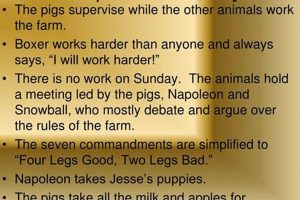
Tip 1: Identify Recurring Phrases. The phrases “I will work harder” and “Napoleon is always right” are repeated throughout the narrative. Recognize these recurring statements as indicative of his core character traits and as tools used by the pigs to maintain control.
Tip 2: Analyze Contextual Placement. Pay close attention to the situations in which the character utters these phrases. Note if they occur after setbacks, during moments of propaganda, or when his faith in the leadership is being tested. The context provides crucial insight into their meaning.
Tip 3: Examine the Literal vs. Symbolic Meaning. While his expressions appear simple on the surface, consider their symbolic weight. His willingness to “work harder” represents the exploited labor of the working class, and his belief in “Napoleon” signifies blind faith in authority.
Tip 4: Contrast with Other Characters’ Views. Compare the character’s views with those of other animals, such as Benjamin or Clover, who exhibit more skepticism. This contrast highlights the difference between critical thinking and unquestioning acceptance.
Tip 5: Relate to Historical Allegory. Connect his character and pronouncements to specific aspects of the Russian Revolution and the Stalinist era. His naivete and dedication mirror the experiences of many members of the proletariat who were manipulated by the state.
Tip 6: Consider the Author’s Intent. Reflect upon George Orwell’s purpose in creating this character and his famous sayings. These quotes are intended to serve as a cautionary tale about the dangers of totalitarianism and the exploitation of the working class.
By adhering to these guidelines, a more nuanced and thorough understanding of the character and his contributions to the overall narrative will be achieved.
Analyzing the phrases illuminates the novel’s critique of power structures and manipulation.
1. Unwavering dedication

Unwavering dedication, as embodied by the character, is inextricably linked to key expressions within George Orwell’s Animal Farm. This attribute, while initially appearing virtuous, ultimately contributes to his exploitation and tragic fate. His pronouncements serve as stark reminders of the potential consequences when dedication is divorced from critical thinking.
- “I will work harder”: The Embodiment of Commitment
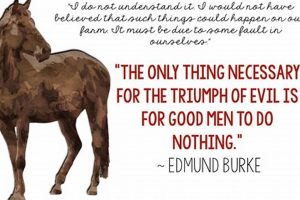
This recurring statement exemplifies his work ethic. It reflects his belief that personal effort will solve any problem facing the farm. This phrase encapsulates the common sentiment within the working class that increased labor equates to progress and betterment. However, it also exposes his limited understanding of the systemic issues at play. The more he repeats this, the more he is exploited. This mirrors instances in real-world historical movements where laborers were encouraged to selflessly contribute to a cause, only to be disregarded by those in power.
- Dismissal of Personal Welfare: Sacrifice as a Virtue
His unwavering dedication leads him to prioritize the collective good over his own well-being. He disregards signs of his failing health, consistently pushing himself beyond his limits. This self-sacrifice is presented as a virtue within the farm’s propaganda, reinforcing his commitment to the revolution and its alleged ideals. Historically, this mirrors the sacrifices demanded of individuals under totalitarian regimes, where personal needs were subordinated to the perceived needs of the state.
- Reinforcement of the Pigs’ Agenda: Unintentional Complicity
His dedication, expressed through his famous utterances, inadvertently reinforces the pigs’ manipulative agenda. By consistently advocating for hard work and expressing unwavering faith in Napoleon, he sets an example for the other animals and discourages dissent. His pronouncements become tools for the pigs to maintain control and suppress opposition, solidifying their power through his seemingly innocuous affirmations.
- The Tragic Irony of Exploitation: Dedicated to His Own Downfall
The most poignant aspect is the tragic irony inherent in his unwavering dedication. His tireless efforts and unwavering belief in the pigs ultimately lead to his demise. He is sold to the glue factory when he is no longer useful, a direct consequence of his exploited labor. This illustrates the danger of blind faith and the potential for even the most dedicated individuals to be betrayed by those they trust.
Through his unwavering dedication, illustrated through his repeated statements, becomes a cautionary figure within Animal Farm. His pronouncements serve as a testament to the dangers of unchecked commitment, the allure of propaganda, and the tragic consequences of prioritizing blind faith over critical analysis. His fate underscores the novel’s broader critique of power, exploitation, and the manipulation of the working class.
2. Blind faith

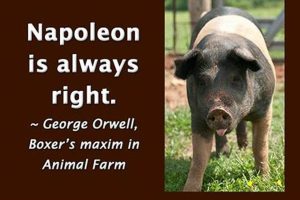
The characters expressions in Animal Farm serve as a prime example of blind faith and its detrimental consequences. The oft-repeated phrase, “Napoleon is always right,” encapsulates an unwavering belief in authority, regardless of evidence to the contrary. This utterance is not born from reasoned analysis or critical evaluation; instead, it stems from a deep-seated trust placed in the pig leadership. This trust, while seemingly admirable in its loyalty, becomes a tool for exploitation. Because of this resolute belief, the character accepts increasingly harsh conditions and blatant manipulations without question. This willingness to accept authority without scrutiny mirrors historical instances where populations, fueled by propaganda and charismatic leaders, have blindly followed ideologies that ultimately led to their oppression. The characters acceptance of Napoleons pronouncements, even when demonstrably false or self-serving, highlights the dangers of abandoning critical thought in favor of unquestioning obedience. The implications of this dynamic within the novel are clear: blind faith enables tyranny and prevents meaningful resistance to injustice.
The practical significance of understanding the connection between these expressions and blind faith lies in its relevance to contemporary social and political landscapes. Recognizing the mechanisms by which individuals can be swayed to accept unsubstantiated claims or oppressive policies is crucial in safeguarding against manipulation. By analyzing the characters unwavering devotion to Napoleon, it becomes possible to identify similar patterns of blind faith in real-world contexts. Examples include uncritical acceptance of political rhetoric, adherence to unsubstantiated conspiracy theories, or unquestioning obedience to charismatic figures, all of which can have significant consequences on individual liberties and societal well-being. Education and promotion of critical thinking skills are vital tools in mitigating the influence of blind faith and fostering a more informed and discerning populace.
In summary, the characters pronouncements, particularly the unwavering belief in Napoleons infallibility, represent a stark warning about the perils of blind faith. By analyzing these utterances within the context of Animal Farm, it becomes evident how such uncritical acceptance can facilitate manipulation and contribute to the erosion of individual freedoms. The challenge lies in promoting critical thinking and encouraging healthy skepticism without descending into cynicism, thereby fostering a society where individuals are empowered to question authority and resist oppressive ideologies.
3. Exploitation
The utterances attributed to a character in George Orwell’s Animal Farm are inextricably linked to the theme of exploitation. His famous pronouncements, seemingly innocent declarations of loyalty and commitment, are, in reality, potent indicators of the manipulative power dynamics at play. His consistent willingness to “work harder,” for instance, is not celebrated as virtuous but rather exploited as a means to extract maximum labor without commensurate benefit. This becomes a recurring pattern, where the pigs leverage his unwavering dedication to advance their own agenda, ultimately leading to his tragic downfall. The character’s unquestioning belief that “Napoleon is always right” further exemplifies this exploitation, as it prevents him from recognizing the pigs’ self-serving actions and inhibits any potential resistance. This dynamic mirrors historical instances where the working class has been encouraged to sacrifice for the collective good, only to be betrayed by those in power who exploit their labor and loyalty for personal gain.
The importance of recognizing exploitation as a central component is crucial for understanding the broader message of Animal Farm. It provides a stark warning against the dangers of unchecked authority and the vulnerability of those who prioritize blind faith over critical thinking. Without the character’s pronouncements and the actions they inspire, the pigs’ exploitation would remain largely theoretical. It is the character’s consistent behavior and pronouncements, serving as a physical and verbal manifestation of the working class, that make the theme of exploitation tangible and resonant. Practical applications of this understanding extend to analyzing contemporary power structures and identifying instances where individuals or groups are being manipulated through propaganda, economic pressure, or the promise of a better future. Identifying these patterns allows for the development of strategies to resist exploitation and promote social justice.
In conclusion, the character’s utterances within Animal Farm are not mere declarations of loyalty or hard work; they are powerful symbols of exploitation. His famous expressions serve as stark reminders of the potential for even the most well-intentioned individuals to be manipulated and used by those in positions of power. The challenge lies in fostering critical thinking skills and promoting awareness of these manipulative tactics so that individuals are empowered to resist exploitation and work towards a more equitable society. Understanding exploitation as a core component of this specific character’s portrayal, enables deeper understanding of wider society relationships.
4. Propaganda's Impact

The impact of propaganda within George Orwell’s Animal Farm is profoundly manifested through the pronouncements of specific characters, most notably through those repeatedly spoken by a particular animal. The manipulation of information and the dissemination of carefully crafted narratives directly shape the actions and beliefs, ultimately influencing the trajectory of the farm’s revolution. This connection between rhetoric and behavior reveals the insidious power of propaganda in shaping societal norms and suppressing dissent.
- Sloganeering and Simplification
Propaganda often relies on the use of simple, easily digestible slogans to convey complex ideas. The repetition of phrases such as “I will work harder” and “Napoleon is always right” reduces complex political situations to easily understandable mantras. This tactic, commonly employed in totalitarian regimes, eliminates nuance and critical thinking, fostering unquestioning obedience. These pronouncements become internalized, shaping his perception of reality and reinforcing his commitment to the ruling pigs, regardless of contradictory evidence.
- Demonization of the Opposition
Propaganda frequently employs tactics to demonize perceived enemies, creating a climate of fear and distrust. Although not explicitly present in his pronouncements, this is reflected in his unwavering loyalty to the pigs, even in the face of adversity. This implicitly supports the propaganda that frames Snowball as a traitor, justifying the pigs’ consolidation of power. The creation of an external enemy diverts attention from internal problems and strengthens the sense of collective identity under the leadership of Napoleon.
- Cult of Personality
The construction of a cult of personality around a leader is a common propaganda technique. The phrase “Napoleon is always right” directly contributes to the construction of this cult, portraying Napoleon as infallible and beyond reproach. This fosters a sense of reverence and discourages criticism, consolidating the leader’s authority. Examples of this tactic abound in history, from Stalin’s Soviet Union to Mao’s China, where leaders were presented as omniscient and benevolent figures deserving of unwavering loyalty.
- Control of Information and Historical Revisionism
Propaganda involves the control and manipulation of information to suit the ruling party’s agenda. While the utterances themselves do not directly alter history, they reflect the successful implementation of such control. His unwavering belief in the pigs’ version of events, despite evidence to the contrary, demonstrates the effectiveness of propaganda in shaping collective memory and suppressing alternative narratives. This tactic ensures that the pigs’ version of events is accepted as the truth, solidifying their grip on power.
In essence, the utterances of a specific character within Animal Farm serve as a microcosm of propaganda’s impact on individual thought and behavior. His pronouncements, shaped by carefully crafted narratives, demonstrate how easily individuals can be manipulated into supporting oppressive regimes. Analyzing the connection between these utterances and propaganda allows for a deeper understanding of the novel’s critique of totalitarianism and the importance of critical thinking in resisting manipulation. These facets connect back to the core theme within Animal Farm, exploring the dangers of unchecked power and the susceptibility of the working class to exploitation.
5. Naivet's danger

The danger inherent in naivet finds a stark embodiment in George Orwell’s Animal Farm, specifically manifested through the pronouncements and actions of a particular character. His unyielding trust and simplistic worldview, reflected in phrases such as “I will work harder” and “Napoleon is always right,” render him susceptible to manipulation and exploitation. This naivet becomes a critical component of his tragic arc, illustrating how good intentions, devoid of critical thought, can pave the way for oppression. A parallel exists in historical contexts where populations, driven by idealistic beliefs but lacking critical analysis, have been led to support authoritarian regimes that ultimately betray their initial promises. This underscores the point that genuine dedication, absent discernment, becomes a tool for those seeking to consolidate power.
Further analysis reveals the practical significance of understanding this connection. The characters inability to recognize the gradual erosion of the revolution’s ideals and the pigs’ increasingly self-serving behavior highlights the importance of cultivating critical thinking skills. By failing to question authority and blindly accepting propaganda, he inadvertently contributes to the establishment of a totalitarian system. This serves as a cautionary tale for contemporary society, where the dissemination of misinformation and the manipulation of public opinion pose significant challenges. Recognizing the subtle ways in which naivet can be exploited is essential for fostering a more informed and resilient populace capable of resisting manipulation.
In conclusion, the tragic fate that befalls the character in Animal Farm serves as a powerful allegory for the dangers of naivet. His utterances, while seemingly innocuous declarations of loyalty and hard work, become potent symbols of the exploitation that arises when critical thinking is abandoned in favor of blind faith. Addressing the challenges of combating naivet requires a multi-faceted approach, encompassing education, media literacy, and the promotion of independent thought. Only through fostering a culture of critical inquiry can society hope to mitigate the dangers associated with unchecked idealism and protect itself from the manipulative forces that seek to exploit it.
6. Tragic downfall

The tragic demise of a specific animal character in George Orwell’s Animal Farm is deeply intertwined with his famous pronouncements. These utterances, initially appearing as symbols of unwavering loyalty and diligence, ultimately foreshadow and contribute to his ruin. The disparity between his intentions and the ultimate outcome highlights the insidious nature of exploitation and the dangers of unchecked authority.
- The Erosion of Idealism
The character’s repeated assertion, “I will work harder,” embodies his unwavering belief in the revolution’s initial ideals. However, as the pigs consolidate power and betray these principles, his dedication is exploited. The erosion of the revolution’s promise, coupled with his inability to recognize this decline, directly contributes to his tragic trajectory. This facet parallels historical instances where idealistic movements devolved into oppressive regimes, leaving behind disillusionment and despair.
- Blind Faith as a Catalyst
The phrase “Napoleon is always right” exemplifies the character’s blind faith in the pig leadership. This unquestioning obedience prevents him from recognizing the pigs’ self-serving actions and inhibits any potential resistance. His unwavering belief becomes a catalyst for his exploitation, as he willingly accepts increasingly harsh conditions and blatant manipulations. This echoes historical instances of charismatic leaders manipulating followers into accepting oppressive policies under the guise of a greater good.
- The Price of Unquestioning Loyalty
His unquestioning loyalty ultimately proves to be his undoing. He prioritizes the collective good over his own well-being, pushing himself beyond his physical limits and ignoring signs of his declining health. This self-sacrifice, while seemingly admirable, makes him vulnerable to exploitation. The pigs, recognizing his unwavering commitment, leverage his dedication for their own gain, ultimately discarding him when he is no longer useful. This tragic irony underscores the dangers of prioritizing blind loyalty over self-preservation and critical thinking.
- Symbol of Exploited Labor
Ultimately, the character’s tragic downfall serves as a potent symbol of exploited labor. His pronouncements, initially intended as expressions of commitment, become haunting reminders of the pigs’ manipulative power. His demise highlights the vulnerability of the working class to exploitation and the importance of challenging oppressive power structures. This connects directly to the core themes of Animal Farm, cautioning against the dangers of unchecked authority and the need for critical awareness in the face of propaganda and manipulation.
These facets, interwoven with specific phrases attributed to this character, paint a vivid picture of his demise. The tragic trajectory, fueled by unwavering dedication and blind faith, serves as a cautionary tale regarding the dangers of exploitation and the erosion of revolutionary ideals. His experiences demonstrate importance of challenging power, resisting propaganda, and prioritizing critical thinking.
7. Allegorical weight
The utterances attributed to a specific character in George Orwell’s Animal Farm carry significant allegorical weight, functioning as representations of broader social and political realities. These pronouncements are not merely lines of dialogue; they are symbolic expressions that amplify the novel’s critique of totalitarian regimes and the exploitation of the working class. Analysis of these phrases reveals layers of meaning beyond their literal interpretations, underscoring the novel’s purpose as a cautionary tale.
- Representation of the Proletariat’s Mindset
The repeated phrase, “I will work harder,” embodies the relentless work ethic and unwavering commitment often associated with the proletariat. This symbolizes the willingness of the working class to sacrifice for the collective good, a sentiment that is subsequently exploited by those in power. Historically, this mirrors the Soviet Union’s emphasis on industrial production and the glorification of labor, often at the expense of individual well-being. In the context, this reflects the naive trust and willingness that allows for the exploitation of a character and those he represents.
- Symbol of Blind Faith in Leadership
The unwavering declaration, “Napoleon is always right,” functions as an allegory for blind faith in authoritarian leaders. This represents the unquestioning obedience that enables totalitarian regimes to maintain control, suppressing dissent and manipulating the population. The phrase directly alludes to the personality cults surrounding figures like Stalin and other dictators, where criticism of the leader was considered an act of treason. This phrase, when heard by others on the farm, influences and leads others to the same line of thinking that exploits his own character.
- Reflection of Societal Manipulation Through Propaganda
The combination of simple slogans and unquestioning obedience reflects the power of propaganda in shaping public opinion. It illustrates how easily individuals can be manipulated into accepting false narratives and oppressive policies. The character’s adherence to these pronouncements highlights the dangers of a lack of critical thinking and the susceptibility of the working class to manipulative rhetoric. In the novel, others within the farm can utilize this tactic for control because of the character’s dedication.
- Tragic Consequence of Uncritical Dedication
The tragic downfall, precipitated in part by these pronouncements, serves as an allegory for the consequences of uncritical dedication and blind faith. The character’s exploitation and ultimate demise highlight the dangers of prioritizing loyalty over self-preservation and critical analysis. This echoes the fates of many individuals throughout history who were sacrificed for the perceived greater good of a totalitarian state. The final fate of the character, and all that he represented, provides the allegorical weight.
These allegorical facets enhance the story, as the repeated phrases are indicative of wider themes, cautioning against the dangers of unchecked power, the manipulation of the working class, and the erosion of revolutionary ideals. By imbuing these simple utterances with deeper symbolic meaning, the allegorical weight contributes to the novel’s enduring relevance as a critique of totalitarianism and a warning against the perils of blind faith.
Frequently Asked Questions Regarding Utterances in Animal Farm
The following questions address common inquiries concerning specific lines and their relevance within George Orwell’s allegorical novel.
Question 1: What is the significance of the phrase “I will work harder”?
This utterance embodies unwavering dedication, however, it simultaneously highlights vulnerability to exploitation. It represents the character’s belief that increased effort will solve all problems, ignoring systemic issues.
Question 2: How does the statement “Napoleon is always right” contribute to the narrative?
This phrase symbolizes blind faith in authority, enabling manipulation and suppressing dissent. It represents unquestioning obedience, preventing critical evaluation of the pig leadership’s actions.
Question 3: In what context are these utterances typically employed?
These pronouncements are frequently employed after setbacks or during moments of propaganda, reinforcing commitment to the leadership and discouraging criticism.
Question 4: Do these lines serve a purpose beyond character development?
These lines amplify the novel’s allegorical message regarding power, social inequality, and the dangers of totalitarian regimes. They are symbolic expressions representing broader social and political realities.
Question 5: How do these utterances relate to historical events?
These utterances parallel aspects of the Russian Revolution and the Stalinist era, where the proletariat was encouraged to sacrifice for the collective good under seemingly infallible authority.
Question 6: What is the overall message conveyed through these particular pronouncements?
The message is that good intentions and unwavering dedication, devoid of critical thought, can lead to exploitation and tragic consequences, particularly under oppressive regimes.
In essence, these verbal expressions contribute meaningfully, revealing the core themes.
An understanding of these elements allows for an informed comprehension of the novel.
Boxer’s Quotes in Animal Farm
The analysis of Boxer’s quotes in Animal Farm reveals a profound commentary on the dangers of naivete, blind faith, and the insidious nature of exploitation. These oft-repeated phrases, seemingly innocuous declarations of loyalty and hard work, serve as potent reminders of the vulnerability inherent in unquestioning obedience and the tragic consequences that can arise when critical thinking is abandoned in favor of subservience to authority. His pronouncements become symbols, representing broader sociopolitical realities and highlighting the manipulative tactics employed by oppressive regimes. The exploration detailed here has demonstrated a comprehensive examination of those select statements.
The enduring relevance of these utterances lies in their capacity to serve as a cautionary tale against the seductive allure of propaganda and the erosion of revolutionary ideals. The tragic fate, directly related to the adoption of these statements, serves as a timeless reminder of the importance of vigilance, critical analysis, and a commitment to resisting all forms of oppression. Continued reflection on these elements is essential in safeguarding against the recurrence of such injustices, reinforcing the need to remain ever-alert to the manipulation of power and the exploitation of the vulnerable.