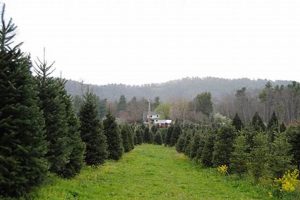
A property dedicated to cultivating trees, often for eventual sale as Christmas trees, landscaping specimens, or timber, when situated on sloping terrain, presents unique opportunities and challenges. These specialized agricultural operations require careful planning and management to maximize yield and minimize environmental impact due to the topography.
The location of such a business offers aesthetic advantages and potentially better drainage compared to flat land. This can lead to healthier trees and a more attractive setting for customers. Historically, these ventures have provided crucial seasonal employment and contributed to local economies, while also playing a role in carbon sequestration and soil conservation.
The following sections will delve into the specific techniques used in managing such a property, considering aspects like erosion control, species selection appropriate for the environment, and efficient harvesting methods that maintain the integrity of the landscape. Understanding these factors is key to the sustainable operation of any tree-growing endeavor located on an incline.
Management Strategies for Sloping Tree Cultivation
Optimizing tree growth and operational efficiency on gradients requires specific and carefully implemented strategies. Proper planning can improve yield, reduce environmental impact, and ensure long-term sustainability.
Tip 1: Erosion Control Implementation: Terracing is essential to minimize soil loss. By creating level platforms, water runoff is slowed, allowing for better absorption and reduced erosion. Planting ground cover between rows further stabilizes the soil.
Tip 2: Species Selection Based on Slope Aspect: The direction a slope faces affects sunlight exposure and moisture levels. Southern-facing slopes are drier and require drought-tolerant species, while northern-facing slopes retain more moisture, supporting different tree varieties.
Tip 3: Efficient Irrigation Systems: Drip irrigation is highly recommended on inclines to deliver water directly to the roots, minimizing water waste and erosion. Carefully placed emitters ensure even distribution across the slope.
Tip 4: Optimized Planting Density: Avoid overplanting, as this can lead to competition for resources and hinder growth. Spacing should be calculated based on the mature size of the selected species and the slope’s characteristics.
Tip 5: Contour Planting Techniques: Planting trees along the contour lines of the slope helps to interrupt water flow and reduce soil erosion. This method also maximizes water infiltration into the soil.
Tip 6: Strategic Harvesting Practices: Selective harvesting, rather than clear-cutting, preserves the integrity of the slope and minimizes disturbance to the surrounding environment. Consider using specialized equipment designed for operation on inclines.
Tip 7: Regular Soil Testing and Amendments: Soil composition can vary significantly across a slope. Regular testing allows for targeted application of amendments, ensuring optimal nutrient levels for healthy tree growth.
The success of any sloping tree-growing operation hinges on understanding and adapting to the unique challenges posed by the terrain. Implementing these tips fosters a healthy and productive environment.
The subsequent section will examine the long-term ecological benefits associated with careful and sustainable tree cultivation on sloping land.
1. Slope Stabilization Techniques

The successful operation of a hillside tree farm is inextricably linked to the effective implementation of slope stabilization techniques. The natural inclination of the terrain introduces the inherent risk of soil erosion, which, if unchecked, can lead to significant land degradation, loss of valuable topsoil, and ultimately, the failure of the tree crop. Therefore, employing various stabilization methods is not merely an optional practice but a fundamental necessity for the long-term viability of the enterprise. The cause-and-effect relationship is clear: inadequate stabilization leads to erosion, which directly impacts tree health and growth; conversely, robust stabilization practices foster a stable growing environment, promoting vigorous tree development.
Several techniques are commonly employed, each addressing specific aspects of slope stability. Terracing, for example, transforms a steep slope into a series of level platforms, effectively reducing the angle of repose and minimizing water runoff velocity. Retaining walls, constructed from materials such as stone or treated timber, provide structural support, preventing soil slippage. Ground cover vegetation, including grasses and low-growing shrubs, establishes a network of roots that bind the soil together, enhancing its resistance to erosion. The selection and application of these techniques are often tailored to the specific characteristics of the hillside, considering factors such as soil type, slope gradient, and prevailing weather patterns. In the case of a Christmas tree farm, incorporating rows of the trees themselves on contour lines adds another layer of erosion control, as the tree roots further stabilize the slope.
In conclusion, slope stabilization is not just a component of a hillside tree farm; it is a foundational element upon which the entire operation rests. Without adequate measures to mitigate erosion and maintain soil stability, the long-term productivity and sustainability of the farm are severely compromised. A comprehensive understanding of slope stabilization techniques and their application is essential for any individual or organization seeking to establish and maintain a thriving tree-growing business in a sloping environment. The challenge lies in selecting and implementing the most appropriate techniques for each unique hillside context, ensuring both environmental protection and economic viability.
2. Species Adaptability

The success of a hillside tree farm is intrinsically linked to the concept of species adaptability. Selecting tree varieties capable of thriving in the specific environmental conditions presented by a sloping landscape is not merely a consideration, but a fundamental determinant of long-term viability and profitability. The interplay between tree genetics and environmental factors dictates the health, growth rate, and overall productivity of the operation.
- Soil Type Tolerance
Hillside environments often exhibit significant variation in soil composition, drainage, and nutrient availability across relatively short distances. Selecting species tolerant of the prevailing soil type, whether it be acidic, alkaline, sandy, or clay-rich, is crucial. For example, certain pine species may thrive in well-drained, nutrient-poor soils characteristic of upper slopes, while spruce varieties may prefer the more moist, nutrient-rich conditions found in lower-lying areas. Failure to account for soil preferences can result in stunted growth, increased susceptibility to disease, and ultimately, economic losses.
- Slope Aspect and Microclimate
The direction a slope faces, known as its aspect, significantly influences sunlight exposure, temperature, and moisture levels. Southern-facing slopes tend to be warmer and drier, requiring drought-tolerant species such as certain juniper or fir varieties. Northern-facing slopes, conversely, are cooler and moister, potentially supporting species like hemlock or some spruce. Microclimates, localized variations in temperature and humidity, can also exist within a hillside, necessitating careful selection of species that can tolerate these specific conditions. Ignoring aspect and microclimate considerations can lead to uneven growth patterns and reduced overall productivity.
- Erosion Control and Root Structure
Certain tree species possess root systems that are particularly effective at stabilizing soil and preventing erosion, a critical concern on sloping landscapes. Deep-rooted species, such as oak or certain pines, can provide significant structural support, anchoring the soil and reducing the risk of landslides. Species with extensive, fibrous root systems, like certain shrubs and groundcovers, can further enhance erosion control by binding the soil surface. Integrating species with these desirable root characteristics into the tree farm design can contribute to long-term soil health and stability.
- Disease and Pest Resistance
Hillside tree farms, like all agricultural operations, are vulnerable to diseases and pests. Selecting species that exhibit natural resistance to common local diseases and pests can significantly reduce the need for chemical interventions, promoting environmental sustainability and reducing operational costs. For example, choosing disease-resistant varieties of Christmas trees can minimize the risk of widespread infestations that can decimate entire crops. Prioritizing disease and pest resistance in species selection is a proactive approach to ensuring the long-term health and productivity of the tree farm.
The strategic selection of species adapted to the specific environmental conditions of a hillside is a cornerstone of successful tree farm management. By carefully considering factors such as soil type, slope aspect, root structure, and disease resistance, operators can maximize productivity, minimize environmental impact, and ensure the long-term sustainability of their operations. Recognizing species adaptability is not merely an agronomic consideration, but a crucial element in the overall business strategy of a hillside tree farm.
3. Erosion Mitigation Strategies

The inherent instability of sloping terrain necessitates comprehensive erosion mitigation strategies as an integral component of any sustainable hillside tree farm operation. The relationship between these two elements is one of direct dependency; without proactive measures to control soil erosion, the long-term viability of the tree farm is severely compromised. The causes of erosion on hillsides are numerous, including rainfall impact, concentrated surface runoff, and gravity-induced soil creep. These forces, if unchecked, lead to the loss of valuable topsoil, which directly impacts tree health and growth. Furthermore, sediment runoff pollutes nearby water bodies, creating environmental problems that extend beyond the immediate property boundaries. The importance of erosion mitigation strategies lies in their ability to counteract these forces and maintain a stable, productive environment for tree cultivation. For instance, terracing transforms a steep slope into a series of level platforms, slowing down water runoff and allowing for better absorption. This technique, employed in vineyards and rice paddies for centuries, demonstrates the effectiveness of altering the landscape to manage erosion.
Specific applications of erosion mitigation strategies within a hillside tree farm context include the use of cover crops, contour planting, and strategic placement of water diversion structures. Cover crops, such as grasses or legumes, establish a dense root system that binds the soil and protects it from rainfall impact. Contour planting involves arranging trees along the contour lines of the slope, creating a series of natural barriers that intercept runoff. Water diversion structures, such as swales or check dams, redirect concentrated flow into vegetated areas where the water can infiltrate the soil. The selection of the most appropriate mitigation strategies depends on various factors, including the slope gradient, soil type, rainfall patterns, and the type of trees being cultivated. A case study of a Christmas tree farm in the Appalachian Mountains demonstrated that implementing a combination of terracing, cover cropping, and contour planting reduced soil loss by over 70% compared to traditional planting methods.
In conclusion, erosion mitigation strategies are not merely an add-on to hillside tree farm management; they are a fundamental prerequisite for long-term success. By understanding the causes and consequences of erosion and implementing appropriate mitigation techniques, tree farm operators can protect their investment, preserve the environment, and ensure the sustainable production of trees. The challenge lies in adapting these strategies to the specific characteristics of each hillside environment and integrating them seamlessly into the overall farm management plan. Failure to address erosion effectively can lead to significant economic and environmental consequences, underscoring the critical importance of prioritizing erosion mitigation in hillside tree farm operations.
4. Water Management Systems
Effective water management systems are an indispensable component of a successful hillside tree farm. The natural incline of the terrain presents unique challenges related to water distribution, erosion control, and overall tree health. Insufficient or poorly designed systems can lead to water scarcity in some areas, waterlogging in others, and increased soil erosion, all of which negatively impact tree growth and survival rates. A well-engineered system, conversely, ensures adequate water availability, minimizes erosion, and promotes the efficient use of this vital resource. The cause-and-effect relationship is evident: inadequate water management leads to stunted growth or tree loss; effective management promotes healthy, robust trees. For example, farms that rely solely on natural rainfall often experience significant variations in tree growth depending on slope position and seasonal precipitation patterns, whereas farms with managed systems can mitigate these fluctuations. The selection and implementation of appropriate water management strategies are therefore critical for achieving consistent and predictable yields.
Several water management techniques are commonly employed on sloping tree farms, including drip irrigation, micro-sprinklers, and surface water harvesting. Drip irrigation delivers water directly to the root zone of each tree, minimizing water waste through evaporation or runoff, a key advantage on inclined surfaces. Micro-sprinklers provide a broader coverage area than drip emitters but still offer targeted watering, reducing water loss compared to traditional overhead sprinklers. Surface water harvesting involves collecting rainwater runoff from roofs or other impervious surfaces and storing it in ponds or tanks for later use. This approach can significantly reduce reliance on external water sources and enhance the sustainability of the operation. An example is the construction of small check dams along drainage channels to slow water flow and increase infiltration, thus reducing erosion and replenishing groundwater reserves. The specific combination of techniques employed will depend on factors such as the size of the farm, the type of trees being grown, and the local climate.
In summary, water management systems are not simply an optional add-on for hillside tree farms; they are a fundamental requirement for long-term sustainability and profitability. The effective management of water resources is essential for ensuring adequate tree growth, minimizing erosion, and promoting environmental stewardship. The challenge lies in designing and implementing systems that are tailored to the specific conditions of each individual farm and that are economically viable in the long term. By prioritizing water management, tree farm operators can mitigate the risks associated with sloping terrain and create a thriving and resilient agricultural enterprise.
5. Sustainable Harvesting

Sustainable harvesting practices are paramount for the long-term economic and ecological viability of any hillside tree farm. These methods ensure that timber or other forest products are extracted in a manner that minimizes environmental impact, maintains biodiversity, and allows for the continued productivity of the land. The application of sustainable harvesting principles to sloping terrain presents unique challenges, necessitating careful planning and execution to prevent erosion, protect water quality, and preserve the aesthetic value of the landscape.
- Selective Cutting and Forest Structure
Selective cutting involves removing individual trees or small groups of trees while leaving the majority of the forest canopy intact. This approach maintains a diverse forest structure, promoting habitat for wildlife and reducing the risk of soil erosion. On a hillside tree farm, selective harvesting requires careful consideration of slope stability and water flow patterns to prevent landslides and minimize runoff. Properly implemented, selective cutting mimics natural disturbances and allows the forest to regenerate naturally.
- Erosion Control Measures during Harvesting
Harvesting operations on slopes inevitably disturb the soil, increasing the potential for erosion. Implementing erosion control measures during and after harvesting is essential to protect water quality and maintain soil productivity. These measures may include installing sediment barriers, constructing water diversion structures, and re-vegetating disturbed areas with native plant species. Minimizing the size of clearings and avoiding harvesting during periods of heavy rainfall are also crucial strategies for preventing erosion.
- Minimizing Soil Compaction
Heavy machinery used in harvesting operations can compact the soil, reducing its ability to absorb water and impeding tree root growth. Minimizing soil compaction is essential for promoting forest regeneration and maintaining soil health. This can be achieved by using low-impact harvesting equipment, limiting the number of passes with machinery, and operating equipment only when the soil is relatively dry. Implementing designated skid trails can further concentrate compaction in specific areas, leaving the majority of the forest floor undisturbed.
- Long-Term Forest Health and Productivity
Sustainable harvesting is not simply about extracting timber; it is about managing the forest as a whole to ensure its long-term health and productivity. This includes monitoring forest health, controlling invasive species, and promoting the growth of desirable tree species. On a hillside tree farm, sustainable harvesting practices should be integrated with overall forest management plans to create a resilient and diverse ecosystem that provides a variety of ecological and economic benefits.
The successful implementation of sustainable harvesting practices on a hillside tree farm requires a comprehensive understanding of forest ecology, hydrology, and soil science. It also requires a commitment to long-term stewardship and a willingness to adapt management practices based on monitoring and research. By embracing sustainable harvesting, tree farm operators can ensure that their operations are both environmentally responsible and economically viable.
6. Accessibility
The concept of accessibility is critical to the operational success and economic viability of a hillside tree farm. The sloping terrain characteristic of these farms presents inherent challenges to movement, both for personnel and equipment, directly impacting efficiency and cost-effectiveness. Limited accessibility can result in increased labor requirements, higher equipment maintenance costs, and difficulties in transporting harvested trees. Conversely, well-planned and implemented accessibility solutions can streamline operations, reduce risks, and improve overall profitability. For example, a farm lacking adequate roads may require more manual labor for planting and harvesting, significantly increasing operating expenses.
Accessibility considerations extend beyond simple road construction. The gradient and stability of pathways, the load-bearing capacity of bridges, and the turning radius of vehicles must all be factored into the design of the infrastructure. Furthermore, accessibility must be considered in the context of different seasons and weather conditions. Snow and ice can render steep paths impassable, while heavy rains can create muddy conditions that hinder vehicle movement. In a Christmas tree farm setting, consider the experience of customers as well. Well-maintained paths for individuals selecting their trees increase sales and positive experiences. Therefore, strategic planning and investment in appropriate infrastructure are essential for overcoming the challenges posed by sloping terrain.
In conclusion, accessibility is not merely a logistical concern for a hillside tree farm; it is a fundamental determinant of operational efficiency and profitability. By addressing the challenges posed by sloping terrain and implementing appropriate accessibility solutions, tree farm operators can reduce costs, improve safety, and enhance the overall sustainability of their operations. The lack of foresight regarding this matter causes tangible financial repercussions, solidifying accessibility as a core tenet of hillside tree farm management.
7. Economic Viability

The economic viability of a hillside tree farm is inextricably linked to its ability to generate revenue that exceeds its operational costs over the long term. Sloping terrain presents specific economic challenges that demand careful planning and efficient management. Increased costs associated with erosion control, specialized equipment, and labor can significantly impact profitability. The degree to which a hillside tree farm successfully addresses these challenges directly determines its long-term financial sustainability. For example, a tree farm incurring excessive erosion-related expenses due to inadequate mitigation strategies may face diminished yields and increased remediation costs, ultimately jeopardizing its economic prospects. Conversely, a farm strategically investing in preventative measures and efficient practices can achieve greater profitability and stability. This cause-and-effect relationship underscores the critical importance of economic viability as a foundational component of a successful hillside tree farm.
Diversification of revenue streams can significantly bolster the economic resilience of these businesses. Focusing solely on timber production may expose the farm to market volatility and cyclical demand fluctuations. Integrating other revenue-generating activities, such as Christmas tree sales, maple syrup production, or recreational opportunities like hiking trails or agritourism events, can provide supplementary income streams and buffer against economic downturns. For instance, a New England tree farm capitalizing on foliage tourism during the fall months can generate substantial revenue, offsetting potential losses from timber sales. Furthermore, effective cost management, including optimizing fertilizer application, controlling pests and diseases, and minimizing equipment downtime, plays a crucial role in maximizing profitability. Real-world examples of successful hillside tree farms often demonstrate a proactive approach to both revenue generation and cost control, ensuring a stable financial foundation.
In conclusion, economic viability is not merely a desirable outcome for a hillside tree farm; it is an essential prerequisite for its long-term survival. The unique challenges posed by sloping terrain necessitate a comprehensive approach that integrates efficient management practices, diversified revenue streams, and proactive cost control measures. A failure to prioritize economic viability can lead to financial instability and ultimately, the demise of the enterprise. Understanding the practical significance of this connection and implementing appropriate strategies are crucial for ensuring the continued success and sustainability of hillside tree farms. The ongoing viability is dependent on the farm’s adaptation and economic sustainability.
Hillside Tree Farm
The following section addresses common inquiries regarding the establishment, operation, and management of a tree farm situated on sloping terrain. The information provided is intended to offer clarity and guidance on key considerations.
Question 1: What are the primary challenges associated with establishing a hillside tree farm?
Establishing a tree farm on a hillside presents unique challenges, including increased susceptibility to soil erosion, difficulties in accessing and managing the land with conventional equipment, and variations in soil moisture and nutrient availability due to slope aspect.
Question 2: How does slope aspect affect tree selection for a hillside tree farm?
Slope aspect, the direction a slope faces, significantly influences sunlight exposure, temperature, and moisture levels. Southern-facing slopes tend to be drier and warmer, requiring drought-tolerant species, while northern-facing slopes are generally cooler and moister, supporting a different range of tree varieties.
Question 3: What erosion control measures are most effective on a hillside tree farm?
Effective erosion control measures include terracing, contour planting, the use of cover crops, and the construction of water diversion structures. These techniques help to slow water runoff, stabilize the soil, and prevent the loss of valuable topsoil.
Question 4: How does water management differ on a hillside tree farm compared to a flatland operation?
Water management on a hillside tree farm requires careful consideration of runoff patterns and drainage. Drip irrigation and micro-sprinklers are often preferred over traditional overhead sprinklers to minimize water waste and erosion. Water harvesting techniques can also be employed to capture and reuse rainwater.
Question 5: What specialized equipment is typically required for operating a hillside tree farm?
Operating a tree farm on sloping terrain may necessitate the use of specialized equipment, such as all-terrain vehicles (ATVs), tractors with hillside capabilities, and winches for transporting trees. The specific equipment needs will depend on the slope gradient and the type of trees being grown.
Question 6: What are the long-term sustainability considerations for a hillside tree farm?
Long-term sustainability requires a holistic approach that integrates erosion control, water management, and responsible harvesting practices. Maintaining soil health, protecting biodiversity, and minimizing the use of chemical inputs are also crucial for ensuring the long-term viability of the operation.
Understanding these fundamental aspects is crucial for the successful establishment and management of a productive and environmentally responsible tree farm in a sloped environment. The ability to adapt and implement these methods will determine the success of the farm.
The following section will explore the regulatory and permitting requirements associated with establishing and operating a tree farm.
Hillside Tree Farm
This exploration of the operations on inclines has highlighted several crucial elements, including slope stabilization techniques, species adaptability, erosion mitigation strategies, water management systems, accessibility considerations, and the overarching importance of economic viability. Successful ventures in this sector require a comprehensive understanding of these interlinked factors.
The future of such enterprises hinges on embracing sustainable practices and adapting to evolving environmental and economic landscapes. A commitment to responsible land stewardship and continuous improvement will ensure the continued provision of valuable resources and ecological benefits from these unique environments. Consider the information provided herein when evaluating investment and resource allocation decisions.

![Smiths Christmas Tree Farm: [Your City/Region]'s Best Holiday Tree | The Conscious Farmer | Sustainable Agriculture for a Healthier Planet](https://livingedgefarm.com/wp-content/uploads/2025/08/th-8055-300x200.jpg "Smiths Christmas Tree Farm: [Your City/Region]'s Best Holiday Tree The Conscious Farmer | Sustainable Agriculture for a Healthier Planet")