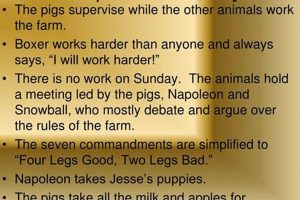
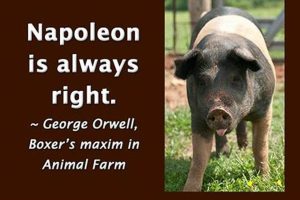
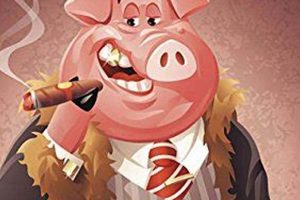
The concluding section of Orwell’s allegorical novella depicts the farm years after the revolution. The narrative details the complete transformation of the animal-led society back into a state resembling, and ultimately surpassing, its initial oppressive conditions under human ownership. The pigs, having consolidated their power, have adopted human habits, including walking upright, carrying whips, and wearing clothes. The other animals find themselves working just as hard, if not harder, than they did under Mr. Jones, but now with less food and no hope of a better future. Squealer continues to manipulate the animals through propaganda and rewritten history, ensuring their continued obedience and preventing any possibility of rebellion.
Understanding this chapter provides crucial insight into the dangers of unchecked power, the manipulation of language, and the cyclical nature of revolutions. It underscores the novel’s overall message about the corrupting influence of authority and the fragility of utopian ideals. Its historical context lies in the Russian Revolution, serving as a cautionary tale about the betrayal of revolutionary principles and the rise of totalitarian regimes. The chapter highlights how easily ideals can be distorted and used to justify oppression, ultimately demonstrating the importance of vigilance against those who seek to control others.
The focus now shifts to a more detailed examination of specific elements within the chapter, including the changing commandments, the pigs’ interactions with humans, and the final, devastating realization for the other animals. A closer analysis of these aspects provides a deeper appreciation for Orwell’s masterful critique of power and societal control as presented in the concluding pages.
Analyzing the Concluding Chapter
Examining the concluding chapter offers critical lessons regarding power dynamics and societal control, as demonstrated within the allegorical narrative.
Tip 1: Recognize the Erosion of Ideals: Observe how revolutionary principles are gradually subverted. Note the slow, incremental changes that lead to the complete betrayal of the initial vision, illustrating how easily noble aims can be corrupted.
Tip 2: Identify the Manipulation of Language: Pay close attention to Squealer’s role in rewriting history and distorting the truth. Understanding his techniques reveals how propaganda and biased narratives can maintain control and suppress dissent.
Tip 3: Analyze the Role of the Working Class: Consider the complacency and ignorance of the other animals. Their inability to question authority or recognize the pigs’ deceit contributes to their oppression, highlighting the importance of critical thinking and awareness.
Tip 4: Understand the Cyclical Nature of Power: Recognize the repetition of oppressive structures. The farm reverts to a state even worse than under Mr. Jones, demonstrating the inherent dangers of unchecked power, regardless of who wields it.
Tip 5: Examine the Symbolism of the Final Scene: Interpret the pigs’ transformation into indistinguishable figures from the humans. This symbolizes the complete erasure of the revolution’s original intent and the ultimate corruption of its leaders.
Tip 6: Contextualize with Historical Events: Relate the events to the Russian Revolution and other historical instances of totalitarian regimes. This provides a broader understanding of the novel’s relevance and its warning against the abuse of power.
Understanding these critical elements allows for a more comprehensive grasp of the concluding chapter’s significance and its implications for understanding societal dynamics.
Moving forward, it’s important to consider the broader themes and lasting legacy of the complete work, reflecting on its message and its continued relevance in contemporary society.
1. Pigs' Humanization
The pigs’ humanization within the concluding chapter is not merely a superficial transformation but rather a culmination of their gradual assumption of power and abandonment of Animalism. This process, starting with small privileges like sleeping in beds and culminating in walking upright and carrying whips, signifies the complete corruption of the revolution’s initial ideals. It represents a direct cause-and-effect relationship: the pigs’ unchecked power leads to their adoption of the very traits they initially condemned in humans. This adoption is a key component, providing a tangible illustration of the revolution’s failure and the re-establishment of oppressive hierarchies. Historical parallels exist in various revolutions where initial leaders, after securing power, mirrored the behaviors and excesses of the regimes they overthrew.
Examining specific instances, such as the pigs’ acquisition of human clothing and their convivial gatherings with neighboring farmers, highlights the practical implications of this transformation. These actions demonstrate the pigs’ increasing detachment from the other animals and their growing integration into the world of human exploitation. This has practical significance because the other animals see the betrayal, yet they are in no condition to fight back or rebel for equality. The pigs, representing the ruling class, prioritize their self-interest and solidify their control, mirroring the actions of corrupt political elites in real-world scenarios. This transformation is not just a symbolic device; it is a functional one, enabling the pigs to better exploit and control the other animals.
In summary, the pigs’ humanization encapsulates the novel’s central message about the corrupting influence of power. The challenge lies in recognizing and preventing the gradual erosion of ideals that leads to such a complete reversal of revolutionary principles. This understanding connects to the broader theme of vigilance against those who seek to control and exploit others, regardless of their initial intentions or professed ideologies, as the story of Animal Farm provides a fictional but pertinent warning for real-world application.
2. Exploitation Continues

The persistence of exploitation in the concluding chapter directly underscores the complete failure of the animal revolution. This continuation is not simply a status quo; it represents an intensification of labor demands coupled with diminishing returns for the working animals. The chapter illustrates how the pigs, initially promising liberation, have established a system more oppressive than that of Mr. Jones. This outcome highlights a crucial cause-and-effect relationship: the unchecked consolidation of power by the pigs inevitably leads to increased exploitation of the other animals. “Exploitation Continues” functions as a vital component within the chapter, demonstrating the cyclical nature of oppression and the futility of revolution without genuine systemic change. Historically, numerous revolutions have resulted in a similar transfer of power from one exploitative group to another, such as certain post-colonial states where indigenous elites replaced foreign rulers, maintaining exploitative economic structures.
Analyzing specific examples within the chapter, such as the increased working hours, the reduced food rations, and the construction of the windmill under increasingly harsh conditions, reveals the practical implications of this continued exploitation. The animals’ inability to challenge the pigs’ authority, coupled with Squealer’s propaganda, ensures their continued subjugation. This has practical significance, as it demonstrates the effectiveness of propaganda and the suppression of dissent in maintaining exploitative systems. Consider historical examples of labor exploitation during industrial revolutions, where workers faced inhumane conditions and minimal compensation, highlighting the enduring nature of this societal issue. The animals’ plight mirrors these instances, underscoring the universality of exploitation when power is concentrated and unchecked.
In summary, the continued exploitation evident in the concluding chapter encapsulates the novel’s pessimistic outlook on revolution and power dynamics. The challenge lies in identifying and dismantling the underlying structures that perpetuate exploitation, rather than simply replacing one group of oppressors with another. This understanding connects to the broader theme of social justice and the need for constant vigilance against the abuse of power, offering a cautionary tale about the potential for revolutions to be co-opted and transformed into instruments of further oppression. Understanding that “Exploitation Continues” highlights the importance of systematic, rather than simply superficial, change to avoid the repetition of this tragic outcome.
3. Commandments' Erasure

The erasure and subsequent alteration of the Seven Commandments in the concluding chapter represents a pivotal element in the overall narrative. This act is not merely a symbolic gesture; it is a systematic dismantling of the foundational principles upon which Animal Farm was established. The Commandments, initially intended to prevent animal exploitation by humans, are gradually modified to suit the pigs’ increasingly self-serving agenda. There exists a direct cause-and-effect relationship where the pigs’ acquisition of power leads directly to the manipulation and eventual obliteration of the original moral code. The Commandments’ erasure serves as a critical component within, signifying the ultimate betrayal of the revolution’s ideals and the descent into totalitarian rule. Historically, the manipulation of foundational laws and principles has been a common tactic employed by autocratic regimes to legitimize their actions and suppress dissent, as seen in the revisionist interpretations of historical events by totalitarian states.
Analyzing the specific alterations, such as the change from “No animal shall drink alcohol” to “No animal shall drink alcohol to excess,” reveals the practical implications of this manipulation. Such subtle modifications allow the pigs to indulge in activities previously forbidden while maintaining the illusion of adherence to Animalism. Similarly, the transformation of “All animals are equal” to “All animals are equal, but some animals are more equal than others” openly acknowledges the newly established hierarchy and justifies the pigs’ privileged status. This has practical significance in demonstrating how language can be used to distort reality and legitimize inequality. Consider instances of corporate greenwashing, where companies use misleading language to present themselves as environmentally responsible while engaging in practices that harm the environment. The pigs’ manipulation of the Commandments mirrors such tactics, illustrating the power of language to deceive and control.
In summary, the Commandments’ erasure encapsulates the novel’s warning about the dangers of unchecked power and the manipulation of ideology. The challenge lies in recognizing and resisting such subtle forms of manipulation and remaining vigilant against those who seek to distort the truth for their own gain. This understanding connects to the broader theme of critical thinking and the importance of upholding principles of justice and equality, providing a cautionary tale about the potential for revolutionary ideals to be perverted and used as instruments of oppression. Preventing the erasure of fundamental principles necessitates a commitment to transparency, accountability, and the preservation of historical truth.
4. Hope's Extinguishment

The pervasive atmosphere of “Hope’s Extinguishment” in the concluding section is intrinsically linked to the events described within. The complete erosion of the original revolutionary ideals, coupled with the intensification of labor and the manipulation of the governing principles, leads directly to a state of profound disillusionment among the animals. There exists a clear cause-and-effect relationship: the pigs’ betrayal of the revolution causes the dissipation of any remaining hope for a better future. The extinction of hope functions as a crucial component, signifying the ultimate failure of Animal Farm and the triumph of oppressive forces. Historically, the collapse of hope has often been a precursor to societal stagnation and the entrenchment of autocratic regimes, as seen in periods following failed revolutions where populations succumb to apathy and resignation.
Analyzing specific details, such as Boxer’s unwavering yet ultimately futile dedication, highlights the practical implications of “Hope’s Extinguishment”. Despite his tireless efforts, Boxer is betrayed and sent to the knacker, symbolizing the crushing of individual aspirations under a totalitarian system. The younger generation of animals, born into this oppressive reality, lacks any memory of the revolution’s initial promise, further contributing to the sense of despair. This absence of hope breeds apathy and prevents any potential for resistance. Consider instances where propaganda and censorship have been used to stifle dissent and maintain control, effectively extinguishing any hope for change. The animals’ gradual acceptance of their diminished circumstances mirrors the phenomenon of learned helplessness, where individuals cease to resist oppressive conditions due to repeated failures and a perceived lack of control.
In summary, “Hope’s Extinguishment” encapsulates the tragic outcome of Animal Farm and serves as a potent warning against the dangers of unchecked power and the betrayal of revolutionary ideals. Recognizing the factors that contribute to the loss of hope is crucial for preventing similar outcomes in real-world contexts. This understanding connects to the broader theme of social justice and the importance of fostering resilience and critical thinking in the face of adversity. Maintaining hope requires vigilance against manipulation, a commitment to preserving historical memory, and the active promotion of principles of equality and justice.
5. Identity Loss
The concluding chapter illustrates a profound erosion of identity among the animals, directly connected to the broader themes of societal decay and totalitarian control. This phenomenon extends beyond individual experiences, impacting the collective understanding of their shared history and purpose.
- Erosion of Animalism
The gradual abandonment of Animalism as a distinct ideology directly contributes to identity loss. As the pigs appropriate human behaviors and rewrite the commandments, the fundamental principles that defined the animals’ identity are eroded. The animals no longer possess a unique philosophy separating them from their former oppressors, leading to a blurring of boundaries and a diminished sense of self.
- Suppression of Individual Expression
The pigs’ totalitarian regime actively suppresses any form of individual expression or dissent. This includes the silencing of dissenting voices and the promotion of propaganda designed to enforce conformity. As the animals are deprived of their ability to express their thoughts and feelings, they become increasingly homogenized, losing their individual identities within the collective.
- Historical Amnesia
Squealer’s manipulation of historical records creates a state of historical amnesia, further contributing to identity loss. By rewriting the past to suit the pigs’ agenda, the animals are deprived of a clear understanding of their revolution’s origins and its original goals. This distortion of history undermines their sense of collective identity and makes them more susceptible to manipulation.
- Physical and Mental Exhaustion
The unrelenting labor and harsh living conditions experienced by the animals contribute to their physical and mental exhaustion. This state of exhaustion diminishes their capacity for critical thought and self-reflection, making them more vulnerable to the pigs’ propaganda and less able to resist the erosion of their identities. The constant struggle for survival overshadows any sense of individual purpose or agency.
These facets of identity loss collectively paint a bleak picture of societal disintegration under totalitarian rule. The erosion of Animalism, the suppression of expression, the manipulation of history, and the physical and mental exhaustion of the animals all contribute to the final, devastating realization that Animal Farm has become indistinguishable from the oppressive society it initially sought to overthrow. This loss of identity underscores the novel’s warning about the dangers of unchecked power and the importance of preserving individual and collective identity in the face of tyranny.
Frequently Asked Questions
This section addresses common questions regarding the concluding chapter of Orwell’s Animal Farm and its significance within the broader context of the novella.
Question 1: What is the primary focus of the final chapter?
The primary focus is the complete reversion of Animal Farm to a state resembling its pre-revolutionary conditions, highlighting the pigs’ consolidation of power and the animals’ continued exploitation.
Question 2: How does the pigs’ behavior evolve in this final section?
The pigs fully embrace human characteristics, including walking upright, wearing clothes, and engaging in trade with neighboring farmers, symbolizing their complete betrayal of Animalist principles.
Question 3: What happens to the Seven Commandments by the conclusion of the story?
The Seven Commandments are either altered to suit the pigs’ self-serving agenda or replaced entirely with a single commandment: “All animals are equal, but some animals are more equal than others.”
Question 4: What is the significance of the other animals’ passivity?
The other animals’ inability to recognize the pigs’ manipulation and their acceptance of increasingly harsh conditions underscores the dangers of ignorance and the importance of critical thinking in resisting oppression.
Question 5: What are some historical parallels to the events depicted in this chapter?
The chapter reflects the cyclical nature of revolutions where initial ideals are often betrayed, mirroring events in the Russian Revolution and other historical instances of totalitarian regimes.
Question 6: What overarching message does the concluding chapter convey?
The concluding chapter serves as a cautionary tale about the corrupting influence of power, the manipulation of language, and the importance of vigilance in safeguarding against oppression and ensuring social justice.
In essence, this last section underscores the novel’s pessimistic view of utopian endeavors while providing stark insight on absolute power, corruption and societal structures. The core message is about awareness of inequality.
The analysis will now explore the themes present with examples to guide the discussion.
Concluding Remarks
The preceding analysis of the concluding section has elucidated the profound implications within. Key points considered included the pigs’ complete transformation, mirroring human vices; the continued exploitation of the other animals, exceeding previous levels; the systematic erasure of the original Commandments; the extinguishing of hope among the oppressed; and the ultimate loss of distinct animal identity. These elements converge to depict a society where the revolution’s initial aspirations have been entirely subverted, resulting in an oppressive regime that surpasses the previous human control. The narrative provides a disturbing cautionary tale about the corrupting influence of power and the fragility of utopian ideals.
The enduring relevance lies in its stark depiction of power dynamics and the importance of vigilance against those who seek to control and exploit others. Understanding its principles is crucial for fostering informed citizenry capable of resisting manipulation and upholding principles of equality and social justice, ensuring that the lessons learned from this allegorical tragedy are not forgotten.