In George Orwell’s Animal Farm, a central ideology fuels the revolution. This ideology, often considered the story’s equivalent to communism, proposes a society where animals are free from human tyranny and exploitation. The core tenets promote equality among all creatures, shared labor, and collective ownership of resources. It envisions an egalitarian community devoid of social hierarchies or individual enrichment at the expense of others. For example, the Seven Commandments, initially representing this guiding philosophy, aim to prevent actions associated with human oppression, such as sleeping in beds, wearing clothes, or drinking alcohol.
The significance of this ideological framework lies in its function as a catalyst for the animals’ rebellion and their subsequent attempt to create a utopian society. It provides a compelling motivation for the animals to overthrow Mr. Jones and take control of the farm. Understanding the principles and promises inherent within this system is essential to grasping the initial optimism and ultimate tragedy that unfolds. Historically, it serves as an allegorical representation of the Russian Revolution and the subsequent distortion of communist ideals under Stalin’s regime. The rapid deviation from its original principles underscores the potential for corruption and the dangers of unchecked power, even within seemingly utopian systems.
Subsequent analysis will delve into how this initial vision is corrupted and manipulated by the pigs, leading to a totalitarian state mirroring the oppressive conditions it initially sought to eradicate. This examines the specific ways in which the Seven Commandments are altered and the consequences of this manipulation on the lives of the other animals, revealing the crucial themes of power, propaganda, and social control within the novella.
Tips for Understanding its Role
To effectively analyze the role of the central ideology in Animal Farm, consider the following points. These suggestions facilitate a deeper comprehension of its implementation, corruption, and ultimate impact on the narrative.
Tip 1: Identify Core Tenets: Pinpoint the fundamental principles initially established. These include equality, collective ownership, and the elimination of human exploitation. Note how these principles are explicitly defined and later subverted.
Tip 2: Trace the Evolution of the Seven Commandments: Track the modifications made to the Commandments throughout the story. Each alteration signifies a shift in power and a departure from the original egalitarian ideals. Analyze the specific wording changes and their implications.
Tip 3: Analyze Pig Leadership Strategies: Examine the methods employed by the pigs to maintain control and justify their actions. Focus on how they utilize propaganda, manipulate language, and exploit the other animals’ ignorance to solidify their dominance.
Tip 4: Compare Initial Vision to the Final Reality: Contrast the utopian ideals presented at the outset of the rebellion with the dystopian conditions that emerge under the pigs’ rule. This comparison highlights the devastating consequences of unchecked power and corruption.
Tip 5: Recognize the Role of Key Characters: Evaluate how individual characters contribute to or are affected by the changing ideological landscape. For example, assess Boxer’s unwavering loyalty, Benjamin’s cynicism, and Clover’s growing unease to understand the diverse reactions to the corruption of the original system.
Tip 6: Explore the Allegorical Connections: Recognize the parallels between the events in Animal Farm and the Russian Revolution. Understanding the historical context enhances comprehension of the political satire and the cautionary message regarding totalitarian regimes.
Tip 7: Assess the Consequences of Ignorance and Apathy: Note how the lack of education and critical thinking among the majority of the animals allows the pigs to manipulate them effectively. This highlights the importance of intellectual independence and vigilance in preserving freedom.
By focusing on these aspects, a comprehensive analysis of its role is achievable, revealing the novel’s enduring relevance as a critique of political ideology and power dynamics.
These insights enable a more nuanced understanding of the novel’s themes, paving the way for deeper exploration of the characters, plot, and allegorical significance.
1. Equality

Equality constitutes a cornerstone of the revolutionary ideology depicted in George Orwell’s Animal Farm. This principle, integral to the animals’ initial vision, dictates that all creatures are inherently equal, irrespective of their species, physical strength, or intellectual capacity. The promise of equality serves as a primary motivation for the animals’ rebellion against Mr. Jones, providing a compelling rationale for their collective action. They envision a society free from the hierarchies and injustices imposed by humans, where every animal shares in the benefits of their labor. Without the fundamental commitment to equality, the entire ideological foundation of the farm collapses. The animals would have no incentive to overthrow their human oppressor and replace it with their own leadership.
The importance of equality within the ideological framework of the farm is underscored by the initial formulation of the Seven Commandments, which explicitly denounce any behavior that suggests a hierarchy or preferential treatment. Commandments prohibiting sleeping in beds, wearing clothes, or drinking alcohol are all rooted in the desire to avoid replicating the inequalities observed under human rule. However, the subsequent erosion of equality under the pigs’ leadership illustrates the fragility of this principle and the ease with which it can be subverted in the pursuit of power. The pigs, through systematic manipulation and propaganda, gradually elevate themselves above the other animals, justifying their preferential treatment by claiming intellectual superiority and the necessity of their leadership. This betrayal of the original ideal has real-world parallels in several revolutions where equality was sacrificed for the benefit of few.
The demise of equality on the farm serves as a cautionary tale about the dangers of unchecked power and the importance of vigilance in safeguarding fundamental principles. The transformation of Animal Farm from a nascent utopia into a totalitarian state highlights the practical significance of understanding how easily ideals can be corrupted and manipulated. The story underscores that true equality requires not only the absence of external oppression but also a constant effort to prevent the emergence of internal hierarchies and the abuse of power. Without constant oversight and critical evaluation of leadership, even the noblest of aspirations can devolve into tyranny, mirroring the very injustices they sought to overcome. The tragedy underscores the need to maintain that equality is not just a starting point, but an ongoing commitment.
2. Collective Ownership

Within the framework of Animal Farm, the concept of collective ownership stands as a pivotal component, fundamentally intertwined with the ideology driving the animal revolution. This principle, representing a rejection of private property and individual accumulation of wealth, dictates that all resources and means of production are owned and controlled by the community as a whole. It is presented as a necessary condition for achieving equality and preventing the exploitation inherent in a system of private ownership. This communal approach is key to understanding the initial aims and subsequent corruption within the farm’s social structure.
- Resource Distribution
Collective ownership necessitates a system for distributing resources equitably among the population. In the early stages of Animal Farm, this is reflected in the shared labor and equal access to food. The animals work together to harvest crops, and the yield is intended to be divided fairly. The failure of this system, as the pigs begin to hoard resources for themselves, demonstrates the practical challenges of maintaining collective ownership without transparency and accountability. A real-world parallel can be found in the Israeli kibbutz movement, where communal ownership and shared labor were central tenets. However, even in these intentional communities, issues of individual contribution and differing needs have presented ongoing challenges to equitable distribution.
- Decision-Making Processes
Effective collective ownership requires a mechanism for collective decision-making. Initially, Animal Farm operates under the supposed guidance of open meetings and debates, allowing all animals to participate in shaping the farm’s policies. However, this democratic process is gradually eroded as the pigs consolidate power and begin to make decisions unilaterally. The absence of genuine collective input and the suppression of dissenting voices undermine the very foundation of communal ownership. The failure to establish robust and inclusive decision-making processes highlights a common pitfall of collectivized systems, observed historically in various communist regimes where centralized control stifled individual agency and grassroots participation.
- Incentives and Productivity
The success of collective ownership hinges on creating incentives for individuals to contribute their labor effectively. In Animal Farm, the initial enthusiasm and shared sense of purpose motivate the animals to work diligently. However, as the pigs exploit the other animals and appropriate the fruits of their labor, motivation wanes. The lack of individual reward and the perception of unfair distribution lead to decreased productivity and resentment. This mirrors historical experiences in collectivized agricultural systems, where the absence of private incentives often resulted in lower yields and widespread dissatisfaction. Finding a balance between collective benefit and individual recognition remains a critical challenge for any attempt to implement collective ownership.
- Prevention of Exploitation
At its core, the idea is supposed to prevent exploitation. By eliminating private property, the animals are meant to avoid the accumulation of wealth and power in the hands of a few. This, however, is what happens as the pigs grab more and more power. They create situations where the original idea is no longer about collective ownership, but individual. They start to exploit the other animals just like the humans did, and the other animals do not even realize it at the time, just like in historical revolutions where the people ended up worse than before the revolution.
In conclusion, the concept of collective ownership in Animal Farm serves as both a utopian aspiration and a cautionary tale. While it initially embodies the promise of equality and shared prosperity, its ultimate failure underscores the practical difficulties of implementing such a system, particularly in the absence of transparency, accountability, and genuine collective participation. The distortion of collective ownership by the pigs highlights the vulnerability of even the noblest ideals to corruption and the importance of safeguarding against the abuse of power, reinforcing the allegorical message of the novella.
3. Animal Liberation

The aspiration for liberation from human oppression forms a cornerstone of the ideology within Animal Farm. This principle serves as the primary catalyst for the animals’ rebellion, framing their struggle as a fight for autonomy and freedom from exploitation. Understanding this objective is essential for interpreting the animals’ motivations and the subsequent trajectory of their society.
- Overthrow of Human Authority
Achieving liberation necessitates the complete dismantling of human control over the farm. This includes not only the expulsion of Mr. Jones but also the rejection of all practices and customs associated with human dominion. The animals initially embrace this goal wholeheartedly, destroying symbols of their former enslavement, such as whips and chains. The act of rebellion itself becomes a tangible expression of their desire for self-determination and a rejection of imposed subjugation.
- Rejection of Anthropocentrism
Animal liberation implies a rejection of anthropocentrism, the belief that humans are superior to other species and have the right to exploit them. Within the context of the farm, this translates into a conscious effort to establish a society based on equality, where animals are no longer viewed as mere instruments for human benefit. The Seven Commandments, particularly those prohibiting sleeping in beds, wearing clothes, and drinking alcohol, reflect a desire to distance themselves from human habits and establish a distinct animal identity.
- Self-Governance and Autonomy
True liberation entails the capacity for self-governance and autonomous decision-making. The animals initially attempt to establish a democratic system, with open meetings and debates to determine the farm’s policies. However, the pigs gradually seize control and manipulate the decision-making process to serve their own interests, ultimately betraying the animals’ aspiration for self-determination. The erosion of self-governance highlights the dangers of unchecked power and the importance of vigilance in safeguarding freedom.
- Economic Emancipation
An important facet involves gaining control over their labor and the products of their labor. In the initial rebellion, they envision that they will gain full emancipation over the means of production and will be able to fairly and equally split the profit, but the pigs take over and make it so the other animals are working and they are the only ones benefiting, which is similar to how the humans ran the farm.
In conclusion, the animals’ pursuit of liberation within Animal Farm serves as a potent allegory for revolutionary movements that seek to overthrow oppressive regimes. While the initial vision of freedom and equality is compelling, the novella underscores the practical challenges of achieving and sustaining liberation in the face of internal power struggles and the potential for corruption. The animals’ ultimate descent into a new form of tyranny highlights the importance of critical thinking, democratic governance, and constant vigilance in safeguarding hard-won freedoms, underscoring a bleak message for any revolutionary movement.
Shared labor forms an integral component of the ideological system presented within Animal Farm, directly reflecting the principles of communal effort and collective benefit inherent within its revolutionary context. This facet examines the relationship between collaborative work and the animals’ initial aspirations for an egalitarian society.
- Elimination of Exploitation
The concept of shared labor aims to eliminate the exploitation of one animal by another. Under Mr. Jones’s rule, the animals toiled for human benefit, receiving only minimal sustenance in return. The revolution seeks to replace this system with one in which all animals contribute according to their ability, and the fruits of their labor are distributed equitably. This principle reflects a core tenet of many socialist ideologies, which advocate for the abolition of wage labor and the establishment of a worker-controlled economy. For example, in early Soviet Russia, collectivized farms aimed to distribute labor and resources among the peasantry, although the implementation often diverged significantly from the ideal.
- Collective Productivity
The initial success of Animal Farm is attributed to the animals’ collective productivity. Driven by a shared sense of purpose and the promise of a better future, the animals work tirelessly to cultivate the land and build a prosperous community. This demonstrates the potential of collaborative effort to achieve significant outcomes when individuals are motivated and aligned towards a common goal. Similar examples can be found in cooperative movements throughout history, where communities have pooled their resources and labor to achieve economic self-sufficiency and social well-being. However, maintaining this collective productivity requires sustained commitment, effective organization, and equitable distribution of benefits.
- Social Unity and Cohesion
Shared labor fosters a sense of social unity and cohesion among the animals. Working side-by-side, they develop bonds of camaraderie and mutual support, strengthening their collective identity and reinforcing their commitment to the farm’s ideals. This sense of community is essential for overcoming challenges and maintaining solidarity in the face of adversity. Examples of this can be observed in traditional agricultural societies, where communal work practices contribute to social cohesion and reinforce shared cultural values. However, as divisions emerge and inequalities widen, the sense of unity erodes, undermining the social fabric of the community.
- Subversion by the Pigs
The pigs gradually manipulate the system of shared labor to their own advantage. While initially participating in the work, they soon begin to delegate tasks to the other animals, while reserving the easiest and most rewarding jobs for themselves. Through propaganda and coercion, they convince the other animals to work harder and longer hours, while disproportionately benefiting from their labor. This betrayal of the principle of shared labor reflects a common theme in revolutionary narratives, where idealistic goals are often undermined by the self-serving actions of those in power. The Soviet Union under Stalin is an example where shared labor in practice devolved into an oppressive system that only benefited the elite.
The narrative underscores that shared labor, while initially promising, is susceptible to corruption and manipulation. The pigs’ exploitation of the other animals demonstrates that even the most well-intentioned ideals can be distorted in the pursuit of power, resulting in a society that mirrors the very oppression it sought to overcome. The ultimate failure highlights the importance of accountability, transparency, and vigilance in safeguarding against the abuse of power.
5. Oppose Human Oppression

Within Animal Farm, the principle of opposing human oppression serves as the foundational motivation for the animal revolution and underpins the ideological system often referred to as “animal farm what is animalism.” This inherent opposition not only defines the initial purpose of the rebellion but also shapes the subsequent development and ultimate corruption of the society the animals attempt to establish.
- Rejection of Exploitation
Opposing human oppression necessitates the complete rejection of all forms of exploitation imposed by humans. This encompasses the animals’ forced labor, the withholding of resources, and the overall subjugation to human will. The act of rebellion itself becomes a symbolic rejection of this exploitation, with the animals seizing control of the farm and declaring their independence from human dominance. Historically, anti-colonial movements often mirror this rejection of exploitation, with colonized populations rising up against imperial powers to reclaim their autonomy and resources.
- Establishment of Self-Governance
The desire to oppose human oppression compels the animals to establish a system of self-governance, where they make their own decisions and control their own destinies. This reflects a fundamental principle of self-determination, wherein communities have the right to govern themselves without external interference. The animals’ initial attempts to create a democratic society, with open meetings and collective decision-making, demonstrate their commitment to this principle. However, the subsequent rise of the pigs and their consolidation of power highlight the challenges of maintaining self-governance in the face of internal power struggles and corruption. A real-world example of this struggle can be seen in post-revolutionary societies, where the initial ideals of self-governance often give way to authoritarian rule.
- Preservation of Animal Identity
Opposing human oppression requires the preservation and celebration of animal identity, distinct from human customs and values. The animals seek to create a society that reflects their unique needs and characteristics, free from the constraints imposed by human expectations. The Seven Commandments, particularly those prohibiting the adoption of human behaviors, symbolize this desire to maintain a distinct animal identity. However, as the pigs increasingly adopt human traits, such as walking on two legs and wearing clothes, they betray this principle and erode the boundary between animal and human, signifying the corruption of the original ideology. Indigenous cultures around the world often face similar challenges in preserving their unique identities in the face of cultural assimilation and external pressures.
- Challenge to Anthropocentrism
At its core, this opposition challenges anthropocentrism, the view that humans are the most important beings. The animals seek to create a society where all species are valued and respected, rejecting the human-centric worldview that has justified their oppression. However, the pigs eventually replicate this anthropocentric mindset, viewing themselves as superior to the other animals and exploiting them for their own benefit. The end of the book signifies that the animals are back where they started, but their role is being played by the pigs.
These facets demonstrate that opposing human oppression constitutes a multifaceted principle that is supposed to be the center of “animal farm what is animalism”. While it initially serves as a powerful catalyst for change and a unifying force for the animals, the novella underscores the inherent difficulties in sustaining this opposition in the face of internal power struggles and the allure of dominance. The corruption of this core principle ultimately leads to the animals’ descent into a new form of tyranny. This highlights the complexities inherent in any social change movement and the importance of being vigilant in safeguarding from the return of an oppressor, whether human or animal.
6. Seven Commandments

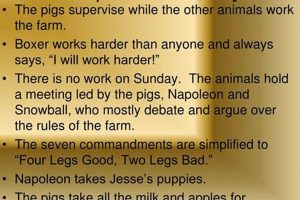
The Seven Commandments serve as the codified moral and ethical framework of “animal farm what is animalism,” directly embodying its core principles. The Commandments are not merely a set of rules but a distillation of the animals’ revolutionary ideals into easily memorizable tenets. They function as a guiding ideology, outlining what behaviors are permissible and forbidden in the newly established animal-run society. Each Commandment is designed to prevent the resurgence of human-like oppression and to promote equality, collective ownership, and animal liberation. The practical significance of understanding the Commandments lies in their representation of the original vision. This vision, intended to be a stark contrast to the perceived injustices of human rule, establishes a baseline against which the subsequent corruption and deviation from these ideals can be measured. For instance, the initial commandment, “Whatever goes upon two legs is an enemy,” establishes a clear boundary against human influence, while “All animals are equal” codifies the principle of equality. The Commandments are like the Bill of Rights for the animals in that they are supposed to protect them and guide them on how to live.
The alteration and manipulation of the Seven Commandments by the pigs directly reflect the erosion of these initial ideals and the gradual transformation of Animal Farm into a totalitarian regime. Each change to a Commandment signifies a step away from the original principles of “animal farm what is animalism” and towards the establishment of pig dominance. For example, the modification of “No animal shall sleep in a bed” to “No animal shall sleep in a bed with sheets” justifies the pigs’ increasing comfort while subtly undermining the principle of equality. Similarly, the transformation of “No animal shall drink alcohol” to “No animal shall drink alcohol to excess” rationalizes the pigs’ indulgence while placing the blame on the act of overindulgence rather than the act of drinking itself. This illustrates how the gradual subversion of language and the manipulation of rules can be used to justify inequality and maintain power. Historically, such distortion of principles finds parallels in various totalitarian regimes that have rewritten history and manipulated laws to legitimize their actions and suppress dissent. Like in the book 1984 where the Ministry of Truth is actually a lie, the pigs change what the “truth” to the animals is, without them realizing it.
In summary, the Seven Commandments are intrinsically linked to “animal farm what is animalism,” serving as its concrete manifestation and a measure of its corruption. Their initial articulation encapsulates the animals’ utopian aspirations, while their subsequent alteration reveals the gradual erosion of these ideals and the rise of totalitarianism. Understanding the connection between the Commandments and the core principles they represent is crucial for grasping the novella’s central themes of power, propaganda, and the dangers of unchecked authority. The changes to the commandments cause the animals to lose their rights and be forced back into a system worse than before the revolution. The story provides a sobering lesson regarding the fragility of ideals and the importance of vigilance in safeguarding against their manipulation. This serves as a reminder that the mere existence of laws or principles does not guarantee justice or equality; constant scrutiny and active participation are essential for preventing their subversion.
Frequently Asked Questions
The following questions address common inquiries regarding the driving ideology within George Orwell’s Animal Farm. They aim to clarify misconceptions and provide a deeper understanding of its principles and significance.
Question 1: Is “animal farm what is animalism” simply a synonym for communism?
While it bears striking resemblance to communist ideals, it functions as an allegory for a broader range of political ideologies and revolutionary movements. While specific elements parallel events in the Russian Revolution, its critique extends to any system where power is concentrated and abused, regardless of its theoretical foundation.
Question 2: What is the primary function of the Seven Commandments in the narrative?
The Seven Commandments serve as a codified set of principles representing its core tenets. They are intended to guide the animals’ behavior and prevent the resurgence of human-like oppression. Their manipulation by the pigs directly reflects the corruption of these initial ideals and the gradual descent into totalitarianism.
Question 3: How does the concept of equality manifest itself within the story?
Equality, as envisioned in the early stages of the farm, dictates that all animals are inherently equal, irrespective of their species or abilities. This principle motivates the rebellion against Mr. Jones and the initial attempts to create a just and egalitarian society. However, the pigs’ subsequent elevation above the other animals reveals the fragility of this ideal and the ease with which it can be subverted.
Question 4: What role does shared labor play in the overall ideological framework?
Shared labor aims to eliminate exploitation and foster a sense of collective productivity and social unity. The animals initially work together towards a common goal, but this system is gradually manipulated by the pigs, who exploit the other animals’ labor for their own benefit, undermining the principle of shared effort and equitable distribution.
Question 5: To what extent does it critique revolutionary movements in general?
It offers a cautionary critique of revolutionary movements. While highlighting the initial promise of liberation and equality, it underscores the potential for corruption, the dangers of unchecked power, and the importance of vigilance in safeguarding against the abuse of authority. The narrative suggests that revolutions, however well-intentioned, can easily devolve into new forms of tyranny if not carefully managed.
Question 6: Why is the ending of Animal Farm considered to be so bleak?
The ending is bleak because it depicts the complete subversion of its initial ideals and the re-establishment of an oppressive social order. The pigs, having adopted human traits and consolidated their power, are indistinguishable from their former oppressors. This suggests a cyclical nature to power dynamics, where revolutions often fail to achieve lasting change and ultimately perpetuate the same injustices they sought to overcome.
In conclusion, it is a complex and multifaceted concept that explores themes of power, equality, and the corruption of ideals. Analyzing this ideology is essential for understanding the novella’s enduring relevance as a critique of political systems and social structures.
Subsequent sections will explore the allegorical connections of the novella, delving into historical parallels and contemporary relevance.
Conclusion
The exploration of “animal farm what is animalism” reveals a complex interplay of revolutionary ideals, practical challenges, and inherent vulnerabilities to corruption. The initial promise of equality, collective ownership, and liberation from oppression, as encapsulated within the Seven Commandments, provides a powerful impetus for the animals’ rebellion. However, the subsequent manipulation of these principles by the pigs underscores the fragility of utopian visions and the dangers of unchecked power. The examination of shared labor, opposition to human oppression, and the very definition of equality reveals the inherent difficulties in maintaining these ideals. The narrative serves as a potent allegory for the corruption in social movements. The story presents that having noble aspirations does not guarantee success. The corruption, which can occur with any system, can be difficult to stop or even notice.
Understanding the nuances of “animal farm what is animalism” provides critical insight into the timeless themes of power, propaganda, and social control. The novella’s bleak conclusion serves as a reminder of the importance of vigilance in safeguarding against the abuse of authority and the ever-present potential for even the noblest aspirations to be subverted. It encourages continued reflection on the ethical foundations of social and political systems. The ongoing relevance lies in its cautionary message. Social goals must continue to evolve as a movement evolves to ensure they do not become the very problem they sought to resolve.