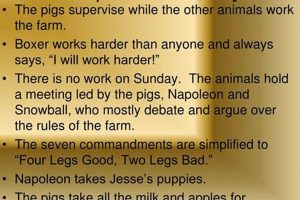
Chapter six of Orwell’s allegorical novella details the animals’ increasing struggles to build the windmill, a central project symbolizing progress and self-sufficiency on the farm. The narrative focuses on the growing hardships faced by the animals as they encounter material shortages and challenging weather conditions. Furthermore, this section illustrates the pigs’ manipulative tactics, specifically their deviation from original resolutions against trade with humans. This sets the stage for further exploitation and control.
The significance of this chapter lies in its exposure of the gradual corruption of the initial revolutionary ideals. The animals unwavering belief in their leaders and the pursuit of a better future is exploited by the pigs, who prioritize their own comfort and power. The introduction of trade, initially presented as a necessary evil, represents a slippery slope towards the complete abandonment of the core tenets of Animalism. Historically, this mirrors the corruption seen in many revolutions where initial high hopes devolved into authoritarian rule and the exploitation of the populace by a new elite.
The following analysis will delve into specific instances of manipulation, the erosion of animal equality, and the thematic implications concerning power, propaganda, and the dangers of unquestioning obedience as demonstrated throughout this pivotal section of the narrative.
Effective comprehension of this pivotal chapter requires careful attention to specific details and thematic elements. The following points offer guidance for a thorough analysis.
Tip 1: Analyze the Windmill Construction. Focus on the meticulous descriptions of the animals’ labor. Note the specific challenges they face, such as the lack of proper tools and the harsh weather, and consider how these obstacles represent broader struggles against oppressive forces.
Tip 2: Scrutinize the Pigs’ Decision to Trade. Pay close attention to the justifications offered by Squealer for engaging in commerce with humans. Evaluate the subtle shifts in language used to persuade the other animals and observe how this undermines the initial principles of Animalism.
Tip 3: Examine the Role of Propaganda. Identify instances where Squealer uses manipulative language and distorted facts to control the narrative. Analyze how fear and misinformation are employed to suppress dissent and maintain the pigs’ authority.
Tip 4: Consider the Symbolism of Mr. Whymper. Understand the significance of the human solicitor as a representative of the outside world. Consider how the pigs’ reliance on Mr. Whymper highlights their growing dependence on the very forces they initially sought to overthrow.
Tip 5: Trace the Erosion of Equality. Observe how the animals are gradually subjected to longer working hours and reduced rations while the pigs enjoy increased comfort and privilege. Document specific examples of unequal treatment to illustrate the corruption of the revolution.
Tip 6: Investigate Boxer’s unwavering loyalty. Assess how Boxer’s constant dedication and mantra of “I will work harder” is taken advantage of, making him a symbol of the exploited working class. How does his strength serve the pig’s agenda?
Tip 7: Note the increasing lack of dissent. Observe how the other animals seem to be getting resigned to the changing state of affairs. The lack of questioning should signal how easily power can control.
A deeper understanding of chapter six necessitates a critical examination of these points. Focusing on these specific elements unlocks significant insights into the novel’s broader themes of power, corruption, and the dangers of utopian ideals.
The analysis of these tips prepares the reader to fully grasp the broader narrative arc and underlying political commentary embedded within the work.
1. Windmill

The “Windmill: Hard Labor” facet within the sixth chapter highlights the stark contrast between the animals’ initial revolutionary fervor and the grim reality of their existence under the pigs’ rule. The construction project, meant to symbolize progress and improved living conditions, instead becomes a tool for exploitation and control.
- Physical Exhaustion and Depletion of Resources
The animals endure relentless labor under increasingly difficult conditions, resulting in physical exhaustion and a depletion of the farm’s resources. The chapter details the challenges of quarrying stone, transporting materials, and battling the elements. This physical hardship underscores the pigs’ willingness to sacrifice the well-being of the other animals for their own ambitions, mirroring historical instances where ambitious construction projects were achieved through the exploitation of labor.
- Erosion of Original Ideals
The intensified workload directly contradicts the original principles of Animalism, which promised a shorter workday and improved living standards. The animals’ commitment to the windmill, driven by propaganda and fear of Jones’ return, blinds them to the fact that their lives have become more arduous than before the revolution. This illustrates the insidious way in which utopian ideals can be twisted to justify oppression, as seen in various communist regimes.
- Boxer’s Exploitation
Boxer, the loyal and hardworking cart-horse, exemplifies the animals’ dedication and naivet. His unwavering commitment to working harder, fueled by Squealer’s propaganda, allows the pigs to exploit his strength without concern for his well-being. This parallels the exploitation of the working class in industrialized societies, where individuals are often pushed to their limits for the benefit of a ruling elite.
- Suppression of Dissent
The animals’ preoccupation with the windmill leaves them little time or energy to question the pigs’ leadership or the increasingly unequal distribution of resources. The demanding work schedule serves as a distraction from the erosion of their rights and the pigs’ gradual consolidation of power. This mirrors historical tactics used by authoritarian regimes to suppress dissent by keeping the populace preoccupied with survival and productivity.
The element of “Windmill: Hard Labor” is critical to understanding the larger themes. By focusing on the animals’ physical struggles, the chapter exposes the pigs’ manipulative tactics and the gradual corruption of the revolutionary ideals. The construction ultimately becomes a symbol of oppression, demonstrating how noble aspirations can be twisted into instruments of control. Ultimately, it reveals how the pig’s leadership turns an idealistic venture to one with hard labor.
2. Trade

Within the context of chapter six, the element of “Trade: Human Contact” represents a significant deviation from the foundational principles of Animal Farm. The initial resolutions, established after the expulsion of Mr. Jones, explicitly forbade any engagement with humans. The pigs’ decision to circumvent this principle, ostensibly for the benefit of the farm, marks a crucial turning point towards the complete abandonment of Animalism. The introduction of Mr. Whymper, a human solicitor, facilitates this exchange, creating a conduit through which the pigs can acquire necessary supplies. This trade, while presented as a pragmatic necessity, serves primarily to consolidate the pigs’ power and privileges.
The act of trading with humans undermines the animals’ belief in their self-sufficiency and the superiority of their revolutionary system. This is because the animals are unable to manage resources by themselves without Mr. Whymper. The pigs can present themselves as wise leaders who are willing to make difficult choices for the good of all, even if it means compromising on their initial ideals. The human contact also opens the farm to external influences, providing the pigs with opportunities to learn new methods of exploitation and control. For example, the pigs learn how to manipulate market prices to their advantage, further enriching themselves at the expense of the other animals. The pigs use Mr. Whymper and other humans as scapegoats when problems occur. They blame them to divert attention from their own mismanagement and corruption. Historical examples abound of revolutionary movements compromising their core tenets to maintain power, often leading to the very oppression they initially sought to overthrow. The Soviet Union’s reliance on capitalist trade during its early years serves as one such parallel, where ideological purity was sacrificed for economic survival.
The introduction of “Trade: Human Contact” is thus not merely an economic transaction; it is a symbolic betrayal of the revolution’s ideals. This action facilitates the pigs’ ascent to a totalitarian regime, further accentuating existing power differentials. Recognizing the pivotal role of trade in this chapter allows for a more nuanced understanding of the corruption that permeates Animal Farm. This shift highlights the broader theme of how power corrupts, and how even the noblest intentions can be subverted for personal gain, and it should serve as a warning against the allure of pragmatism when it comes at the expense of principle.
3. Squealer

The character of Squealer represents the potent force of propaganda within the narrative arc. His role in chapter six is crucial for understanding how the pigs maintain control and manipulate the other animals into accepting increasingly unfavorable conditions. Squealer’s rhetoric, characterized by distortion, obfuscation, and appeals to emotion, effectively neutralizes dissent and ensures the animals’ continued commitment to the pigs’ agenda. The pigs’ decision to engage in trade with humans, a direct violation of Animalism’s original tenets, is justified through Squealer’s skillful manipulation of language. He presents this compromise as a necessary measure to secure essential resources and prevent the farm’s collapse, framing it as a pragmatic adaptation rather than a betrayal of principles. This echoes historical instances where authoritarian regimes have used propaganda to justify unpopular policies or actions, often by emphasizing the need for unity and sacrifice in the face of perceived threats.
Consider, for instance, the implementation of the windmill construction project. Despite the animals’ arduous labor and dwindling resources, Squealer consistently paints a rosy picture of progress, attributing any setbacks to external factors or the machinations of Snowball, a convenient scapegoat. His constant reassurances and statistics, often lacking in verifiable accuracy, serve to maintain the animals’ morale and prevent them from questioning the project’s feasibility or the pigs’ motives. Such tactics are reminiscent of the Soviet Union’s use of propaganda to promote its Five-Year Plans, downplaying failures and exaggerating successes to maintain public support. The practical significance of understanding Squealer’s role lies in its relevance to contemporary society. The ability to critically analyze information and identify manipulative rhetoric is essential in navigating the complex landscape of modern media and political discourse. By recognizing the techniques employed by Squealer, readers can develop a greater awareness of how propaganda can be used to shape public opinion and influence behavior.
In summary, Squealer’s presence is inextricably linked to the erosion of Animalism and the pigs’ consolidation of power. His propaganda serves as a crucial mechanism for maintaining control, justifying deviations from the original principles, and suppressing dissent. The challenges of recognizing and resisting propaganda are underscored by the animals’ gradual descent into a state of unquestioning obedience, highlighting the importance of critical thinking and vigilance in protecting against manipulation. The presence of Squealer serves as a cautionary note within the broader narrative and as a reminder of the enduring power of propaganda within society.
4. Food
The “Food: Ration Reduction” element of chapter six serves as a stark indicator of the deteriorating conditions on Animal Farm. Initially, the revolution promised abundance and equitable distribution, yet this chapter reveals a stark departure from those ideals, highlighting the pigs’ growing dominance and the other animals’ increasing hardship. It is crucial to analyze this aspect to fully grasp the depth of the pigs’ manipulation and the consequential impact on the farm’s populace.
- Undermining of Revolutionary Promises
The diminishing food rations directly contradict the revolution’s promise of improved living standards. As resources become scarcer, the pigs prioritize their own consumption while imposing cuts on the other animals. This betrayal of the initial principles creates a sense of disillusionment and resentment, even among those animals who remain loyal to the pigs. This mirrors the historical experiences of many revolutions, where initial promises of prosperity are replaced by scarcity and inequality under new regimes.
- Control Through Deprivation
Ration reductions serve as a tool of control, weakening the animals and making them more dependent on the pigs for survival. A hungry animal is less likely to question authority or challenge the established order. This dynamic is not unique to Animal Farm; throughout history, oppressive regimes have used food as a weapon, controlling access to sustenance to maintain power and suppress dissent. The Holodomor in Ukraine, where Stalin deliberately engineered a famine to break the spirit of Ukrainian resistance, stands as a tragic example of this strategy.
- The Illusion of Progress
Despite the shrinking rations, Squealer uses propaganda to convince the animals that they are better off than they were under Mr. Jones. He manipulates statistics and compares their current situation to a romanticized version of the past, distracting them from the reality of their hunger. This manipulation underscores the power of propaganda in shaping perceptions and maintaining control, even in the face of tangible hardship.
- Boxer’s Undeterred Work Ethic
Boxer’s unwavering commitment to hard work, even as his rations are reduced, highlights the tragic consequences of blind loyalty. He continues to believe that his efforts will contribute to the greater good of the farm, unaware that he is being exploited by the pigs. His dedication, rather than improving his own situation, only serves to further their agenda. This aspect emphasizes how the pigs manipulate the working class.
In summary, “Food: Ration Reduction” is not merely a detail of chapter six; it is a central element that exposes the pigs’ manipulation, the erosion of revolutionary ideals, and the overall decline of Animal Farm. By controlling the food supply, the pigs maintain their dominance and suppress any potential opposition. This theme is a reminder of the dangers of unchecked power and the importance of vigilance in protecting individual rights and freedoms.
5. Pigs

The “Pigs: Lifestyle Change” element within chapter six represents a critical component of the farm’s descent into totalitarianism. This change signifies more than just a superficial adjustment; it reflects a fundamental shift in power dynamics and the abandonment of the initial egalitarian ideals that fueled the revolution. The pigs’ gradual adoption of human habitssleeping in beds, consuming alcohol, and engaging in tradedirectly contravenes the foundational principles of Animalism. This transformation isn’t merely a matter of comfort; it symbolizes their growing separation from the other animals and their consolidation of power.
This lifestyle change is not only a symptom of the pigs’ corruption but also a tool for reinforcing their dominance. By appropriating privileges previously associated with humans, the pigs establish a hierarchical system that justifies their superior status. This is evidenced by the pigs’ increasing consumption of scarce resources while the other animals face ration reductions. The pigs’ lifestyle change is enabled by the introduction of trade and the exploitation of the other animals’ labor, especially that of Boxer. This arrangement mirrors historical instances of social stratification where the ruling class enjoys opulent lifestyles at the expense of the working class. The parallels to the Russian Revolution, where the Bolshevik elite gradually adopted the trappings of the former aristocracy, are particularly striking. Understanding this shift is practically significant because it illuminates how revolutionary ideals can be subverted and replaced by new forms of oppression, often masked by superficial justifications of necessity or progress.
Ultimately, the “Pigs: Lifestyle Change” element in chapter six serves as a microcosm of the farm’s larger trajectory from utopia to dystopia. The pigs’ increasing indulgence and detachment from the other animals highlights the inherent dangers of unchecked power and the susceptibility of revolutionary movements to corruption. By examining this aspect, readers can gain insight into the factors that contribute to the failure of utopian experiments and the importance of safeguarding against the abuse of power, even in the name of equality. The pigs’ lifestyle change demonstrates that power, no matter how originally gained, has the potential to corrupt.
6. Boxer
Boxer’s unwavering work ethic forms a central and tragic element of Chapter 6, illustrating the exploitation of the working class under the burgeoning totalitarian regime. His dedication, initially intended to advance the collective good, is relentlessly manipulated to serve the pigs’ self-serving agenda. Boxer’s consistent efforts highlight the deceptive nature of the farm’s purported progress and the extent to which revolutionary ideals have been distorted.
- Unquestioning Obedience and Exploitation
Boxer’s unwavering commitment, epitomized by his personal motto “I will work harder,” is exploited by the pigs. His strength and relentless labor are crucial to the construction of the windmill and the overall functioning of the farm. Yet, this dedication is not reciprocated with fair treatment or improved conditions, reflecting the historical exploitation of the working class. His loyalty becomes a liability, allowing the pigs to extract maximum effort without regard for his well-being. This mirrors situations where laborers are coerced or incentivized into excessive toil without adequate compensation or safety measures.
- Propaganda and Manipulation
Squealer effectively uses propaganda to reinforce Boxer’s commitment to the cause, framing his hard work as essential for the farm’s success and the prevention of Jones’ return. This manipulation preys on Boxer’s naivet and his genuine desire to contribute. He is continuously reassured that his efforts are valued, even as his rations diminish and his health deteriorates. Such propaganda techniques are akin to those employed by totalitarian regimes to maintain popular support for oppressive policies, convincing individuals that their sacrifices are necessary for the greater good.
- The Tragic Hero
Boxer’s character functions as a tragic hero, embodying the virtues of hard work, loyalty, and selflessness. However, these qualities are ultimately his downfall, rendering him vulnerable to exploitation. His inability to question authority or recognize the pigs’ manipulative tactics leads to his demise. This tragic arc serves as a cautionary tale about the dangers of blind faith and the importance of critical thinking, particularly in the face of persuasive rhetoric.
- Symbolism of the Working Class
Boxer represents the working class whose dedication and belief in revolutionary ideals are easily manipulated by those in power, especially where education or critical thinking is lacking. His ultimate fate serves as a stark warning, emphasizing the vulnerability of the working class in systems where power is concentrated and dissent is suppressed. Without proper safeguards, the genuine efforts of those who contribute the most can be exploited to maintain the status quo of the ruling elite.
Boxer’s story illustrates the broader themes of exploitation, propaganda, and the dangers of blind obedience, all of which are central to understanding the chapter’s narrative. In “chapter 6 summary animal farm,” Boxer’s fate encapsulates the corruption of the revolution. It exemplifies the subversion of noble aspirations by those seeking personal gain, resulting in a society where the hardworking are exploited and the ideals of equality are forsaken. Furthermore, it serves as an allegory for the larger corruption of the Soviet Union as it evolved under Stalin, and for societies where dedication and work are weaponized in service of oppression.
7. Equality

The “Equality: Fading Dream” concept within the summary of chapter six directly reflects the corruption permeating Animal Farm. The initial promise of equality, the cornerstone of the animals’ rebellion against Mr. Jones, steadily erodes throughout the chapter. Multiple factors contribute to this decline. The pigs’ gradual adoption of human habits, such as sleeping in beds and trading with humans, sets them apart from the other animals, creating a visible social hierarchy. The ration reductions imposed on the general animal population contrast sharply with the pigs’ increased consumption, further highlighting the growing disparity. The manipulation of language and history by Squealer distorts the animals’ understanding of their past and present, making it difficult for them to recognize the extent to which equality has been compromised. The animals’ unwavering loyalty, particularly that of Boxer, is exploited by the pigs, solidifying their control and perpetuating the cycle of inequality. These elements, individually and collectively, demonstrate the disintegration of the revolution’s founding principle, resulting in a society where equality exists only in name.
The importance of recognizing “Equality: Fading Dream” as a component is critical to understanding the broader themes. By charting the decline of equality, it becomes possible to evaluate the subtle and not-so-subtle ways in which power dynamics shift and revolutionary ideals are corrupted. This component reveals how easily the initial promise of a just and equitable society can be subverted by those in positions of authority. Historical examples such as the French Revolution, where the ideals of liberty, equality, and fraternity were ultimately overshadowed by the Reign of Terror and the rise of Napoleon, illustrate this pattern. Similarly, in many socialist and communist states, the pursuit of egalitarianism often resulted in authoritarian regimes where power was concentrated in the hands of a select few, and individual freedoms were curtailed. Practical examples can be seen in the pigs’ control over the farm’s resources, their manipulation of the animals’ labor, and their suppression of dissent, all of which contribute to the erosion of equality and the consolidation of their power.
Understanding the connection between “Equality: Fading Dream” and the chapters events provides significant insight into the nature of power, propaganda, and the dangers of utopian ideals. The events serve as a cautionary reminder of the fragility of revolutionary principles and the constant need for vigilance in safeguarding against the abuse of power. The erosion of equality in chapter six is not merely a plot point; it is a crucial thematic element that underscores the broader message and its relevance to the interpretation of the full text.
Frequently Asked Questions
The following questions and answers address common points of inquiry regarding a critical chapter within Orwell’s allegorical novella. This section aims to clarify misunderstandings and deepen comprehension.
Question 1: What is the primary conflict presented in this chapter?
The central conflict revolves around the animals’ struggle to construct the windmill amidst increasingly difficult conditions, coupled with the pigs’ controversial decision to begin trading with humans. This decision directly contravenes the initial principles of Animalism and introduces a moral dilemma for the other animals.
Question 2: How does Squealer’s role evolve in this chapter?
Squealer becomes increasingly instrumental in manipulating the other animals through propaganda and misinformation. He expertly justifies the pigs’ decisions, downplays the hardships, and deflects blame onto Snowball, solidifying the pigs’ control over the farm’s narrative.
Question 3: What is the significance of the windmill project?
The windmill serves as a symbol of progress, self-sufficiency, and the animals’ collective aspirations. However, it also becomes a vehicle for exploitation, as the pigs use it to justify increased labor demands and solidify their authority over the other animals. The challenges in the windmills construction represent the inherent difficulties in implementing idealistic visions in a flawed system.
Question 4: In chapter 6 summary animal farm, what does the introduction of Mr. Whymper symbolize?
Mr. Whymper, the human solicitor, represents the pigs’ growing reliance on the outside world and their willingness to compromise their revolutionary ideals for economic gain. He also symbolizes the pigs’ increasing sophistication and their ability to manipulate human society for their own benefit.
Question 5: How does this chapter contribute to the overall theme of corruption?
This chapter is pivotal in illustrating the gradual corruption of the revolution. The pigs’ increasingly self-serving actions, the erosion of equality, and the manipulation of the other animals all contribute to the overarching theme of how power can corrupt even the noblest of intentions.
Question 6: What happens to food?
Food resources become more scarce, impacting the other animals. This scarcity is a means of control by the pigs who enjoy better food, increasing their strength and authority.
Chapter 6 marks a turning point. The revolution’s initial ideals, coupled with increasingly difficult conditions, are slowly forgotten and replaced by an atmosphere of inequality and control by the pigs.
The following section delves deeper into the character analysis to support the chapter’s thematic elements.
Analysis
The comprehensive breakdown presented highlights the critical juncture represented within chapter six. Elements examined, including the exploitation of labor in the windmill construction, the compromising introduction of trade with humans, the insidious manipulation through Squealer’s propaganda, the increasing scarcity of food, the pigs’ shifting lifestyle, and the fading dream of equality, demonstrate the irreversible corruption of the initial revolutionary principles. These factors are interconnected, each amplifying the others, culminating in a society starkly at odds with its original utopian vision.
The examination of “chapter 6 summary animal farm” compels a sober reflection on the enduring relevance of Orwell’s allegory. Recognizing the mechanics of power, propaganda, and the erosion of ideals is crucial for maintaining vigilance against similar patterns in real-world socio-political contexts. Continued critical analysis and discourse are essential to ensure that the lessons learned from Animal Farm serve as a constant safeguard against the cyclical recurrence of oppression.